
Kristi Koslow — Blood Bath — Crime Library
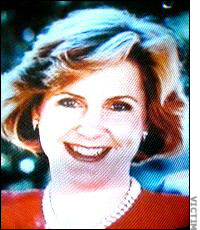
Face down in a pool of crimson, in the shadow of a blood-spattered grade-school picture of the smiling stepdaughter she helped raise, Caren Koslow lay dead, nearly decapitated. This Fort Worth oil-heiress and her wealthy banker husband never knew as they slept in the early hours of March 12, 1992, that this was the day a family fury would be set free.
Security code in hand, two young men had tiptoed in the dark across a perfectly manicured lawn, disabled the house alarm, broken through a door, then, quickly and without contemplation, made their way to an upstairs bedroom.
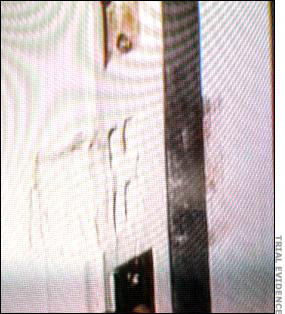
Sleeping in their River Crest estate, Jack and Caren Koslow had little time to prepare for the intrusion, and were ordered to the floor by the teens.
Forty-eight-year-old Jack later recalled for investigators how he had attempted to retrieve a shotgun from a nearby closet, but was stopped in his tracks, as the bloody streaks on the closet mirror would confirm.

A rapid, violent attack ensued. One man beat the defenseless couple with a crowbar, as his accomplice searched the nearby closet for money he had been told would be there. A deadly knife attack followed.
“I went and I stood over Caren, lifted her chin and cut left to right. I did the same thing to Jack,” the youth testified in trial. Investigators would retrieve a hunting knife from the room, which matched a smaller version located in Jack’s drawer, whose handles had been dirtied with bloody handprints.
Assuming their victims dead, the pair went to search the closet again for the money. At that time, Jack had been able to get to his feet and had gone after the boy, who proceeded to hit him again with the crowbar until the businessman slumped to the floor in defeat. While Caren lay dead and Jack unconscious, the two teens grabbed Jack’s wristwatch and $200 in cash before escaping the house.
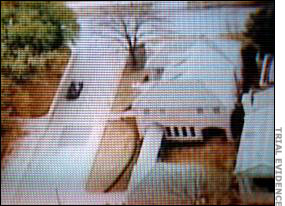
“I remember the whole world turning black,” Jack, would later relay during court testimony about the time when he fell unconscious on a carpet saturated with his own blood. Upon waking, he had managed to run to a neighbor’s house at 4:13 in the morning, a bloody, beaten body, nearly collapsing on their stoop, crying, “You’ve got to help me.”
At 7:30 a.m. on March 12, the phone was ringing off the hook at the neighbor’s house. The caller turned out to be the woman’s friend, worried she was the one stabbed to death at the Clark Avenue and Washington Terrace address, an attack quickly gaining in media coverage. That day, she wished she didn’t live across the street from the Koslow’s pink mansion at 4100 Clarke.
Forty-five minutes and 42 phone calls later, she joined her group of friends, also escaping phone calls from media and concerned friends, to go for a morning walk. “Our support system is clicking in,” one of the friends told reporters.
A former president of the Fort Worth School Board, the woman recalled seeing the Koslows that previous Saturday night at a gala for the Fort Worth Symphony. Her husband had seen Jack the night before while dining at LaPiazza. She and Caren had been in the same book club the year before. They were friends and neighbors, and they looked out for each other.
Another of the walkers was planning a luncheon fundraiser for victims of violence, an ironic coincidence. She became friends with the Koslows during summers spent in Aspen, where the couple had a second home.
“She liked English flower arranging and she did table settings at P.S. The Letter on Camp Bowie,” the woman told reporters. “And you always saw her with her dog. She loved that dog.”
Caren’s constant companion was a small fluffy dog whose name they couldn’t remember. The animal’s presence was familiar around the neighborhood where Caren had walked it regularly.
Caren’s death had become a shocking interruption throughout the normally peaceful neighborhood. “We need to talk,” the women said. “It’s such a natural process of assimilating shock.” she said, stopping mid-step to rest. “The first process is to say to your friends, ‘Yes, it happened. Yes, we are grieving.’ “
Though grieving, the most prevalent question still was resting uneasily in the minds of everyone: Who would do such a thing? As River Crest residents would soon find out, the truth would be harder to grasp than anything they could dream up.

Twelve days passed after this brutal act of violence and no arrest had been made. All of Fort Worth was watching Jack’s every move. Local police suspected Jack was after his wife’s fortune and killed her to access it, but a lack of condemning evidence had deferred a definitive case. Forensic specialists even said there was no way Jack could have inflicted his own wounds.
On the day of Caren’s funeral, her husband, beaten and bruised, made an appearance, much to the surprise of local police and media correspondents, who were convinced of his guilt.
The cops were confident their man was right in front of them, so much so that a warrant had been issued, but not served. “We were even saying, ‘God, will they arrest him already? Are they waiting until a coffin is put in the ground?'” a local reporter explained.
It wasn’t long until the tide would change in this parricide investigation. A call to the police department from a teenage boy would unravel a spool of lies and deceit the country would find astonishing. His single detailed statement also changed the lives of three teens forever.
The teen transferred to police the crowbar and bloodstained clothing he had been asked to conceal after the attack in River Crest. He then implicated Jeffrey Dillingham, a young video store clerk. Dillingham, they had no idea, would have information of his own to reveal, to show he had not acted alone.
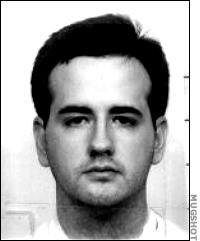
Jeffrey Dillingham knew exactly what to expect the night he became a murderer. Even though he had never seen or met the couple, what were two bodies compared to $1 million cash he had been promised? Greed was as green as the perfect lawn he would have to step over to secure his financial future.
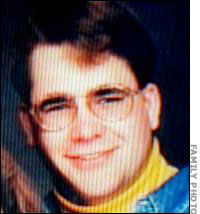
His accomplice, Brian Salter, had been provided with the house alarm code and a map. The two young men knew where to go, without having to waste time searching for stairways, doors or their victims, who would have no time to respond to the men bursting through the bedroom door while they slept in the night.
Six days into his 19th year, an honor student at White Settlement’s Brewer High School, Dillingham, dressed in black, vaulted over the wooden fence at the Koslow home, an expansive 4,000-foot property, followed by Salter.
In a backpack, the boys carried two pistols, the ones stolen from Salter’s parents, with the help of Salter’s girlfriend, the night of the attack; a pry bar; and glass cutters, extra ammunition and two knives. Confidence and knowledge were on their side as they moved under the dark Texan sky.
Meanwhile, the mastermind behind the murder of Caren Koslow sat in her bedroom. A conversation at the hospital the following day between Jack’s sister and her niece was bizarre, the aunt recalled for investigators.
Kristi Koslow mentioned she was tired because she had been up all night wrought with nervousness, until she received a phone call at 4 a.m., when she was able to fall asleep peacefully.
And, while pandemonium ensued the morning following a brutal attack, during which her 40-year-old stepmother was slashed and bludgeoned to death, and her father beaten unconscious, Kristi received a phone call.
The first thing she wanted to know was “Are they dead?” and why her father had not been killed.
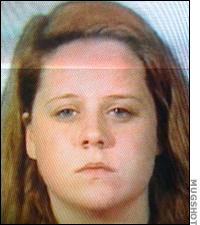
Two weeks prior to the horrific event that would leave Jack without a wife, he received an unexpected visit from his daughter Kristi and Salter. He thought it odd because they were not close and it was not like her to stop by “just because.” She told him that day that she “wanted to stop by and give me a kiss,” Jack said.
His first wife had been granted custody of Kristi, whom they had adopted at birth, giving Jack weekends to maintain a fatherly relationship with his young daughter, only 7 at the time of his divorce. He recalls being very upset and disappointed with her, but that he never stopped loving her, as any parent, even one with a spoiled and self-absorbed teenager.
The relationship followed that broken path and grew worse when Kristi reached 13. Jack says the rudimentary argument between him and his daughter was her lack of attendance at school. He voiced his disapproval and “in my opinion, that’s the reason she stopped seeing us,” he told jurors. He and his first wife, Paula, persisted in a conflict of the way Kristi was disciplined.
He and Caren would scold Kristi about her choice in clothes and jewelry, saying when she was with her mother she was not allowed to wear the things they gave her. “It was something stupid,” Kristi said later during a 2002 interview in prison. “But it made a profound statement to me as a 14- or 15-year-old.”
Today, Kristi admits she realizes why her father and stepmother acted as they did, trying to keep her in school and out of the trouble that seemed to follow her. She said during her 2002 interview that her father would call her, attempting to make dinner plans, but he was a pawn in a losing battle, facing an obstinate teen who would betray him in a way he would never imagine.
“I wasn’t the most likable person at the age of 17. I wasn’t the most wonderful person. I didn’t have wonderful morals and values and ideals about life,” Kristi confessed.
This young woman was out for revenge against the woman who stole her father, and was out for her money as well.
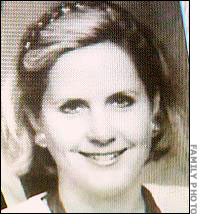
A friend of Salter’s younger sister testified Kristi was very negative about her stepmother. It’s one thing to think things, but to tell friends and even siblings of friends, and then their friends is another. “Step-witch” and “step-bitch” are just two terms this girl said she had heard repeatedly spoken by Kristi.
The medical examiner of Tarrant County showed jurors photos of Caren’s mutilated body during Kristi’s trial in the summer of 1994. Gaping wounds and blood-saturated clothes were too much for Caren’s sister. She had to leave the courtroom while the autopsy findings were discussed in grisly detail.
After sustaining twenty-nine wounds in all, Caren died after a fatal blow to the neck with the pry bar, which crushed her larynx, causing her to suffocate. Salter admitted that after the beatings, he cut both the victims’ necks. Kristi’s stepmother had a deep, foot-long slash across her throat, which would have been fatal, had she still even been alive.
The jury then was shown a video of Caren’s stepdaughter in the midst of a nervous laugh, the day after the murders, 12 days before her arrest. “It’s scary,” the young mastermind said to the cameras. “It’s hard not knowing why someone would do this.” Kristi said she and Caren were as close as stepdaughter and stepmother could be, and that no one hated her father’s wife in any way she knew of.
What truly was scary, people in the quiet Fort Worth community began to think, is that first, this could happen in their neighborhood, and second, that hatred for a well-respected woman ran so deep in a step-daughter she tried to love.
Kristi’s statement to police rambled into the “horrible” feelings she felt about “everything they said and had done to me.” Parenting in River Crest had become dangerous and loving homes were no longer considered safe, especially when a child such as Kristi, who had been provided everything she wanted, was now being implicated for murder.

Horrendous killing techniques right out of a NYPD case file were on the mind of teenage Kristi long before she got the nerve to act on them, or hire someone else to do the dirty work for her. She and her fiancée, Brian Salter, had spent nights talking about poisoning wines, cutting brake lines, ambushing attempts, and then, finally, cutting the throats of her father and stepmother.
All a joke, her attorney tried to persuade a jury in 1994, those comments had been. The joke would end up being on this young, pudgy brown-haired girl, who found she could not buy her way out of murder and life in a Texas prison.
A selfish teenager, she didn’t care about her grandmother’s pearls or antique brooch. The family treasures Kristi Koslow aspired to inherit totaled a minimum of $12 million cash, or so she thought, while plotting the murders of her adopted father and stepmother. “I just wanted to get money. I wanted my mom to have money,” this young woman, now sitting in a Texas prison, said more than a decade ago.
In a confession of her involvement in the murder plot, Kristi described herself as being a “Robin Hood” to help Salter pay bills for his ailing mother and have a nice, new car in which to drive, of course, her, around Fort Worth.
And, as a Robin Hood icon, she wanted it done quietly and quickly. “It would be easy,” she told Salter. This Robin Hood expected her recipient to make the first move, leaving her with clean hands and full pockets, not exactly the traditional Disney character many have to come to admire.
It was Dillingham who, after his own arrest, finally advanced the blame to Salter and Kristi, putting all three of them in front of the law, pleading for their young lives. Kristi had offered him and Salter $1 million of her inheritance, in return for the murder of her father and stepmother.
Salter had admitted to Kristi thoughts of killing his parents, to solve his own teenage woes. She suggested they get rid of hers too, leaving the future free to live as they liked. No parents telling them to stay in school or be home by ten is any teenager’s dream come true. These spiteful youths wanted more than a curfew extension. They wanted no parents — period, and were willing to go to extreme and appalling lengths to fulfill their naïve ambitions.
When the couple became engaged over Christmas holiday in 1991, Salter said during Kristi’s trial that at that time her desire to live a life of luxury at a young age became more substantial and obsessive. She felt her parents “owed” her a bright future, brighter than what she was already being given, which by most standards, was already far beyond privileged.
Friends of the pair say Kristi was fortunate in many aspects. Attending the finest schools available, with money and popularity, Kristi had not a care in the world. What she did have, however, these same friends said, was a temper. Not an angry, furious temper, but more of a temper-tantrum-like attitude. She expected things to go her way. Nothing else was acceptable.
As Salter’s parents worshipped at church on the night of the attacks, the pair of teen lovebirds took pistols from their house. The final plan, after speculating and strategizing, was to break into the house, disarm the alarm, knock the couple out and cut their throats.
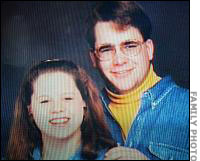
Nineteen years old — one day he was shopping for new cars and mansions, the next serving a life sentence for murder: a slap on the hand, many will agree, for the murder of Caren and brutal assault on her husband.
Junior-varsity tennis player Salter and Kristi amused themselves by car shopping, choosing a B.M.W. convertible for her and Toyota Land Cruiser for him. It was too good to be true. Teen love had made Salter fall head first into a trap from which he would never be able to extricate himself.
Was it Kristi’s good looks that had him wrapped around her finger? More likely her wealthy daddy, said a friend of the teens at the time of Kristi’s trial. “Anything Kristi wanted Salter to do, all she had to say was ‘Do it’ and he jumped,” this man testified in court. “It got to the point where she wouldn’t even ask him; she’d just tell him what to do.” This young witness recalled something as simple as dining out with the couple and overhearing Kristi order Salter to get her a hamburger.
Salter would have been interested to know he was not even her first choice for the privileged task of murdering her family. A former classmate testified that five months before the murders were committed, she had asked him to fulfill her objective. “She said it would be an easy thing to do,” this teen testified in court in June 1994. He declined, but the murder plot he described was identical to the real-life events which commanded the court gathering at which he was speaking.
A month after his accomplice received the death penalty, Salter pled out, taking a life sentence, and never was forced to face the man whose wife he took, the girlfriend he once trusted and the community he called home, lost to him by blind love.
Kristi could not fit her stepmother’s funeral into her schedule, though the greater part of Fort Worth’s high society attended. Jealousy only added momentum to the destructive course upon which Kristi had embarked. Parricide was a term she most likely had never heard of, yet one she’d gotten to know well. Her love-entranced boyfriend and his friend from a neighboring town had committed a crime incomprehensible to those living in the old-money community of River Crest in Fort Worth, Texas.
“It’s more of a shock for us because we have this inappropriate sense that we have the resources to prevent crime,” said one of four women who joined the Koslow’s neighbor in a walk the morning after the murder occurred. The group strolled across the pristine River Crest Country Club golf course and into a wooded neighborhood overlooking the Trinity River Valley.
“This neighborhood is crawling with personal security systems, guard dogs, electronic beams,” said another walker and neighbor.
“All of the alarms, all of the security systems couldn’t stop this,” remarked a lawyer who was in the process of organizing a Crime Watch where Caren Koslow died.
In an exclusive residential area that was home to such families as the Carters and W.T. Waggoner, many of the owners of the most beautiful homes in English Tudor and Georgian styles held ties to oil, cattle, banking, real estate and mercantile fortunes.
Crime was hindered by expensive and elaborate security systems, even before such technology was ordinary. Private school and fine arts fundraisers were commonplace social occasions where the wealthy contributed large funds to sustain such community programs.
Manicured lawns showed no signs of amateur gardening, and a police chief responding to the murder of Caren Koslow showed the country this homicide was not just another gang slaying. In a city of more than 600,000, it was unusual to have the top administrator of a 1,400-man agency respond to a crime scene.
Big money, big houses and big police agencies were unable to stop a teenage murder conspiracy from taking over the newspaper headlines.
Despite his efforts to maintain a fatherly presence in his daughter’s life, Jack Koslow realized too soon and shockingly that his attempts were ill-received.
Once he regained consciousness on the blood-stained carpet, Jack Koslow said, he rushed to his wife and tried to lift her from the floor. “I knew then she was either dead or dying,” he said, recalling that he was overcome with feelings of “rage and hatred.”
“God just give me the power to get off this floor and defend ourselves,” said Jack Koslow during the trial of his adopted daughter. His thoughts during a time of panic, confusion and horror were for the woman he saw dying in front of him. “She could not move,” Koslow said of his wife that night when they first heard men running up the stairs. “She was totally petrified.”
During her trial in Fort Worth, Jack glanced at his Kristi occasionally. She did not acknowledge his presence, and turned her face when the photos of her dead stepmother were shown.
When asked by the defense attorney during testimony if he recommended Kristi receive the death penalty, his only response was “That’s what she gave Caren.”
Caren and he had met at Texas American Bank, where they both worked at the time. Family, friends and neighbors say they were much in love, rarely argued and had a happy marriage.
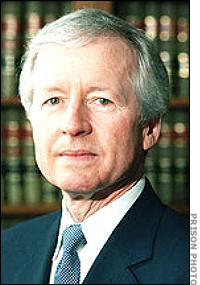
To this day, Jack has never publicly spoken about the night his wife died and the midnight slaughter that tore his family apart. “I have nothing to say. Zero,” he told reporters. Many thought that after the trials had ended, media attention waned and “normal” life resumed, he would speak his mind about the atrocity his daughter masterminded. He has remained quiet and has never shown any desire to contact his daughter in prison.
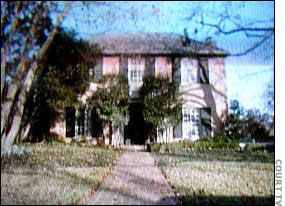
He still lives in Fort Worth, has remarried, is involved in the business community and enjoys a relaxing round of golf. There are few physical remains from the attack; the house was sold, his wife buried, yet a scar can be seen across his throat.
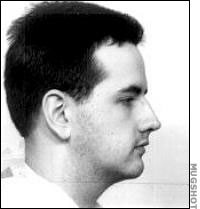
During his trial, Jeffrey Dillingham wept continually. Wept, says a reporter — not cried or wailed. He whimpered like a scared child, not a cold-blooded killer.
After incarceration, this video store clerk ran out his appeals, claiming he had unfairly been sentenced to death when the other two involved were spared the needle. He had refused the plea bargain that would have forced him to testify against Kristi. Her future husband had no problem running for his own life, though. Salter accepted the terms and indicted the girl with whom he had once been mansion-shopping, dreaming of a life after the inheritance paid up.
Dillingham was sentenced to death for murdering a woman he had never seen, nor met. “Dillingham did not even know the victim,” said a prosecutor during trial. “But it didn’t matter to him. He was going to get a million dollars. That was the key point. What I argued to the jury is that he did a cost-effective analysis, and stepping over two bodies was nothing.”
In his final statement, he apologized for his part in the death of Caren Koslow. “I take full responsibility for that poor woman’s death and for the pain and suffering I inflicted on Mr. Koslow.”
At 6:28 p.m. on the first day of November 2000, Dillingham closed his eyes for the final time. Eight minutes before, he had winked at his parents one last time, then gasped as the lethal injection filtered through his body, ending a seven-year stint on death row and 27 years of life. He was the 34th convicted killer in Texas to receive the lethal injection in that year. His crimes had not only killed him, but had also torn apart his family.
When he got to his office after a routine trip to the pharmacist over his lunch hour, Ray Dillingham found a group of co-workers waiting to ask him what had happened and to help him if they could. While this electronics engineer had stepped out of his Fort Worth office, a radio update had reported that Ray’s son had been arrested the night before, for murder.
Ray’s co-worker always heard positive comments about Jeffrey, who had never given his parents a cause for concern. They helped Ray, who had never imagined the need to find an attorney. In fact, he didn’t even know where the local jail was.
Ray’s wife was on a business trip in west Texas, and he drove to Mineral Wells to inform her of the bad news. “I asked her to get into my truck and I explained it to her. It was extremely hard. We thought it was a mistake and would be cleared up,” Ray told the Dallas Morning News.
The “mistake” was never cleared up. Ray and his wife learned that their son had turned from a normal teen to a vicious killer. “People say ‘I’ll never have to deal with anything like that.’ I tell them, ‘Before March 1992, I was just as sure as you are,'” said Dillingham’s grief-stricken father.
Ray and his wife divorced in 1997, not being able to deal with the stress and saying they were no longer the same people they once had been. The shock of Jeffrey’s arrest was too much to bear. “It is like being thrown up against a brick wall over and over again,” his mother said.
She became active in Hope, a chapter of Citizens United for Rehabilitation of Errants (CURE), an organization of families of prisoners, prisoners, former prisoners and other concerned citizens. The group aims to 1) use prisons only for those who have to be in them, and 2) and for those who have to be in them, to provide them all the rehabilitative opportunities they need to turn their lives around.
Dillingham’s father copes by being active in sports: biking, bowling and playing softball. The stress has caused him to be able to fit, at more than 50 years of age, into his son’s clothes that were left behind following his incarceration. Youthful greed had taken this couple’s marriage and their son. “They bring him in handcuffs and lock him in a cage, and you can talk to him through a wire,” says Ray about his visits with his son. “I haven’t hugged him in a long time.”
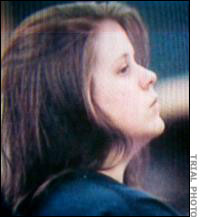
Today, Kristi, the 17-year-old in the news in the 1990s, sits behind bars in Gatesville, Texas, at Mountain View prison for women. She will not be eligible for parole until 2027, at the age of 52.
While she denies masterminding the murder of Caren, she feels guilty. She admits to not being very mature at the time. She has expressed neither love nor hate for her adopting father, but cried for Caren. “If I could take it back, I would,” she said during her 2002 interview from behind bars. “If there was any way I knew of to go back and stop it, I would.”
She has no words for her father, who wished her dead all those years ago. It’s not a priority of hers. She works in the prison kitchen as a butcher and ironically, studies theater arts in night classes, taking something from her past life into her present. Both Jack and Caren were very involved in the local arts.
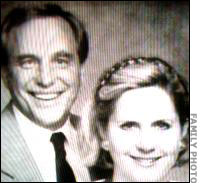
She hopes to someday get out of prison, even though all her court appeals are drained. “I’m not a violent person,” she said. “I don’t feel I’m a threat at all to anybody.” She admits, however, “I understand everybody has to pay a price for what has been done.” Kristi’s price was lenient compared to Dillingham’s, some will say, and the trend of killing for cash was not one plotted only by her.
Money is a motivator, no question about that: especially for the young and wealthy, looking to cash in before their trust fund matures. Between February and November of 1994, four women in Tarrant County, Texas, all faced charges of parricide, the murder of a parent. These heinous crimes all had two things in common: lack of remorse and capital gain.
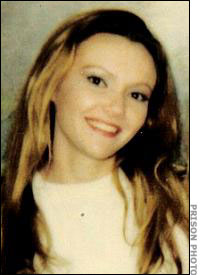
In addition to Koslow, Jennifer “Nicole” Yesconis, Courtney Dunkin and Dorothy Robards were spending their Saturday nights in a stale jail cell instead of at the local social event.
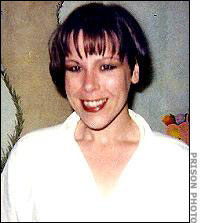
Yesconis, 20 years old in 1994, sought to cash in on a substantial insurance policy and, like Koslow, sent her love-stunned boyfriend and his friend to kill her father and his wife on the eve of their fifth anniversary. The attempt was successful, and though she claimed sexual abuse during the trial, a witness stated Nicole had said she would pay $30,000 for her father’s murder. She was convicted of capital murder.
Courtney Dunkin and her friend, both 16, went after Dunkin’s step-grandmother’s car and credit cards, to take a shopping spree in Mexico. It was also in the plans to kill their boyfriends. Both girls were put on trial as adults.
Robards poisoned her father in February 1993, killing him. A University of Texas at Austin freshman at the time, Robards said she “wanted to be with my mom so bad.”
A juvenile section chief at the Tarrant County district attorney’s office handled the Dunkin and Robards cases. He says all these girls have something in common: a manipulative personality and a spoiled rich-girl attitude. Dr. Jack Levin, a sociology and criminology professor at Northeastern University in Boston, has seen many parricide cases that carry a vault of deep, dark family secrets.
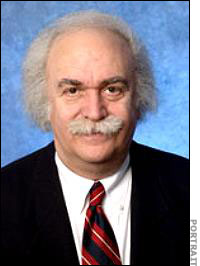
The state district judge at the time of the Koslow trial retired in December 1994 after 29 years, and was unclear why so many children wanting to see their parents in the cold ground was escalating and taking over news headlines. “The violence over the last four or five years has scared me,” he said in February 1995 to the Dallas Morning News. “Young people don’t have any appreciation for life, their own or others.”
Children of divorce often find themselves yelling this to their parent’s new spouse. In the case of adopted children, the attachment is even more distant. They look for answers to the questions: Who am I? Where did I come from? And, most difficult, Why was I given up for adoption?
Children who have endured separation from their natural parents, either from divorce, death or foster placement, have a challenging time coping. As Lori Carangelo explains in Chosen Children, “They lose role models; they lose security. They also experience a sense of rejection and abandonment, of being unwanted and unloved, no matter how loving and supportive their substitute caretakers or adopters.”
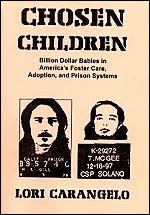
In the case of a killer who is adopted, this lack of contact with natural parents leads to wondering and speculating what his or her birth parents would be like: perhaps they would be the June Cleaver-esque mother who baked cookies and tucked him or her into bed at night, and the father with a steady job, providing for his family.
A common thread among killers who are adopted is that they are very unlikely to strike again. Most are satisfied after the person who is a “substitute” parent is out of the picture.
Nearly 70 percent of California’s prison population is comprised of former foster children. This should surprise no one, says Carangelo. For many decades, this statistic told Americans to support adoption, taking kids from foster care to “real” homes. It may be the quick fix, but does not reach the underlying issue — the mental trauma these children have endured.