
The Mysterious Death of Superman — Everything to Live For — Crime Library
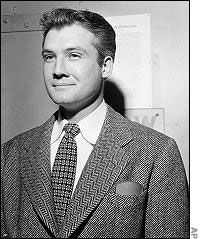
He had movie-star good looks and he took full advantage of them. He was a hero to a generation of children who were just beginning to grow up with television. He had a very promising future ahead of him in Hollywood and, on the surface, everything to live for. So why did George Reeves take his own life?
Or did he?
When George Reeves died at the age of 45 in his Beverly Hills home, it was officially ruled a suicide. For nearly half a century, that explanation was accepted by the general public, but in recent years, it has been called into question. The September 2006 release of the movie Hollywoodland, directed by Allen Coulter and written by Paul Bernbaum, has unleashed a flurry of speculation suggesting that Reeves’ death may have been at the hand of someone else. The movie, featuring Ben Affleck as Reeves, offers a few plausible alternative theories.
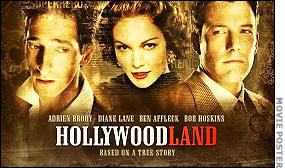
The tag line for the movie reads, “Living in Hollywood can make you famous. Dying in Hollywood can make you a legend.” At the time of his death, Reeves was at the peak of his career, attaining near-legendary status. As the title character on the TV series, The Adventures of Superman, from 1952 to 1958, he was as famous as the president of the United States and movie stars who had been in the business much longer. All over the country children stopped playing and ran inside to watch him on television when the show came on. His heroics fighting the bad guys in a “never-ending battle for truth, justice, and the American way,” were a byproduct of the World War II generation.
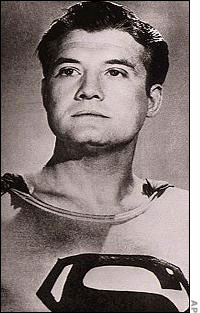
Although the series had been canceled just before his death, and Reeves was reported to have been despondent over it, he still had some bright career prospects looming in front of him. He still had his looks, his marvelous physique, and his talent. Other film offers would have undoubtedly come his way, and the Superman series was about to be regenerated for the 1960-61 season. On the surface, he seemed to have everything to live for. So why would someone commit suicide three days before his wedding? Or a day before a widely publicized championship boxing matchup?
Like most mysteries, there are more questions than answers. Such is the case with the mystery surrounding the death of George Reeves. Although the case is still considered closed and no irrefutable evidence has surfaced that would warrant reopening it, widespread speculation persists nonetheless.
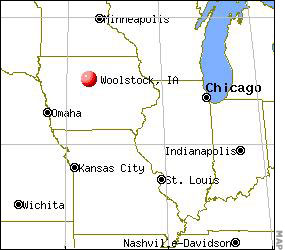
The story of George Reeves begins on Jan. 5, 1914, in the small town of Woolstock, Iowa, where he was born George Keefer Brewer. Located an hour’s drive due north of the state capital of Des Moines, Woolstock is today a farming village of slightly more than 200 people in a sparsely populated rural farming region.
Reeves’ mother, Helen Lescher Brewer, gave birth to him less than nine months after her wedding to Don C. Brewer. In those days there was a stigma against premarital sex, so his birth date was originally given as April 5.
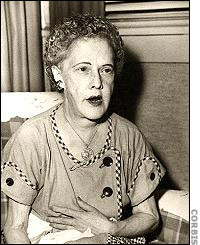
His mother lied to him about his birth date, and it was not until adulthood that he learned the truth. She also reportedly lied to him after she divorced Brewer, telling George his father committed suicide. She later married Frank Joseph Bessolo and, out of respect for his stepfather, who legally adopted him in 1927, George took on his name. He retained it until 1939, when he changed it to the more Hollywood-sounding George Reeves.
While George was a young adult, his mother divorced Bessolo and relocated to Pasadena, California. He became an amateur boxer but reportedly gave it up because of Helen’s concerns for his well-being. Later, he attended Pasadena Junior College, where he became interested in acting. He interned in a number of live stage productions at Pasadena Playhouse, where many great actors performed early in their careers. It was there that he met actress Ellanora Needles, whom he married in September 1940. The marriage lasted 10 years and they had no children.
And then one day he was “discovered.”
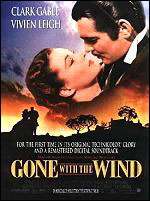
Although he was best known as TV’s Superman, Reeves had a lengthy resume for more than a decade before he was offered that high-visibility role. In 1939, he was cast as Stuart Tarleton, one-half of a pair of twin brothers competing with many other suitors for the hand of the dazzling Scarlett O’Hara (Vivien Leigh) in Gone With the Wind. Although it was a relatively minor role in the opening scene of a marathon production, it served as a springboard for the career of the newly surnamed George Reeves.
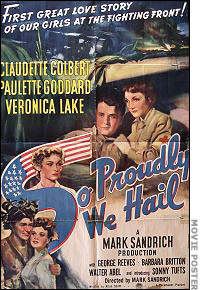
Over the next few years Reeves flirted with true film stardom in such pictures as So Proudly We Hail! (1943), alongside three of the greatest beauties of that era — Claudette Colbert, Veronica Lake, and Paulette Goddard. The term “matinee idol” was very much in vogue at the time and Reeves was well on his way to becoming one. His six-foot, one-inch height, muscular build, and stunning good looks garnered him much attention from filmgoers — especially the ladies, even though he was married and theoretically ineligible. However, World War II intervened and he enlisted in the Army Air Corps where his acting skills kept him out of combat and busy making training films. He also acted in patriotic stage productions like Winged Victory on Broadway.
After the war, Reeves struggled to get his film acting career back on track. Although contracted by Warner Brothers, Twentieth Century Fox, and Paramount — three of the studio giants of Hollywood — Reeves would never achieve true stardom on the large screen. He starred in a few highly acclaimed features like The Adventures of Sir Galahad (1949), in which he was given the title role. However, most of his roles in the postwar years were bit parts in B movies, some of which were uncredited in the films’ original releases. Many of his early pictures were Westerns, which enjoyed a resurgence in popularity in the 1940s. According to one account, these minor roles paid so little he was forced to dig septic systems to earn a decent living. In all, he appeared in about 50 films before making the jump to TV, the medium that launched him into the world spotlight.

Failing to make ends meet in his film career and faced with a divorce, Reeves relocated to New York, where the major networks of the fledgling television industry were headquartered. Although reportedly skeptical of the ability of the new medium to supplant the long-entrenched motion picture industry, Reeves put forth his best effort when he was offered the role of Superman in a feature film that served as a “pilot” for the TV series. According to some reports, the second he strode confidently into the interview room, the producers knew they had found their man.
Superman and the Mole-Men, in which Reeves starred as Superman and Clark Kent, was used to launch the series in 1951 and introduce an already-familiar comic book character to a visual audience. That film was later edited down to a two-part episode for the TV series, retitled “The Unknown People.” The original film was seldom seen after its initial release, but it appeared on a 2005 DVD issue of the first season.
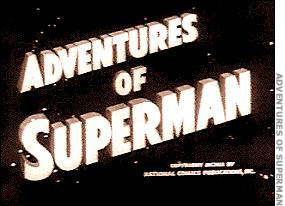
The Adventures of Superman series began airing the following year and continued for a six-year run, ending after the 1958 season. It was produced by Paramount Television, with Whitney Ellsworth, Bernard Luber, and Robert Maxwell as producers, and Harold Stine as director of photography.
As Superman, Reeves worked for low pay even as the titular star, and was only paid during the weeks of production. The half-hour films were shot on tight schedules, at least two shows every six days. He was reportedly astonished when he became an international celebrity. The show eventually aired in 21 countries and had Superman speaking in three different languages.
Although the concept of a superhero on television was a novelty in the early ’50s, the character himself was no stranger to the American scene. First conceived by Joe Shuster and Jerry Siegel in the late 1930s, the “Man of Steel” was the subject of Action Comics issue #1 in June 1938. It was an instant hit, one that would spawn hundreds of superhero incarnations over the next 65 years.

By the time the TV series was launched, nearly every schoolboy in America knew the Superman odyssey saga by heart. Born to scientist Jor-El and his wife Lara on the fictitious planet Krypton, and named Kal-El, the future Superman was launched into space as a baby by his parents as their doomed planet was exploding. After a long journey through space, the baby’s rocket crash landed on Earth and he miraculously survived. The sun rendered him invulnerable and gave him superhuman powers.
Found shortly after his landing by a kindly, childless Midwestern couple, Martha and Jonathan Kent, Kal-El wasn’t long in astounding his adoptive parents with his superpowers. He was given the name Clark (after Martha’s maiden name) and raised as a normal child in the appropriately named Smallville, a farm town coincidentally not unlike George Reeves’ birthplace of Woolstock, Iowa.
As Superboy, the young, displaced Kryptonian performed great acts of heroism in a red, yellow and blue costume and cape with the letter “S” monogrammed inside a field shaped like a cut diamond. Martha Kent made the costume from the blankets found in the rocket ship that brought Kal-El to earth. Among his superpowers, in addition to extraordinary strength and invulnerability, were Superboy’s ability to fly, leap great distances and heights, see through all objects (except lead) with X-ray vision, hear sounds at great distances (super hearing), travel at blinding speeds, and much more.
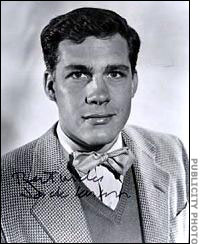
Olson
While a teenager growing up in Smallville, Clark had to keep his true identity a secret in order to protect his loved ones from Superboy’s vengeful enemies. He wore glasses and didn’t take part in sports, pretending to be meek and weak. When he got bullied or taunted, he merely turned a blind eye to the abuse. As Superboy, however, he was the opposite of his secret alter ego: dashing, fearless, and heroic. And, as such, he was highly sought-after by Clark’s pretty, redheaded classmate, Lana Lang, the first of many key people in the life of Superboy/Superman with the initials L.L.
During this time, that Superboy incurred the lifelong enmity of another of Clark’s classmates, Alexander “Lex” Luthor. As the cause of a freak accident that resulted in Luthor losing his hair at an early age, Superboy (and later Superman) became Luthor’s long-standing target for revenge. Discovering that the “Boy/Man of Steel” is vulnerable to green kryptonite, a highly radioactive remnant of Superman’s former home planet, Luthor nearly succeeded in killing his rival in kryptonite-baited traps on a number of occasions.
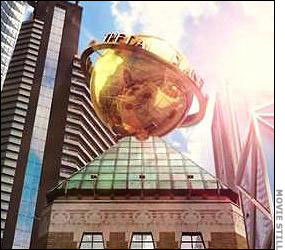
Following the death of his adoptive parents and graduation from Smallville High, Superboy — now Superman, but still Clark Kent in disguise — went from small-town America to the big city, in this case a generic “Metropolis.” He landed a job as a “mild-mannered reporter” for a major newspaper, The Daily Planet, and began a lifelong association with colleagues Lois Lane, “cub reporter” Jimmy Olson, and editor Perry White. Along with police inspector William ‘Bill’ Henderson, this trio — plus Superman — became the main characters in the TV series.
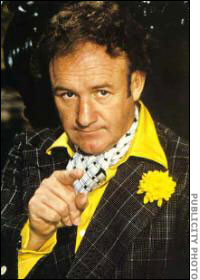
(For some never-explained reason, Lana Lang and Lex Luthor are completely absent from the original TV series, even while continuing their lives in Superman and Superboy comics. In the comics, they follow the “Man of Steel” to Metropolis for different reasons. Lana continues to woo and pursue him, competing with Lois Lane for his affections, while Luthor remains bent on destroying him. Many years later, Luthor would resurface prominently as the arch-villain in a series of Superman movies starring Christopher Reeve, with Gene Hackman in the bad-guy role.)
“Faster than a speeding bullet!” the narrator begins. “More powerful than a locomotive! Able to leap tall buildings in a single bound!” Followers of The Adventures of Superman knew and still know the entire show’s intro by heart.
“Look! Up in the sky!” an excited woman cries to a group of bystanders on the street while pointing upward. “It’s a bird!” another woman cries. “It’s a plane!” a man shouts. “It’s SUPERMAN!” a fourth bystander announces.
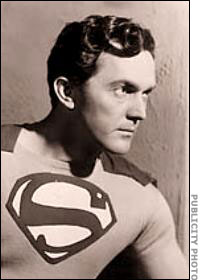
“Yes, it’s Superman,” narrator Bill Kennedy continues in a distinct, solemn baritone, to the universally familiar theme music of Leonard Klatzkin. “Strange visitor from another planet who came to earth with powers and abilities far beyond those of mortal men. Superman… who can change the course of mighty rivers. Bend steel with his bare hands. And who, disguised as Clark Kent, mild-mannered reporter for a great metropolitan newspaper, fights a never-ending battle for truth, justice, and the American way.”
When the TV show premiered on Sept. 19, 1952, no one had any idea how it would play out — least of all its title character. The Adventures of Superman had been a popular show on radio, starring Bud Collyer, for close to a decade in the 1940s when the TV show premiered. However, many radio shows were unable to successfully make the transition from a pure sound medium to a sound AND visual one. It was a risky venture trading sound effects for visual effects and doing so convincingly to viewing audiences.
There were also a number of Superman movies in the late ’40s starring Kirk Alyn in the title role, but reducing the action to a small screen was also a risky venture.
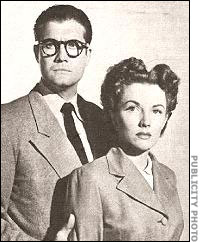
Whatever the drawbacks, the TV incarnation of Superman exceeded expectations. In its first season, it had already begun drawing a cult following, and it retained that following through 104 episodes over the next six television seasons. In addition to Reeves, the cast included Jack Larson as the obsequious, hero-worshiping Jimmy (“jeepers”) Olson, Phyllis Coates and later Noel Neill as Lois Lane, John Hamilton as the crusty, blustering Perry (“Great Caesar’s Ghost!” and “Don’t call me chief!”) White, and Robert Shayne as Inspector Henderson.
The first two seasons were produced in black and white, while seasons three through six were produced in color. In the beginning Reeves wore a brown, gray, and white costume, which photographed better in black and white. Later, when the episodes began shooting in color, he wore the more familiar blue, red, and yellow outfit. However, because most American TVs were only able to receive black and white, even the color episodes came out that way. It didn’t matter, though. Whether in black and white or color, the “Man of Steel” turned into a marketing bonanza unlike any phenomenon before him.
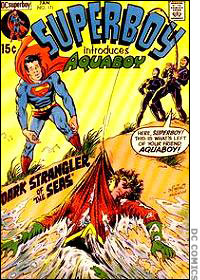
Personally and professionally, the producers of the Superman TV series couldn’t have chosen a more worthy role model than Reeves. Although his personal life wasn’t the most exemplary — he drank heavily, smoked, and was recently divorced and running around with a married woman — he played the superhero role to the hilt in his public appearances. He quit smoking, never brought his girlfriends to his public appearances, and enthusiastically endorsed his sponsor’s healthy products (Kellogg’s breakfast cereals). In every way imaginable, he exuded the appearance of a proud, solid, red-blooded American citizen. Parents who had grown up on Superman comics and radio shows loved Reeves’ portrayal as much as their kids. Whole families often sat down to watch the shows together.
Reeves also performed at and hosted a number of benefits for charitable causes. He was a devout supporter of The City of Hope cancer research hospital and the Los Angeles chapter of United Cerebral Palsy. He also appeared on The City of Hope and UCP Telethons on local Los Angeles TV and at The City of Hope parades in Duarte, California, as Superman.
He also did many benefits and appearances for and with children in his early years as Superman. At all times, during those appearances with children, he tried to impress upon them the importance of obeying the law and doing the right thing. He was always courtly, polite, smiling, and accessible. Unfortunately, he eventually had to curtail his appearances with kids when some of them, unable to distinguish between the TV character and its real-life portrayer, tried to test his “invulnerability” by punching, kicking, or assaulting him in other ways.
One story, believed to be apocryphal, even had a child pointing a loaded gun at him and was ready to fire it to see if the bullets would bounce off his chest. The incident was portrayed in Hollywoodland, in which Reeves (played by Affleck) calmly tells the boy that the bullets could hurt someone else after they ricocheted off his chest. The incident probably never happened, but given Reeves’/Superman’s reputation, such a scenario was not out of the realm of possibility.
years
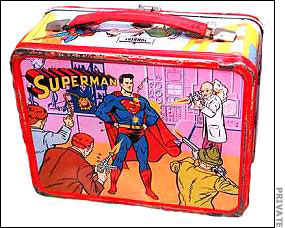
But even Superman’s personal appearances were not as lucrative to the character’s creators as the merchandising opportunities he opened up. Superman comic books, Superman lunchboxes, Superman record players, Superman action figures, Superman everything. You name it, they created it — even replicas of his costume, which, for a time, was the most popular Halloween costume on the racks. And Reeves was out there as much as possible, pushing these product lines. He did whatever he could to lend his and Superman’s names to the merchandising effort.
According to several accounts, his personal appearances were even more lucrative than his paychecks. In the beginning, he was only getting about $200 per episode for risking his life performing most of his own stunts and being held up by wires while simulating flight. They broke on one occasion, causing him to fall and sustain injury. The studio was a lot more careful after that.
Reeves’ private, off-screen persona was, in many ways, 180 degrees removed from the virtuous, morally upstanding character he portrayed on TV and in public appearances. By the time the series reached its top-billing status, the recently divorced Reeves was a hot item in Hollywood. Women were drawn to him like magnets and he could have had his pick of the crop at any time. But, once he made a choice, he appeared to be faithful and rarely, if ever, strayed while the relationship was solid.
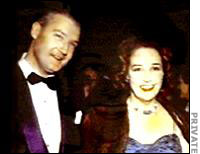
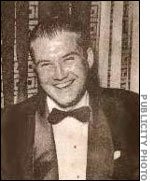
Soon after the Superman phenomenon hit full swing, Reeves became deeply involved in what appeared to be his most fulfilling relationship. Toni Mannix was dark-haired, sensuous, fun-loving, adventurous, and well-endowed. She was also married. Her husband, E.J. ‘Eddie’ Mannix, was a highly placed, hot-shot producer with MGM and was considerably older than her. They had lived together for many years before marrying in 1951.
Camille Antoinette ‘Toni’ Lanier Mannix was a former Ziegfeld Follies showgirl when she met Mannix. She even had a key role in the movie that was made about Florenz Ziegfeld, The Great Ziegfeld (1936), one of her few actual film credits. For many years, she was content to be squired around Hollywood on Mannix’s arm as a trophy wife, even before they got married. She was drawn to money and power, and Mannix had both during the Golden Age of Hollywood.
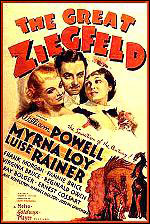
Eight years older than Reeves, Toni nonetheless attracted him and they had a torrid, long-term relationship, which was fully known to Mannix, who had a Japanese mistress of his own. Toni and Reeves were fairly public with their arrangement, but the press, out of respect for the clout Mannix wielded, never exposed the relationship outside the industry. And, because she was still legally married, Reeves never brought Toni to any of his public functions for fear of what it would do to his squeaky-clean Superman image.
In Hollywoodland, the two met at a dinner party, which is likely how it happened in real life. Portrayed by Diane Lane in the movie, Toni seduces Reeves not just with sex, but also with expensive gifts, including a house. She is extremely possessive, quick to jealousy, and protective of the younger man who is not as savvy in the ways of Tinseltown as she is. He returns her favors in kind, giving her the love she hasn’t been getting from her much-older husband.
In one memorable scene from the movie, Reeves, Toni, Mannix, and Mannix’s Japanese mistress are dining at the same table in a restaurant. Reeves, attempting to be polite, tries asking Mannix’s mistress a question and Mannix brusquely orders him not to talk to her, adding that she doesn’t speak a word of English. Meanwhile, Reeves and Toni are playing blatantly obvious touchy-feely games with each other under the table.
However, despite her beauty and her sexual prowess, Toni was only too aware of the limitations of these attributes. She was eight years older than Reeves and knew her attractiveness wouldn’t last forever. By the time their relationship ended, she was already in her early 50s. In one memorable line from the movie, she tells Reeves, “I have another seven years, then my ass drops like a duffel bag.”
Her fear that she might eventually lose one of the most eligible bachelors in Hollywood was well-grounded. It finally happened. Just as the fictitious Superman was surrounded by key people who had the initials L.L., the real-life George Reeves found one of his own. Her name was Leonore Lemmon.
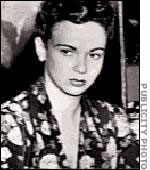
When a young, bold, brunette named Leonore Lemmon spies George Reeves dining in a New York restaurant, she immediately sets her cap for him. Slipping away from her female companion at the bar, she makes her way over to the table and puts the make on him. That night, she straddles him in bed, using the best weapon in her feminine arsenal to tighten the noose around her all-too-willing prey.
That’s how it happened in the movie. According to accounts, it wasn’t much different in real life. The relationship didn’t take too much effort to progress from there. Reeves was in New York, single and fancy-free. Toni was still legally married, 3,000 miles away in California.
Had Reeves and Toni simply hung onto what they had another four years, Mannix would have been dead and they could have been free to marry. But apparently Reeves had other ideas. He was a one-woman man who had been divorced for eight years. He was ready for another shot at it.
Little is known about the background of Leonore Lemmon. She was known in her early years as a member of the so-called Café Society. This was the collective description for the aptly named “beautiful people” who gathered in fashionable cafes and restaurants in Paris, London, Rome, or New York, beginning in the late 1800s. Although members of the Café Society were not necessarily members of society’s elite, they attended each other’s private dinners and balls, and took holidays in exotic locations or at elegant resorts.
In the United States, the term Café Society described those who did their entertaining semi-publicly, in restaurants and nightclubs, and who would often include among their group movie stars and sports celebrities. They were generally publicity hounds who wanted to be seen and photographed and written up in the society and gossip columns. In the late 1950s, thanks to the ready availability of air travel, the terms “Jet Set” and “jet setters” became more appropriate and descriptive.
In 1941, Leonore married Jacob L. ‘Jakie’ Webb, who was reportedly a descendant of railroad magnate and multimillionaire Cornelius Vanderbilt. The marriage was short-lived, however, once she quickly discovered that he was almost completely tattooed (known in tattoo circles as a “full suit”). She left him and he later sued her for divorce on grounds of desertion.
Once she and Reeves became deeply involved, Leonore proved to be as possessive, protective, and jealous as Toni. In the movie she is shown to be bitchy, arrogant, and domineering. Nonetheless, Reeves apparently loved her. He broke off his relationship with Toni, resulting in a nasty confrontation that provided one of the most memorable scenes in the movie, one in which no expletives were held back. Leonore soon moved into the Benedict Canyon house Toni bought for him.
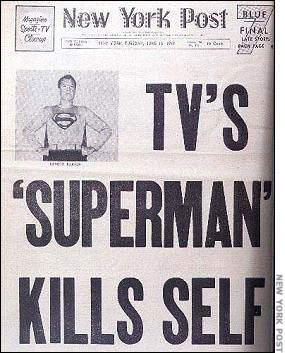
Reeves and Leonore were scheduled to be married in Mexico on June 19, 1959, and spend their honeymoon in Europe. The trip and the wedding never took place. In the early morning hours of June 16, 1959, one shot — possibly more — rang out in the bedroom of George Reeves. The 45-year-old star of the TV Superman series, the world’s first superhero and the idol of millions, was dead.
Leonore and three other friends were guests in Reeves’ home on the night of his death. In the movie, they had been sitting quietly on the couch, drinking and listening to Reeves playing his guitar and singing a tune in Spanish. After Leonore complained that song was boring her, Reeves reportedly told them he was tired and he retired to his bedroom. That was the last time he was seen alive.
By the time the police were notified, 45 minutes had passed since Leonore and her guests claimed they heard the shot around 1:59 a.m. When the police arrived, Reeves was lying naked on his bed, dead of a single gunshot wound to the right temple. The coroner who did the official inquest was quick to rule it a suicide, but questions immediately arose. Evidence collected at the scene and observations of the surroundings suggested other probable causes of death.
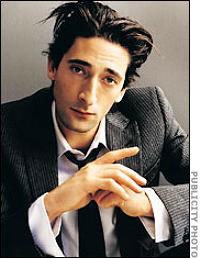
movie ‘Hollywoodland’
Reeves’ mother, Helen Bessolo, arrived in Los Angeles and quickly commissioned her own investigation. Although an elaborate funeral was held for Reeves and was well-attended by Hollywood’s finest, his body would not be cremated for another three years while the investigation was ongoing. Helen hired a detective from the Nick Harris Detective Agency, a young operative named Milo Speriglio, to conduct an investigation, thereby postponing the cremation of the body for three years. However, Reeves’ mother died before any substantial new evidence could be uncovered.
In the movie, Speriglio’s name is changed to the much-easier-to-pronounce Lou Simo, who is convincingly played by Adrien Brody. Simo smells a rat, just as Speriglio did, and his investigation uncovers some glaring inconsistencies in what the official report stated: inconsistencies that suggested different conclusions. Simo is dogged in his pursuit of the real facts in the case, and what he uncovers both shocks him and nearly gets him killed.
The private investigator looking into the Reeves case found the following inconsistencies related to the evidence suggesting that his death was not a suicide:
- No fingerprints were found on the gun.
- There were no powder burns on the head wound, which would imply the gun was held several inches from the head at the time it was fired. This is unusual for a suicide. The victim usually has the gun held directly against the head.
- His hands were not tested for gunpowder residue, so that’s no help one way or the other.
- The spent shell was found under his body. How could that have happened?
- Other bruises were found on his body. How did they get there?
- The gun was found between his feet. In nearly all suicides involving a gun, where it falls is usually consistent. If the victim is sitting or standing, it falls to his or her feet. If he or she is lying down, it would fall next to the head. It is believed that Reeves was lying down at the time.
- The police were not called for at least half an hour to 45 minutes after the death. The theory is that Leonore and the houseguests had to sober up so they could get their stories straight.
- Over the years, the general assumption has been that Reeves was depressed over the Superman show’s cancellation, and this depression caused him to take his own life. He was supposedly unhappy over being “typecast” in the Superman role and unhappy over not being able to get any other roles. However, his supposed “slump” was over by the time of his death, and his friends agreed he was happier than had been in years. He was looking forward to his marriage and to another season of the popular TV show, which had just been rescheduled for the following season. Money wasn’t a problem either; he got residuals from the Superman reruns and other sources. In addition, he had reportedly signed a five-picture deal with Paramount Pictures.

Moore
Some accounts, supported by scenes in the movie, say that he was being forced to consider going into professional wrestling just to sustain himself. However, aside from appearing publicly with some well-known professional wrestlers, there is no credible evidence to suggest that he ever took this prospect seriously.
Moreover, the day after his death, he was scheduled to box with light heavyweight champion Archie Moore. Why would someone take their own life when they were given the chance to shine in the spotlight of such a high-profile event?
Over the years after Reeves’ death, Jack Larson and Noel Neill both insisted that Reeves did not commit suicide. However, neither of them were there when it happened.
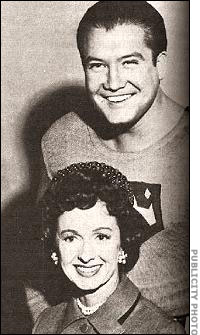
Reeves as Superman
But there is some credible evidence that could be used to back the suicide theory and verdict. It was reported that Reeves had suffered a concussion in an auto accident shortly before his death, which resulted in a doctor prescribing heavy-duty painkillers. This leads some to suspect that his mental health may have been compromised, and he could, indeed, have been driven to take his own life. He also had a drinking problem at one time but had reportedly gone on the wagon about a year before his death. Nonetheless, the blood-alcohol content found in his body shortly after his death was revealed to be .27, two and a half times the legal intoxication point.
On the Straight Dope website, which tries to give straight answers to urban myths, a staffer and Reeves expert identified only as “jumblejim” examines all the evidence and known facts, and concludes that Reeves’ death was a suicide. Among other things, he believes that Reeves was sitting up when he shot himself, which would make it logical to find the gun by his feet and the spent bullet casing under his body. The casing could have fallen on the bed and Reeves could have fallen on top of it. The bullet hole in the ceiling, too, could be easily explained if Reeves had been sitting up.
No fingerprints were found on the gun but if, as had been reported, the gun had been recently oiled, it would have been impossible to get a reliable set of prints. Fingerprints do not hold in oil any better than they would in any other liquid.
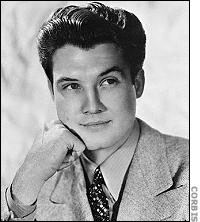
Based on the inconsistency of the evidence, there has been widespread speculation over who might have killed Reeves (and why) if he didn’t do it himself. One theory has it that he was killed by Leonore, in a fit of passion or an argument — possibly over whether they would marry. But, like everything else surrounding Reeves’ death, this is pure speculation. And, if this was the case, why would the houseguests risk their own reputations to cover for her?
What came to light during the independent investigation was the presence of two bullet holes in the floor at the foot of Reeves’ bed. How did they get there? Leonore’s explanation was that she was playing with the gun on another occasion, several days earlier, and it discharged.
Leonore, when questioned, maintained that Reeves killed himself due to his “failed career” and his alleged inability to find more work. Unfortunately, for those theorists who suspect foul play, her version of the evening’s events is the only official one. There was no reliable list of exactly who was present in the house at the time of the shooting. According to Lemmon, those present were Carol Von Ronkle, William Bliss, and Robert Condon.
Some theorists suggest that Reeves’ and Leonore’s relationship was quite volatile, and they were often seen arguing in public. Her reputation as a New York City nightclub hell-raiser dated back to the 1940s, leading some to conclude that she and Reeves could have been arguing in his bedroom the night he was shot. She could have been holding the gun and it may have discharged as they struggled for possession of it. This could possibly explain the bullet holes in the floor, in addition to the fatal wound in his head and the bullet hole in the ceiling.
Casting further suspicion on Leonore, many wondered why she left California the day after Reeves’ death, never to return, and never explaining why she waited so long after the death to call the police. None of the other houseguests have ever provided public testimony.
Giving credence to the theory that Leonore or another person might have been involved was the angle at which the shot appeared to have been fired. A bullet hole was found in the ceiling above the bed. How would that have gotten there if Reeves fired the fatal shot himself into his head while lying down?
Another theory, equally plausible, infers that Toni Mannix might have been responsible, though not directly. She was known to be hurt, bitter and angry over the breakup of their affair, particularly since Reeves and Leonore were living in a house she had bought for him. Leonore told investigators after Reeves’ death that Toni was harassing him with phone calls for months, so much so that he sought legal advice on how to deal with them.
Consequently, Toni might have hired someone to kill him, a theory given further credence by the fact that her husband reportedly had ties to the mob. Had this been the case, Leonore and the other guests that night might have been threatened with a similar fate if they ever said anything.
However, doubt has been cast on this theory by the fact that Toni continued to worship Reeves even after he broke up with her and after his death. For years afterward, until she was stricken with Alzheimer’s disease, Toni sought to perpetuate his memory in every way she could. After her husband’s death in 1963, Toni was left wealthy and she lived comfortably until her death in 1983.
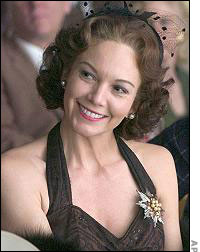
movie
And, despite his engagement and near-marriage to Leonore, Reeves must have felt, deep down, the same about Toni. He left his entire estate to her in his will and named no one else as a beneficiary. After the reading of the will, Leonore was quoted as saying, bitterly, “Toni got a house for charity, and I got a broken heart,” referring to the charities for which both she and Reeves worked tirelessly.
The theories that Reeves might have been murdered by someone hired by Mannix himself don’t hold water. Mannix knew about the relationship long before it ended and gave covert approval to it, so he could carry on with his Japanese mistress. He would have had no motive for killing his wife’s lover.
Recently an item was found in a Poughkeepsie, New York, newspaper, printed the day Reeves died and the day after. L.A.P.D. Sergeant V.A. Peterson, one of the case’s investigators, is said to comment on Lemmon’s statement in the following manner:
Miss Lemmon blurted, “He’s going to shoot himself.” A noise was heard upstairs. She continued, inexplicably, “He’s opening a drawer to get the gun.” A shot was heard. “See, I told you so.”
Whether this is true or not will probably never be known. Leonore died on New Year’s Day, 1990, taking whatever knowledge she had to the grave with her.
So what really happened to George Reeves in the early morning hours of June 16, 1959? Did he really kill himself, did Leonore Lemmon do it, or was a hitman hired by Toni Mannix responsible? The truth, if something other than the official explanation for his death, may never be known.
Nearly fifty years have passed and any trail of credible evidence has long since grown cold. Hollywoodland may have cast doubts on the official cause of Reeves’ death and may have opened the floodgates for a deluge of speculation, but it hasn’t changed anything. At least not yet, and it probably won’t. No one seems eager to reopen and reinvestigate the case. In all likelihood, it will remain closed. In the years since Reeves’ death, Los Angeles has mushroomed into the nation’s second largest city, with close to four million people, and the high percentage of crime that accompanies such a population burst. LAPD has more than enough work on its hands investigating current and recent crimes than to expend valuable manpower on crimes that might have been committed five decades ago.
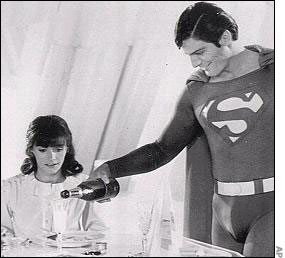
The memory of George Reeves lives on two generations later in Superman reruns and in the legacy his success spawned. A series of four Superman movies, starring Christopher Reeve and featuring Margot Kidder as Lois Lane, hit the big screen between 1978 and 1987. The role catapulted Reeve to wide acclaim, similar to what happened to George Reeves (who was no relation, despite the similarity of their names), and it had the same result. It typecast Reeve for a number of years; however, he was able to break out of it and take on other starring roles into the mid-1990s.
Tragically, the role appeared to be cursed. While taking part in an equestrian competition in Virginia on May 27, 1995, Reeve was thrown from his horse and paralyzed from the neck down. Confined to a wheelchair and special breathing apparatus for the next nine years, he was a spokesman for the rights of the handicapped and stem cell research, and was the head of an eponymous foundation for research on paralysis and spinal cord injuries. Throughout the remainder of his life he nurtured hope that he would walk again, and was even beginning to regain a sense of feeling in his last few years. However, he eventually succumbed to heart failure brought on by an infection common to paralyzed people, and he died on Oct. 10, 2004, at the age of 52.
In obituaries and political cartoons, Reeve was lauded as much for his bravery in dealing with his paralysis as he was for his on-screen portrayal as the “Man of Steel.” He was considered a “super man” for what he endured over the last nine years of his life. In one cartoon, a sad Superman is shown arriving at Reeve’s grave with flowers, while in another, a grief-stricken Superman looks to the reader with a Daily Planet in his hand, having just read the news of Reeve’s death, tearfully saying “He was my hero…”
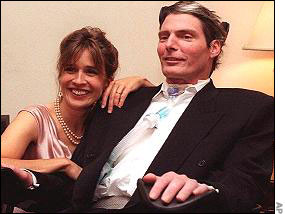
Reeve’s wife, Dana, who bravely stuck with him through his paralysis to the end of his life and carried on with his cause afterward, died of cancer on March 6, 2006. The movie, Superman Returns, is dedicated to the memory of Christopher and Dana Reeve.
There has been a TV series based on the Superman story cleverly entitled Lois and Clark: The New Adventures of Superman (ABC, 1993-97). There have also been a number of pictures done on Superboy and Smallville. And, in the small city of Metropolis, Ill., (population 6,500), the self-proclaimed “Home of Superman,” there is an annual Superman Festival that has been going on for nearly 30 years during the early part of June. There is a 15-foot-high bronze, tri-colored statue of Superman and a “Super Museum,” and the “Man of Steel” is featured in the city’s official stationery and signage. The city’s newspaper is called The Planet and Superman slogans and souvenirs are everywhere in Metropolis.
The legacy of Superman, as exemplified by George Reeves, lives on.