
All about Team Killers, part two by Katherine Ramsland — Folie a Deux? — Crime Library
TEAM KILLERS, PART TWO
Folie a Deux?
When two people go on a killing spree together, the question is always asked whether either would have ever done such a thing alone. Did they bring out the worst in each other? Had they never met, might each of their lives have been different?
Roy Hazelwood, a former FBI profiler, and his associate, Janet Warren, did a study of the patterns they found among partners in which sexual sadism was a strong dynamic, publishing it in the third edition of Practical Aspects of Rape Investigation. They spoke with 20 women who had been the wives and girlfriends of men whom they considered sexually sadistic. They hoped to learn more about the habits and sexual preferences of these men, as well as to understand more clearly how they persuade women to partner up with them and even get involved in killing. It is one of the few studies done in which the women get to speak, and while it is valuable for understanding a certain type of killing couple, some of the generalizations give the impression that the psychology of team killers follows a specific formula. Nothing could be further from the truth.

of Janus, by Ian Brady
Before looking at this study, let’s study a few different types of couples to see how they portray a certain type of dynamic. We begin with the case of Ian Brady and Myra Hindley, known as Britain’s notorious Moors Murderers. While their case has been covered extensively by many authors, a new book by Brady himself gives their experience together a different cast. That publication came about from his contact with noted crime writer, Colin Wilson, who himself offers an analysis.
When Wilson engaged in a prison correspondence with Brady, he had a unique chance to try to understand a murderer’s logic. Brady wrote him hundreds of letters about the nature of killing, and the result was Brady’s book, The Gates of Janus, with an introduction from Colin Wilson.

Called “the most evil man alive,” Brady offers his insights into many other murderers, affirming Wilson’s classification of Brady as “a self-esteem killer.” By that he means that some murderers are fueled primarily by one of the “growth needs” listed on psychologist Abraham Maslow’s hierarchy of human motivations (hunger, safety, social connection, self-esteem, and self actualization). Self-esteem killers act out to feel better about themselves and to win admiration. That does seem like a feasible explanation for Brady’s crimes, but a look at Brady’s philosophies indicates that he may have been motivated by the need for self-actualization, a step above self-esteem on Maslow’s hierarchy. In other words, for him, killing appeared to be a creative expression of his nihilistic ideas about life. He didn’t need a partner, but once he had one, all he had to do was persuade her to accept his philosophies.
Punishment
Ian Brady was a fan of Russian author, Fyodor Dostoevsky, who wrote such classics as Crime and Punishment and The Possessed. Both books deal with someone who becomes obsessed with planning a crime, and Dostoevsky had laid out the psychology of such a person in detail. The character of Raskolnikov in Crime and Punishment, in particular, is obsessed with proving that he is beyond the laws of society because he is a “superior” man. He interprets that to mean that, should he decide to, he could kill someone at whim, without consequences. He selects an old woman and carries out his plan, having also to murder another woman who happens along. Then he writes feverishly about the act and its proof that he is a superior being. While he ended up disintegrating, which disproved his ideas about himself, Brady took the notion seriously. For him, it seemed a real possibility.
Brady developed as a loner in Glasgow, Scotland, who indulged in petty crimes that by the age of 17 landed him in jail. His exposure in jail to hardened criminals apparently had some influence, according to Wilson’s understanding from Brady’s correspondence, and Brady developed an attitude that he was going to act out against society for the injustices against him. His goal was to amass as much money as he could in the least amount of time. Once released from prison, he looked for opportunities to achieve that. He continued to read widely and became a strong admirer of Hitler and Nazism. He also denounced religion.
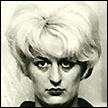
Myra Hindley was 18 when she met Ian Brady in 1961. She was a simple girl who loved children, and she took a job at Millwards LTD in Manchester, England, where Brady was working. She became infatuated with him and so was an easy mark.
“Ian told me,” says Colin Wilson, “that the relationship was so close that they were virtually telepathic.” Brady managed, according to Myra’s diary, to convince her there was no God and that morality was relative. That meant that her own convictions could not have been firmly grounded. Did he have a sense of this or did he manipulate her into being so pliable? It’s likely that her conversion was a little bit of both.
He spoke of Nazism and the violent hedonistic philosophies of the Marquis de Sade, and soon had her hating people as much as he did. He proposed that they enrich themselves through a life of crime, to which she acceded, and she soon found herself helping him to rape children and bury them on the moors. Their first victim in 1963 was a 16-year-old girl, but the children got progressively younger. The next was a 12-year-old boy. (For full details on these crimes, see Crime Library’s story devoted exclusively to this killing couple.)
Brady hoped to acquire another accomplice, Myra’s brother-in-law, David Smith, who came under Brady’s spell. He tried to get Smith to kill someone, but when the job was mishandled, Brady grew paranoid, so Myra had to persuade him not to kill the young man. Brady later got him involved in a murder that he had performed in the home of Myra’s grandmother, with the elderly woman present upstairs. However, Smith couldn’t take what he’d seen, and he told his wife, who informed the police. They arrested Brady first, and then Myra. In 1966, both were sentenced to life in prison, but neither admitted to involvement in these criminal acts. They wrote to each other from their separate prisons. However, Myra returned to Catholicism and her attitudes about Brady shifted. She began to say that she had been under his influence. He had changed her. It had never been her idea.
Myra wanted out of prison, so she wrote a long document that detailed how Brady was entirely responsible for the murders. Like many such psychopathic couples, each partner looks to his or her own interests, so Myra decided to use him to win parole. At first, Brady had exonerated her, but upon hearing how she had turned on him, he implicated her in everything, even saying that some of the brutality was her idea.
By 1987, Myra had admitted to her part in the murders, although she claimed that she was forced into it through blackmail. Brady, she said, wanted to commit the perfect murder, and she had helped him get victims, but she denied being present to any of the actual killings. She believed that Brady would kill her, too, or her grandmother, so she went along with whatever he asked. She also implicated David Smith as Brady’s accomplice. Either she was telling the truth or she was playing her female advantage while being even more conniving than Brady.
Yet for all her detail, Brady gave a fuller peak into the motives and experiences of the career killer. In his book, he makes it clear that he thinks of crime as an exciting venture for the solitary explorer, “consciously thirsting to experience that which the majority have not and dare not.” Human nature, he believes, when not bounded by social convention, is more inclined toward “the crooked.” Nevertheless, it’s not the ultimate high; in fact, its lack of satisfaction can be a real letdown. The doer of such deeds is generally too preoccupied with the possibility of discovery that he fails to fully experience it as he might.
As for murder itself, “viewed scientifically, the death of a human being is of no more significance than that of any other animal on earth.” Serial killers, he adds, are people who are “unavoidably a failure in many normal walks of life.” This would describe both him and Myra. Such a person lacks patience, he writes, and eschews the kind of boredom that most other people accept. “The serial killer has chosen to live a day as a lion, rather than decades as a sheep.” Once he has committed homicide, he accepts his acts as normal, and the rest of humanity as “subnormal.”
While Brady goes on to describe the cases of individual serial killers such as Ted Bundy and Carl Panzram, he only addresses the dynamics of a team in depth when he discusses the Hillside Stranglers, cousins Kenneth Bianci and Angelo Buono. Here he talks about the shared delusion known as folie a deux, an intellectual form of persuasion and conversion of one partner by another. It can only occur, he says, if the target person is “fertile soil in which such proposals can readily take root.” In other words, the criminal desire must already be present.
This analysis removes any ideas about the compliant accomplice who was merely the right kind of person in the wrong place at the wrong time. If a person got involved in crime as the result of another person’s influence, then that person was already a criminal waiting to happen. That’s Brady’s take on it, anyway.
Brady takes a swing at Myra when he writes, “It is human nature that, if caught, the pupil will blame the master for his criminal conduct.” Even so, the pupil’s zeal, had she not been caught, would have outraced the master’s. In that case, a role reversal may occur and the master becomes the pupil. Myra, he seems to be saying, was as bad as he and might easily have become worse.
While he wrote a letter denying that his relationship with her was based on coercion, she insists that he had a certain charm that made her believe anything and want to do anything for and with him. Was that due to her vulnerability or to his power? It’s difficult to tell.
Whether Myra was a dormant criminal with Brady’s nihilistic criminality a catalyst or whether she acted out of some other motivation, it seems clear that Brady was the dominant personality. It’s more likely than not that had she never met him, she would have lived a much more ordinary life. She might have even been nurturing rather than antisocial.
Yet it’s not always the male who leads the dance. Sometimes two partners are nearly equal in their capacity for atrocity, and their equal ability to suffer no remorse fuels a pattern of increasingly aggressive acts against others. Only when they get caught do they stop. A number of male-female couples fit this profile, despite the fact that the female inevitably claims to have been a victim. However, her actual behavior tells a different story. A case in point is the couple that has become a role model for many killing couples, Bonnie and Clyde. Their story is fairly well-known, but let’s look at a brief summary to see how they developed together as killers.
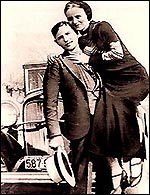
Bonnie Parker liked to write poetry about the exploits of her lover, Clyde Barrow, and she found his violence erotic. Deputy Ted Hinton was one of the six officers who ambushed and shot the couple to death. As the last surviving member of that gang, he tells the story in Ambush: The Real Story of Bonnie and Clyde. While he viewed Bonnie as a nice girl who was fairly normal, it’s clear that Clyde brought out something in her that was anything but. She had plenty of chances to walk away, to turn him in, to say no to the crimes they were committing, yet she stuck with him to the bitter end.
During the 1930s, when people were suffering from a serious nationwide Depression, outlaw gangs made headlines with their sensational bank robberies, shoot-outs and escapes. The like had not been seen since the James Gang the century before.
One of the troublemakers in Dallas, Texas, at that time was Clyde Barrow. Hinton knew Barrow’s family, so he was aware of how Barrow had gotten his start early. His girlfriend since 1930 was Bonnie Parker, a spitfire. Hinton also knew her from her days as a waitress. She hoped to become a singer or a poet. She was 20 when she met and fell in love with 21-year-old Barrow. Already married to a man who had ended up in prison, she cleaved to the outlaw, whose anger at the intense poverty that restricted him, found expression in a reckless aggression that she admired. His older brother was the same, and the townspeople knew them as “that Barrow Bunch.”
The year he met Bonnie, Clyde was sentenced to prison for 14 years for car theft and burglary. He had a fellow inmate cut off two of his toes so he could get out. It didn’t work, but he did get paroled from the overcrowded system in 1932. Bonnie had waited for him.
Clyde’s first murder was an accident, when a bullet ricocheted off a safe. He hadn’t pulled the trigger, but his presence there convinced him he’d end up executed. That added an edge to his adventures: he had nothing to lose, and Bonnie apparently found this exhilarating. Together they went on a spree of robberies, and then began to kill, taking on and losing partners, and always staying together. Police chased them from state to state, but they always eluded capture, and Bonnie wrote poems about it.
Finally, they were trapped, and they went out just as Bonnie envisioneddying together.
On May 23, 1934, six officers awaited the couple on a lonely stretch of road near Gibsland, Louisiana. They had gotten a tip that the couple would be coming down that road. The officers settled in for a long vigil, which finally paid off. The lovers came driving through and the officers just started shooting. “For a fleeting instant, the car seems to melt and hang in a kind of eerie and animated suspension…Clyde’s head has popped backward, his face twisted at the shock of pain as the bullets strike home.”
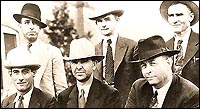
The execution lasted about 12 seconds and then the incident was over. Bonnie and Clyde were dead.
The car took 167 bullets, and a coroner later counted the number of wounds that the killers had received. Each was shot more than 50 times. None of the officers was hit. In fact, neither of the fugitives had managed to fire a single shot.
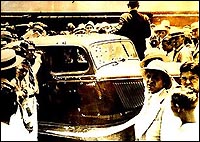
The outlaws were towed to town in their car, and people came from miles around to have a look at them and to touch the “death car.” They wanted to see for themselves the place where Bonnie and Clyde had met their match. School children ripped pieces from Bonnie’s dress and hair.
Despite her desire to be buried next to Clyde, their respective families separated them in death. Yet there was no doubt that they had been in love and had enjoyed their escapades together. Both had probably known that eventually they would be apprehended, but that awareness had failed to stop them. Bonnie had chosen to be with Clyde, and he was a lawbreaker and a killer. She, too, had likely shot at least one of the victims, so wasn’t just along for the ride.
Other women have followed their lovers into crime, but some have later claimed that they had no choice. A look at one such case makes this claim hard to believe. Like Bonnie, Karla Homolka appeared to know what she was doing and to enjoy it, as long as she was doing it with her man, “the king.” Karla is a classic psychopath who appears to have met the man through whom she could act out those things she might not have done on her own. Not that she flinched from them; indeed, she appeared to thrive on them, but she needed a man to put her own inner depravity into motion.
TEAM KILLERS, PART TWO
Compliant Accomplice?
In an article on female serial killers, A.J. Cooper discusses women who kill with adult males. The victim, Cooper says, is usually a family member or an acquaintance, and the male accomplice is typically a boyfriend or husband. The male usually initiates the molestation and the female is usually sufficiently dependent on him to remain passive in the face of violence. She fears being abandoned or beaten. Eventually she may come to accept her role and even get “a measure of sexual/emotional gratification.” Most of them have longstanding insecurity and are poorly educated. Many were abused during childhood.
In Karla Homolka’s case, none of this is true. She was confident, educated and in contact with her family. She was co-equal with her partner in violence, and even suggested some of it before he thought of it. Partnerships like hers, Cooper says, are potentially more dangerous than those in which the woman passively complies.
In Deadlier than the Male, author Terry Manners describes in detail how Karla and her husband, the notorious Paul Bernardo, had killed three girls, starting with her own sister. It was Karla who had drugged young Tammy before Christmas in 1990 so Paul could rape her. Trying to please her man, she slipped an animal tranquilizer into Tammy’s eggnog while they were all together in the basement of Tammy and Karla’s parents’ home, and when the girl passed out, they took turns having sex with her. They made a videotape of these activities so they could relive the pleasure. To their surprise, Tammy vomited and then suffocated and died. They redressed her and dragged her into the bedroom. However, there was no way to save her, so they claimed she’d had too much to drink. Karla took the lead in covering up the murder. The medical examiner failed to check very closely, and Karla and Paul kept their dark secret to themselves. However, Karla then dressed in her sister’s clothes so that Paul could reenact the rape scene.
At no point did she protest and, caught on video, she seems to have thought the whole thing was quite funny.

Karla was 17 when she met Paul Bernardo, 23. To neighbors they seemed the perfect couple, but behind closed doors they carried out atrocities that boggled even the minds of the lawyers who later defended them. Karla had started out seemingly a simple, middle-class girl (she says) who just wanted a boyfriend, but from the moment they met, she was attracted to Paul, the sadist. She let Paul do anything he desired with her and his demands became increasingly brutal. Nevertheless, she wrote notes telling him she wanted more. He liked being in control, and with him Karla later claimed that she felt at peace. They married in 1991 at Niagara Falls, just two weeks after Paul had committed his second murder. Stephen Williams and Nick Pron both published books on the case (see bibliography) and fuller details can be read elsewhere on Crime Library.
Paul had raped and killed 14-year-old Leslie Mahaffy, who was last seen alive at a party and was found dismembered and cemented into seven blocks of concrete submerged in a lake. Then another schoolgirl, Kristen French, disappeared. She was seen being forced into a car in the middle of the day while walking home from school. Two people were in the car. Then weeks later she was found murdered, her long brown hair hacked off.
It turned out that Karla had lured her toward the car because, as she later put it, Paul liked young girls and that way she could keep him happy. Before killing her, they kept Kristin captive for a few days for their pleasure.
Karla was the one who turned Paul in. As the police closed in, she saw a chance to save herself, so she lied to get a short prison term in exchange for details about what Paul had done to the girls. There were incriminating videotapes of both murdered girls being there in his home, forced to have sex. He was charged with 42 criminal counts.
For her cooperation and a plea of guilty to two counts of manslaughter, Karla was sentenced to only two 12-year terms to be served concurrently. At her parole hearing in 1997, it was determined that she was still too potentially violent to be allowed into society. The same was true as of February 2001.
While some people believed that she was coerced into what she did by her overbearing husband, many others are just as certain that she was as much a part of it as he was, and that she enjoyed it. While little research has been done on the remorseless female who uses a man to act out her own violence, this could be a case in which such a dynamic occurred. That she could kill her sister and then continue to participate in more rapes and murders with her sister’s co-killer for several years indicates a deviant personality. She was also caught on videotape telling Paul that she wanted to get many more young virgins for him. He had not scripted her to say this; it was spontaneous and flirty. She clearly had her own ideas about how to torment innocent victims.
Karla and Paul are not alone. In fact, Michael Newton states in The Encyclopedia of Serial Killers that about 25% of all serial killers are male-female teams, including the likes of:
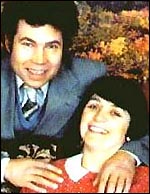
News Services)
- Fred and Rosemary West, who were sexual sadists with more than 12 victims between them. Fred had killed three times before meeting Rosemary, including his first wife, and they worked together to torture nine young girls. Their 16-year-old daughter was among the victims. To elude detection, between 1977 and 1987, they buried the remains in their home. After arrest, Fred said he’d killed more than 20 women. He committed suicide in prison in 1995, while Rosemary is serving a life sentence for 10 counts of murder.
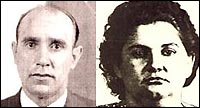
- Martha Beck and Raymond Fernandez swindled women together and killed several. They were suspected in as many as 20 deaths, including a child, but they only confessed to two. Martha, a grossly overweight woman, fell for Raymond’s charm, but he wanted only to take what he could from her. Married three times and quickly divorced, Martha had an appetite for bizarre sex. She persuaded Raymond, who believed in black magic and who had conned over one hundred women out of the money, to team up with her. During 1947 and 1948, they engaged in fraud and deception of vulnerable women, stealing their money, and that activity soon turned to murder. One victim was strangled into unconsciousness and then Martha drowned her in the bathtub. Arrested and tried in a sensational proceeding that involved Martha’s descriptions of her strange sexual practices with Raymond, they were convicted of murder. Despite Martha’s attempt to appear to be a woman who’d fallen under a con man’s spell, these two were executed on the same day in 1951. She proclaimed her love for him all the way to the chair.

- Doug Clark and Carol Bundy were responsible for “the Sunset Strip Slayings” in Hollywood in the early 1980s. Carol would entice young girls into the car so that Doug could force them into sexual acts, during which he would shoot them in the head. He would then have sex with the corpses, or just with a severed head. Once Bundy made the head up to look like Barbie, which Doug then took for his pleasure. When arrested, they were charged with six counts of murderfive females and one male (a friend of Carol’s who had suspected Doug in the string of slayings.) Clark was sentenced to die while Bundy, who testified against him, got two consecutive life terms.
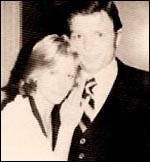
- From 1978 to 1980, Gerald and Charlene Gallego engaged in a series of sex crimes together in California and Nevada. As was the typical pattern for such couples, Charlene (Gerald’s seventh wife) would entice girls into their car so that Gerald could rape, abuse and shoot them. Often kidnapping two girls together, they killed 10 people. A witness gave police enough information to link the last dead couple (a male and female) to the Gallegos, and they ran but were quickly captured. Charlene turned against her husband and was the star witness in trials in both California and Nevada, where Gerald received the death penalty both times. Charlene got 16 years for her part and was released in 1997.
Each couple involved a male and female who together lured and savaged innocent victims, including children. While no formal studies have been done on the kind of chemistry that happens between two people that sets off a rape or killing spree, many experts believe that under other circumstances and with another man, the female might not have been as sadistic or cold-blooded. (Yet in some cases, the female was the dominant or encouraging partner.)
Back to the study that former FBI Special Agent Roy Hazelwood did. He found that most of the women who get involved with these sadistic males are from backgrounds that included physical and sexual abuse. Once merged with their sadistic partners, they become unable to form their own identities because “the sadistic fantasy of the male becomes an organizing principle in the behavior of the women.” From his interviews, he concludes that couples like Karla and Paul are not like the team killers, Bonnie and Clyde.
“Let’s take Bonnie and Clyde,” he says. “Wives and girlfriends of sexual sadists are quite different. I interviewed twenty women, and four of them had participated in the murder of another person. You can’t excuse that. They are legally, morally, and ethically responsible for what they’ve done. But I believe the man had reshaped their sexual norms.” After having spoken to these women, he viewed them as compliant accomplices with weak self-esteem who were isolated and made to believe that the male in their lives was the center of the universe. They had to do what he wanted or their world would fall apart.
Yet those psychiatrists who have evaluated some of these women believe that even without the male, they had the potential for aggression or cunning against others. It was also difficult to confirm the details of their self-reports. Maybe they were abused, maybe they weren’t. There is certainly no evidence of that for Karla Homolka, or Bonnie Parker. That means it may not be just team chemistry. It could be about a shared ability to harm others and a willingness to witness and participate in it without trying to stop it.
In fact, if not for certain women, the lives of some men might not have been so violent.

Karla Fay Tucker, 23, was in the mood for acting out and she wanted to go out. She was a tomboy who liked to prove herself in her Houston, Texas, neighborhood. She could get into a fight with the best of them and she found good company among bikers or Vietnam vets. In 1983, her boyfriend, Daniel Garrett, was teaching her combat maneuvers. There’s no evidence that he would have turned violent had she not goaded him into it. She got high on speed and urged him to go with her for a ride. She was feeling mean that night and she had a target.
There was a guy, she said, that she disliked. His name was Jerry Lynn Dean. She persuaded Daniel to help her to break into his house and take somethingspecifically his Harley motorcycle. Daniel did what she wanted, although he wasn’t comfortable with this act.
When they entered Jerry’s house in the dark, Karla heard him waking up on his futon. Rather than leave before he discovered them, she jumped him, scaring him, and her power over him gave her an enormous rush. He started to struggle as she straddled him, so she grabbed a pickax to hold him down, and the more he struggled, the more she was determined to keep him down. She hit him again and again, using the ax to put 11 deep stab wounds into his throat and chest. The bloody killing excited her and, as he died, she experienced a sexual climax.
But that wasn’t the end of it. Jerry’s girlfriend, Deborah Thornton, was there, too, so Karla began to hit her as well. However, as Gini Graham Scott put it in Homicide, her arms got tired, so she persuaded her boyfriend to finish it. He did what she asked.
Later she bragged about the incident to her sister, who was so disgusted she turned Karla and Daniel in to the police. Karla was convicted of murder and executed in Texas.
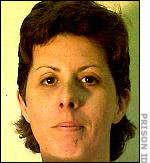
Like her, Judith Ann Neelley persuaded her husband, Alvin Neelley, to participate in a series of brutal crimes. In 1980, she robbed a woman at gunpoint and then began a rampage that involved murder. Together these two viewed themselves as outlaws, calling themselves ‘Boney and Claude.’ One day they lured a 13-year-old girl into their car and in front of their own twins, they molested her and then killed her. Judith injected her with liquid drain cleaner and then shot her. She also shot a man, but he survived the attack and fingered her for shooting him and killing his girlfriend.
When this team was arrested, Alvin claimed that Judith had instigated the crimes, being responsible for eight murders, and he had just gone along with her. She liked to have power over others, he said. He didn’t know what else to do.
Yet when she was arrested, she quickly blamed Alvin and said she was a victim of domestic abuse. She tried to claim she was insane and could not help what she had done. While the jury convicted her of murder in 1983, they recommended a life sentence. However, the judge sentenced her to death, but her sentence was commuted in 1999 to life in prison.
One of their victims who had escaped said that Judith was the one with the gun, and that she had bragged about committing numerous murders, but no evidence ever linked her to any unsolved cases. Nevertheless, she appears to have had a thirst for violence and power. That she was young, slender and blond gave her an advantage with those who would rather believe that the male was the instigator. She was just a girl, after all. Yet the facts of the case say otherwise.
Not all teams are out-and-out killers. Some escalate from other crimes. They cross one moral boundary, and that makes it easier to cross another.
TEAM KILLERS, PART TWO
Tag Team
In Pleasanton, California, on December 2, 1997, 22-year-old Vanessa Lei Samson was abducted while making her usual morning walk to work. A dark green minivan pulled up beside her, the door opened and she was gone.

Carlton Smith tells the story of what happened in Hunting Evil, about a male-female team of rapists who operated in the area for more than four months before they were apprehended.
The story, while unclear, appears to have begun in 1974 with another killing, that of 13-year-old Cassie Riley. She was last seen at a local grocery store. Her body was found on a bush-covered embankment along a creek, with her head pointing toward the water. Her pants were still zipped but pulled down to her ankles. Her shirt and bra were pulled up. Evidence was collected near the crime scene, but most important, investigators found sneaker prints, size 10. That would help to narrow down suspects. The autopsy revealed that Cassie had died from drowning. However, injuries to her head, neck and body showed that she had been the victim of a severe assault. There was no evidence of sexual penetration, but clearly someone had gone after her.
Eyewitnesses, including her own sister, claimed that before her disappearance, Cassie was speaking to a younger man wearing a green shirt with a patch on the sleeve. Jimmy Daveggio was named as one of the boys at the park where she had been seen, so police interviewed him on October 2, 1974. He later revealed that Cassie had once been his girlfriend, but since other boys had claimed the same thing, investigators did not consider this relevant information. In retrospect, it might have been.
Six months later on May 21, 1975, Marvin Mutch was accused of the murder. However, there was no hard evidence to convict and no shoe prints were ever presented to match the prints at the crime scene.
Carlton Smith believes that this may have been where Jimmy Deveggio, who became a violet sexual predator, got his start. He reports that Jimmy’s sister recalled their mother lying to police about Jimmy’s whereabouts on the day Cassie disappeared, saying that he had been home at the approximate time of Cassie’s murder. Where he actually was is anyone’s guess.

As a charming, blue-eyed young man, Jimmy liked women, but his volatile temper got him into trouble. Once he stole a girlfriend’s mother’s car. Another time, he got a young girl pregnant. He was constantly getting into fistfights. Because of his problems, he was sent to live with his natural father in Pacifica, California. But that worked out badly and he was soon back with his mother.
When he robbed a gas station, he was sentenced to a short term at the Alameda County boy’s detention camp. He now called himself Jime, although he acquired another nickname, “Froggie.”
Jime wasn’t good at keeping himself out of trouble, and soon he was into gambling and drugs. He also committed numerous burglaries and was charged with abduction and rape, although because the victim had been intoxicated the charges were dropped.
After further incidents, Jime’s parole officer decided to send him for a psychiatric evaluation. He was determined to be a sex offender and was sent to the California Medical Facility at Vacaville, but was released fairly soon. It wasn’t long before he was arrested again, this time for picking up a female officer posing as a prostitute and offering her money for sex. He was also charged with disorderly conduct and fined for drinking and driving.
Jime moved to Sacramento where he became a member of the motorcycle gang known as the Devil’s Horsemen. The only prerequisite was owning a Harley Davidson, so he stole one. He dyed his hair purple to match his bike and got fiercely tattooed. He soon met his next girlfriend, who was eager to join him in some sadomasochistic activities.
When high school dropout Michelle “Mickie” Michaud first met Jime, or “Froggie,” she was already considered incorrigible. By age 16, she had run away from home and moved in with a drug dealer who beat her. She worked as a prostitute and was arrested in 1991 in a massage parlor. She was fined, went through several more lovers, and then encountered Froggie at a neighbor’s house in 1997.
Mickie was impressed with his motorcycle, and after they got to know each other, with his protection of her. Nobody could treat her like a whore when she was with Froggie. She liked that.
Eventually he moved into her house and during the holiday months stopped her from seeing her parents. He wanted to isolate her for better control. During this time Mickie played house. She took care of her kids, rounded them up when “Daddy” came home, cooked dinner at which Froggie would say grace, and even prepared lunches to take down to the bar. It was good in the beginning, but soon nothing became good enough for Froggie. He would complain if she brought him lunch and he would complain if she didn’t. He became impossible to please.
Just before Christmas, the bar where Froggie worked was robbed of the Christmas presents, and a few nights later the safe was broken into $6000 was missing. Although he was never confronted, in February Froggie was fired on grounds of fighting with customers. He took a job as a security guard.
Froggie soon started bringing girlfriends home. Mickie allowed it to keep him happy, thinking that if she gave him his space, eventually he would get tired and she would have him back.
Yet Froggie eventually became abusive. He would beat her, lock her in his room, and leave for days and not tell her where he was going. He used speed, which put them in debt. To help financially, Froggie’s friend moved in and together they sold crack from the house. It wasn’t long before they were in trouble.
The Sacramento police came looking for Froggie’s friend on a warrant, and while apprehending him, they discovered a stash of methamphetamine and a nine-millimeter pistol. Then they learned about Froggie’s status as a sex-offender. Because there were children in the house, he was ordered to move out
After another suspicious burglary, Froggie was kicked out of the gang, and that’s when he developed a fascination with serial killers, especially Gerald Gallego. Just as Gerald had done with Charlene, Froggie persuaded Mickie to pick up one of his daughter’s friends and lure her back to where he was staying. There Froggie raped her.
Soon, Mickie was fully involved in Froggie’s scheme and they became kidnappers. A 20-year-old night student, Alicia Paredes, was walking home one evening. As she crossed the bridge, a dark green minivan came up beside her. Froggie and Mickie grabbed her so Froggie could rape her. They then dropped her off, but not before she had overheard Froggie refer to the female driver as “Mickie.” She reported it and worked with a sketch artist to develop the suspects.
Froggie removed the two middle seats from the van to better accommodate his plans. He also gave instructions for Mickie to get another woman. He forced this one to perform oral sex on him while Mickie held her head, telling her what to do to “Daddy.” When it was over Froggie tried to console the girl and blamed Mickie for everything. He even sent her to go get ice for the girl’s mouth.
A few days later the couple was back on the road, this time accompanied by Mickie’s daughter. Mickie had told her of “secret lusts” she’d had and that one of them was a desire for them to have sex. Later that night, Mickie held her daughter down and undid her pants to allow Froggie to perform oral sex on her while she called for “Mommy.” When it was over the girl went to sleep in the back of the van.
On another night, they gave drugs to a girl and then hit her over the head as she was hunched over trying to snort it. She tried to fight back, but they hit her again and then handcuffed her. In a safe place, Froggie removed the handcuffs and had the girl fellate him. He commanded her to act like she enjoyed it. She remarked that she couldn’t because the experience reminded her of her stepfather. This ruined Froggie’s fantasy so he stopped. Mickie took over while Froggie masturbated. The couple then took pornographic pictures of her and blackmailed her with them.
Mickie wrote bad checks and was soon arrested. On November 9, 1997, she was booked into the Douglas County jail. While she was there, Froggie removed the rear bench seat from the van. Once Mickie was released, the couple hit the road again with this stripped down van. They grabbed a prostitute. When Froggie attacked her, she fought back and managed to escape.
Things were finally closing in on this couple. A few days after Mickie’s release from jail, the police took a statement from the friend of Mickie’s daughter whom Froggie had violated. She mentioned the gun, the rape and the van. Mickie’s daughter described how her mother had bragged of their rape in Reno as well. The officer on the case soon realized that Froggie was a sex offender.
On November 21, 1997, Mickie’s daughter gave police information about where Mickie and Froggie were. She also told them about other victims.
Even so, the couple remained free, and that was bad news for their next victims.
While checked into a motel in Sacramento, Froggie raped his younger daughter while Mickie waited in the bathroom. Then he performed oral sex on her while he penetrated her with his finger. He went on like this for an hour and then called Mickie to come out of the bathroom and join them. When they were finished, they lay on the bed in the hotel room and Froggie said that he wanted to torture someone. His daughter declined to be his victim. That meant he had to find someone else, so he sent Mickie out to get a flashlight, a man’s shirt and two curling irons.
A few days later, the couple circled the Pleasanton, California, area while Froggie fantasized about the girls he saw walking by. They stopped into a sex store and purchased a gagging device and video titled “Submissive Young Girls.”
On December 1, FBI agents met with Alicia, the first rape victim who had seen them and overheard the female’s name, and showed pictures of Froggie and Mickie. She was unable to identify them. She even went so far as to identify someone else as her attacker.
The next day, the police issued a warrant for the arrest of James Daveggio and Michelle Michaud.
Froggie continued to obsess about torturing and killing someone. One morning while driving around, he ordered Mickie to turn around, go back and pick up the “the one with the pretty black hair.” A few minutes later, they grabbed Vanessa, the woman they would kill. Froggie had rigged the floor of the van by putting ropes through brackets so he could tie up his victim. He placed his new gag on her as well. Then while assuring her about what a good sex slave she was going to be, he sexually assaulted her.
Then Froggie took over the driving while Mickie went into the back. She noticed that one of the curling irons appeared to have blood and feces on it. Froggie got them all to a hotel, where they both assaulted the victim again. Then they got back into the van, where Froggie strangled Vanessa with a rope while he raped her, saying, “There, now we’re bonded forever.”
They dumped the body over an embankment and drove away.
Mickie had a court date the following morning, and the FBI had contacted her mother, who gave her up. The agents tracked down Froggie and Mickie to a motel and made the arrest, on charges of kidnapping and assault. At this time, no one knew that Vanessa Lei Samson had been murdered.
When Mickie was searched, officers found a nylon rope in her pocket. As they were doing this, the van was being searched as well. They discovered a receipt from a Pleasanton motel for November 30 through December 2. They did not yet know its significance, but soon would.
On December 4, Vanessa’s body was discovered partially frozen by the road. It had a ligature mark around the neck. Her backpack was also retrieved, which helped with identification. It was clear that before she had died, she’d been assaulted over a period of timelater discovered to have been about 35 hours.
From the Douglas County jail, Mickie saw a news broadcast reporting that a woman’s body had been found off the side of Highway 88. She confided in a friend she had made in jail, who turned her in to the authorities.
Froggie and Mickie were now suspects in a murder.
Mickie eventually waived her rights and talked to police. She discussed Vanessa and Alicia, but she often trailed off in a distracted way. She went on to say that the gag device should still have Vanessa’s saliva on it because she had never wiped it off. She also told them about the bloody curling iron.
Eventually Mickie was transferred to federal custody and assigned an attorney. Part of her testimony was brought into Froggie’s trial. Mickie pleaded guilty to one count of kidnapping and was sentenced to 12 years, while Froggie got 22 for the same crimes. Mickie eventually appealed.
They were both delivered to the authorities in Alameda County, where a grand jury indicted them for kidnapping and murder of Vanessa. They were ultimately convicted, and on September 25, 2002, five long years after the murder, Froggie and Mickie were sentenced to die. No arguments from their respective attorneys could soften the obvious depravity of their acts. They had tortured a woman for an extended period of time, and that was something that nobody could understand.
Even if a woman could claim that she participated in brutal acts out of fear of a man, it’s beyond comprehension why she would not go to the authorities. Some say that the pressure for women to have men in their lives works even with such couplesbetter to have a killer than no man at all. Yet some women are just as strong, if not stronger, than the male member of the couple. It defies all reason why they think that being part of a killing couple is exciting, even erotic. The fantasy generally does not have the same force of compulsion that it would for a male, and yet certain females do develop an aggressive side that inspires them to act out. They may like that a male leads the dance, or they may initiate the action themselves. In any event, it’s clear that being part of such a team does present a certain amount of positive reward for the female. It’s just as clear that more research should be done on this dynamic.
Alvarez, Alex & Ronet Bachman, Murder American Style. Belmont, CA: Wadsworth, 2003.
Anderson, Brian. “Woman’s Killers get Death: Daveggio, Michaud Sentenced for 1997 Murder,” www.bayarea.com, Sept 26, 2002.
Brady, Ian. The Gates of Janus. Feral House, 2001.
Cooper, A.J., “Female Serial Killers,” in Serial Offenders: Current Thoughts, Recent Findings, ed. Louis Schlesinger. Boca Raton, FL: CRC Press, 2000.
Davis, Carol Anne. Women Who Kill: Profiles of Female Serial Killers. London: Allison and Busby, 2001.
Hazelwood, Robert R. “Sexual Sadists: Their Wives and Girlfriends, ” in Practical Aspects of Rape Investigation, edited by Robert R. Haelwood and Ann W. Burgess. 3rd edition. Boca Raton, FL: CRC Press, 2001.
Hickey, Eric. Serial Murderers and Their Victims. 3rd Ed. Belmont, CA: Wadsworth, 2001.
Hinton, Ted (as told to Larry Grove). Ambush: The True Story of Bonnie and Clyde. Shoal Creek Publishers, 1979.
Jones, Ann. Women Who Kill. Boston, MA: Beacon Press, 1996.
Jones, Richard Glyn, ed. The Mammoth Book of Women Who Kill. New York: Carroll & Graf, 2002.
Kelleher, Michael D. and C. L. Kelleher. Murder Most Rare. New York: Dell, 1998.
Lane, Brian and Wilfred Gregg. The Encyclopedia of Serial Killers. New York: Berkley, 1995.
Lester, D. Serial Killers: The Insatiable Passion. Philadelphia, PA: Charles Press, 1995.
Manners, Terry. Deadlier Than the Male: Stories of Female Serial Killers. London: Pan Books, 1995.
Newton, Michael. The Encyclopedia of Serial Killers. New York: Checkmark Books, 2002.
Pron, Nick. Lethal Marriage. NY: Ballantine, 1995.
Schecter, Harold. The A to Z Guide to Serial Killers. New York: Pocket, 1996.
Schurman-Kaufman, Deborah. The New Predator: Women Who Kill. New York: Algora, 2000.
Scott, Gini Graham. Homicide: One Hundred Years of Murder in America. Los Angeles, CA: Lowell House, 1998.
Smith, Carlton. Hunting Evil. New York: St. Martin’s, 2000.
Williams, Stephen. Invisible Darkness: The Strange Case of Paul Bernardo and Karla Homolka. NY: Bantam, 1996.