
Crime and Crime Scene Analysis of the Marilyn Sheppard Murder — The Assignment — Crime Library
Supervisory Special Agent Federal Bureau of Investigation (Retired) National Center for the Analysis of Violent Crime
December 1, 1999
Mr. Dean Boland
Office of the Prosecuting Attorney
Justice Center
1200 Ontario Street
Cleveland, Ohio 44113
Re: The Estate of Samuel H. Sheppard v. The State of Ohio.
Case No.: 312332

I was asked to conduct a criminal investigative analysis regarding the homicide of Marilyn Reese Sheppard that occurred on or about July 4, 1954. Specifically I was asked to analyze the crime and crime scene, and review all pertinent case materials in order to classify this homicide and offer opinions regarding victimology, motive and the likelihood of more than one offender being involved in this crime. The following report is based on the material I have reviewed.
A Prefactory Note
The field of criminal investigation is a professional area of specialization with pronounced standards, a distinct published literature that ranges from journal articles to textbooks on the subject, college and university courses within undergraduate and graduate curricula, and scholarly treatises which study crime, criminals, victims and the detective function. Texts on the subject abound[i][ii][iii][iv] and scientific principles that apply to this field and many of its sub-specialties are highly developed and widely accepted as authoritative.[v][vi] There are recognized sub-specialties in the criminal investigation field, including Homicide, Robbery, Sexual Assault and Burglary, to name some of the most prominent investigative foci. It is a given that crime is the most studied American social phenomenon[vii] and the four crimes just mentioned are the most studied forms of criminal activity.[viii] The results of these studies have been profusely published, and have resulted in a body of knowledge that has changed the face of police training programs, while contributing to a wider understanding of the dynamics of interpersonal violent crimes and how to investigate them. Specifically, the program of Criminal Investigative Analysis, as pioneered by the FBI, has emerged as a dominant analytical and investigative tool used in violent crime investigations.[ix]
Criminal Investigative Analysis
This process as developed by the FBI involves a behavioral approach to an offense from an investigative perspective as opposed to a mental health viewpoint. The process generally involves several steps:
-
Comprehensive analysis of the victim
-
Comprehensive evaluation of the specifics of the crime scene
-
Evaluation of the crime itself
-
Thorough review and evaluation of the investigative reports
-
Evaluation of all forensic, laboratory or other specialized examinations
Such an evaluation typically affords an experienced criminal investigative analyst the ability to offer informed opinions regarding the crime, crime scene, motive, number of offenders and other potential criminal dynamics.
Victimology
Every meaningful analysis of a violent crime begins with a study of the victim. The purpose of victimology is to determine what, if anything, elevated an individual’s potential for becoming the victim of a violent crime and then to place the victim on a risk continuum from low to moderate to high. The lifestyle of the victim and the situational dynamics present at the time of the crime are the primary focus in making this determination. There was nothing in Marilyn Reese Sheppard’s lifestyle, such as criminal activity, drug use, etc. that would have elevated her risk for becoming the victim of violence, nor were there any situational dynamics that unduly escalated her potential for becoming the victim of a homicide. She was at her home with her son and husband on a holiday weekend in a low-crime area and was either preparing for bed or in bed when attacked. Ms. Sheppard was at low risk for becoming the victim of a violent crime.
[i] Alfred R Stone and Stuart M. Deluca, Investigating Crimes, (Boston: Houghton Mifflin, 1980)
[ii] Charles E. O’Hara and Gregory L. O’Hara Fundamentals of Criminal Investigation 5th ed. (Springfield: Charles C. Thomas, 1980)
[iii] Paul L. Kirk, Crime Investigation 2nd ed. (New York: John Wiley and Sons, 1974)
[iv] Charles L. Swanson, Neil C. Chamelin and Leonard Territo, Criminal Investigation 6th ed. (New York McGraw-Hill 1996).
[v] Ibid. Pg. 24-26
[vi] William J. Bopp, Police Personnel Administration (Boston: Holbrook Press, 1974), P. 194)
[vii] Joseph Sena and Larry Siegel, Introduction to Criminal Justice 7th ed. (Minneapolis West Publishing 1996). Pg. 51-74
[viii] Ibid.
[ix] Vernon J. Geberth, Practical Homicide Investigation (New York CRC Press, 1996) Pg. 707-793
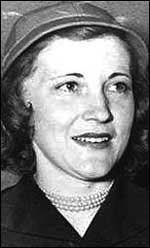
Marilyn Sheppard was murdered on or about July 4, 1954 in her bedroom. There are secondary crime scenes in and around her residence. It is important to note that this crime and crime scene have many elements of staging. Staging can be defined as the purposeful alteration of the crime and crime scene by the offender. Staging is a conscious effort by the offender to mask the true motive for the crime by altering the crime scene to suggest false motives. The offender’s goal in staging a crime scene is to misdirect the investigation and conceal his involvement in the crime.
Non-criminals who stage crime scenes do so in a criminally unsophisticated manner. They typically do not know what real crime scenes look like as their knowledge of crimes and crime scenes is limited to what they have read in books, seen on television or in the movies. The false motives that are staged by criminally unsophisticated offenders are discernable because they are inconsistent with much of the forensic and behavioral evidence present in the crime and crime scene.
There is evidence that the killer staged this crime scene in an attempt to suggest at least three false motives for this crime; (1) a for-profit burglary; (2) a drug-related burglary and (3) a sexually motivated attack. The preponderance of the evidence does not support any of these motives. In this case it was the victim, not money or goods, that was the primary focus of the crime.
A “for-profit” or “drug-related” Burglary:
The crime scene photographs and initial police reports indicate that the killer made a feeble attempt to make the crime scene appear to be a “for profit” burglary, possibly with a drug-related motive.
The initial police reports indicate that the officers observed a doctor’s medical bag on its end with the contents spilled on to the floor. The bag was in front of the door on the right of the entrance hall that led to the study. A desk appeared to be ransacked. Three drawers were pulled out but not removed or disturbed to a great extent. Envelopes, tax stamps and other items were lying on the floor directly in front of the desk. In the study a large desk had all of its drawers removed except one. The drawers were on the floor and appeared to have been ransacked, although the contents remained in the drawers. On the floor behind the desk there was a strong box, some tolls, and Marilyn Sheppard’s bloody watch. Crime scene photographs No. 20 (K-53-54); No. 22 (K-43); No. 23 (K-45); No. 25 (K-49); No. 26 (K-48); No. 27 (K-46) No. 28 (K-47) and No. 29 (no “K” number) are among the crime scene photographs that depict the staged burglary. The only visible damage appears to be broken trophies.
The minimal amount of property damage done while “ransacking” the house is noteworthy because of its inconsistency with the homicide. The offender engaged in overkill in his assault on Marilyn Sheppard, but appeared to be generally careful in handling the property of his victims. This type of care is consistent with someone who had an overriding proprietary interest in these items. Another key indicator that contradicts the hypothesis that this was a “for-profit” burglary is that nothing of any great value has been taken from the scene. The only evidence of anything being taken from the property is Dr. Sheppard’s report of thirty to fifty dollars allegedly missing from his wallet.
Another false motive provided by the offender is an attempt to suggest that this may have been a drug-related burglary. The only evidence that would support a drug-related motive is Dr. Sheppard’s testimony that there were ampules of morphine missing from his medical bag. This bag was found standing on end inside the house with its contents appearing to have simply tumbled out of the bag and onto the floor. The implication being that the offender searched this bag at the scene.
Burglars rarely take the time to stack some drawers, selectively dump the contents of other drawers or search a wallet at a crime scene as was done at this scene. The reason is that it is too high risk an environment, especially when the crime scene is a murder scene. The same is true for the alleged search of Dr. Sheppard’s medical bag. It is unlikely that after committing a homicide and being interrupted by the husband of the victim that a homicidally crazed drug-addict would either take the time or have the ability to selectively identify morphine ampules and demerol among the contents of a medical bag. It is more likely that an offender motivated to commit a for-profit or drug-related burglary would have taken Dr. Sheppard’s wallet and medical bag from the scene and searched them later, when he could do so safely and thoroughly.
F. Lee Bailey, who represented Dr. Sheppard during his second trial, concurred that the scene was a staged burglary. In a letter to the Chief of the Bay Village Police Department dated November 23, 1966 Mr. Bailey stated that, “The dishevelment of the house appears to be more a cover than a quest for valuables, as the worthless things taken tend to indicate. No burglar would hit a woman 25-35 times. He would run away.”
A sexually motivated attack:
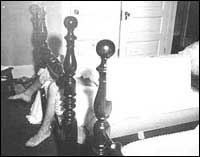
The body of Marilyn Sheppard was found on her bed in the early morning hours of July 4, 1954. Subsequent investigation revealed that her pajama top had been unbuttoned and pushed up exposing her breasts and that one pant leg of her pajama bottoms had been pulled off of her leg. The victim’s knees were at the foot of the bed with her lower legs hanging vertically from the end of the bed. Her legs were slightly spread. Blood smears on her ankles along with the blood pattern higher on the bed sheet suggest that the killer pulled her down toward the foot the bed and into that position. Crime scene photographs No. 36; 37 (K-95); No. 38 and 38A; No 39 (K-96); No. 40 (K-unmarked); Pg. 41 (K-97) are among the crime scene photos that depict the victim’s body on her bed.
(AP)
With her breasts exposed, one pant leg removed, her legs slightly spread and hanging off the foot of the bed, one would have to consider the potential that this was a sexually motivated crime. However, the evidence does not support this hypothesis. Having manipulated the victim as described above, the offender positioned her so that a large horizontal wooden bed post is over her pelvic and vaginal area thus presenting a physical obstruction which would prevent anyone from sexually assaulting the victim in that position. In fact the evidence shows that the victim was not sexually assaulted.
Dr. Thomas Dozier examined the victim’s body at the crime scene and found no gross abnormalities of the pelvic area. The autopsy examination conducted by Dr. Lester Adelson revealed that the victim sustained no vaginal or anal trauma. An examination of the vaginal smears taken from the victim during the autopsy found no spermatozoa present. There is no forensic or physical evidence of a sexual assault on Marilyn Sheppard. The behavioral evidence is consistent with this finding and suggests that the offender had no sexual interest in Marilyn Sheppard, but staged the crime scene to imply a sexual motive.
Photographs No. 38 and 38A reveal blood smearing on the body of the victim. The most likely explanation for this smearing is that it occurred as the offender pushed up the victim’s pajama top with his bloody hands to reveal her breasts. In a sex crime the offender exposes the victim’s breasts so that he may physically fondle and manipulate them. The presence of blood on her torso, but the lack of blood on her breasts reveals an offender who only wanted to expose her breasts, but not touch, fondle or manipulate them.
There is also inconsistent behavioral evidence in that if this was a sexually violent offender who engaged in overkill to subdue his victim it is most likely that the sexually violent behavior would have continued unabated and he would have ripped the victim’s clothing off, and brutally raped her leaving clear evidence of vaginal and anal trauma. This did not occur. The offender took the time to unbutton the victim’s blouse and remove one pant leg of her pajama bottom without ripping or tearing the clothing. There was no vaginal or anal trauma as the killer did not sexually assault his victim.
The physical, forensic and behavioral evidence is consistent with an offender who had no interest in sexually assaulting the victim, but had a great desire to kill the victim. It was also of importance to the killer to display the victim and stage the crime scene to imply a sexual motivation for the crime.
Inconsistencies Regarding the Location of Blood:
(AP)
Dr. Sheppard had no blood on his hands or body following the homicide and denies having washed or cleaned himself. As the killer certainly would have been stained with the victim’s blood after bludgeoning her to death, one might consider this lack of blood on Dr. Sheppard’s person to be consistent with his testimony and his denial of having committed the homicide. It is not. Dr. Sheppard’s testimony as well as the physical evidence at the crime scene sets forth several compelling reasons to believe that not only should Dr. Sheppard have had blood on his person but there also should have been blood on items that had none.
Dr. Sheppard testified that he touched his wife and took her pulse on a least two different occasions by placing his fingers on her neck and throat.
A I looked at her and I felt her (Trial Testimony 12/13/54 Pg. 4971)
A I felt her. I took her pulse at the neck
Q You took her pulse at the neck?
A Yes, sir. (Trial Testimony 12/13/54 Pg. 4973)
Q Did you touch Marilyn’s body?
A I believe I did, sir.
Q And what part of the body did you touch?
A I’m not sure. I believe I touched the neck, the face, possibly the wrists. I touched her, I feel that I touched around the face and neck. (Trial testimony 12/13/54 Pg.4957-58)
Touching his wife’s face and taking her pulse by placing his fingers on her bloodstained neck and/or wrist on at least two separate occasions would have undoubtedly resulted in a primary transfer of blood from the victim to the fingers and hands of Dr. Sheppard. After checking his wife’s pulse a final time, Dr. Sheppard testified that he went downstairs and called the Houks on the telephone. It would be logical to expect a secondary transfer of blood from his fingers and hands to the telephone. No blood was detected on either the telephone or on Dr. Sheppard’s fingers, hands, or person in spite of the fact that Dr. Sheppard testified that he did not wash or clean up.
It is important to note that Dr. Richard Sheppard, brother of Dr. Samuel Sheppard, who arrived at the scene later that morning observed wet blood on Marilyn Sheppard’s face. If the blood on the Marilyn Sheppard’s face was wet when Dr. Richard Sheppard observed the body later that morning, then it was even wetter and more likely to have been transferred to Dr. Samuel Sheppard’s hands and fingers as he took her pulse and touched her face.
Other reasons to expect Dr. Sheppard to have blood on his person is his testimony that he “grappled” with the killer on two separate occasions the night of his wife’s murder. Since the killer would have been covered with the victim’s blood, it would be expected that there would have been a secondary transfer of blood from the offender to Dr. Sheppard having “grappled” twice, yet Dr. Sheppard had no blood on his person. Secondly there would have been blood transferred to Dr. Sheppard’s hand and fingers by the bloody-handed killer as he removed Dr. Sheppard’s wristwatch and ring.
In addition, there is the issue of the blood found on Dr. Sheppard’s wristwatch, which was found in a green bag with his ring and a set of keys. The bag was recovered outdoors, a short distance from his house. The crime scene photographs depict blood spots or spatter (as opposed to smears) on his wristwatch. These would be consistent with impact bloodstains and it would indicate that the watch was near the victim while she was being attacked. It would be expected that similar blood spots or spatter would be found on Dr. Sheppard’s wrist, forearm or hand, immediately adjacent to the location of his watch. No such blood was found.
A transfer bloodstain on his watch would be consistent with a scenario in which either the watch brushed against the victim or a bloody-handed killer removed the watch from Dr. Sheppard’s wrist as is implied by the watch having been recovered in the green bag. There was no such stain on the watch. One might also expect to find evidence of sand from the beach in his watchband as he reported he “grappled” with the killer and was rendered unconscious while on the beach, but there was no evidence of sand in the watchband.
Additionally, it would be expected that there would be evidence of blood on the green bag in which the killer placed the watch as well as indications of blood on the ring and set of keys that were also placed in the bag by the killer. No blood was detected on the green bag or any of the items inside the green bag.
Dr. Sheppard testified that as he regained consciousness in the bedroom, he saw light reflecting off of the badge that he had in his wallet. He later indicated that about between thirty and fifty dollars was missing from this wallet, but that a check and about 60 dollars in cash were under a flap in the wallet and were apparently overlooked by the killer. The implication being that the offender, after murdering Marilyn Sheppard and rendering Dr. Sheppard unconscious, removed the wallet from Dr. Sheppard’s pants, opened it, stole some money, left other money and then discarded the wallet near Dr. Sheppard with the badge displayed. With fresh blood on the killer’s hands, it would be expected that there would be a secondary transfer of blood from the offender’s hands to Dr. Sheppard not only as they “grappled” but also on Dr. Sheppard’s pants and wallet. This would have occurred as the bloody-handed killer removed Dr. Sheppard’s wallet from his pants and then searched the wallet for money. There was no blood on Dr. Sheppard’s wallet or pants.
One must conclude that the most logical explanation for the lack of blood on Dr. Sheppard’s pants and wallet, as well as on his watch, keys and ring and the green bag in which these three items were found is that these items were not handled by anyone with bloody hands. The most logical explanation for the lack of blood on Dr. Sheppard’s person is that he washed himself thoroughly after the murder and before using the telephone to call the Houks. He did not, however, clean the blood spots or spatter from his watch, which present compelling evidence that the watch was in close proximity to the victim as she was being attacked. The only blood on Dr. Sheppard’s pants was one diffuse stain around the knee, which is not really proof of anything.
Also of importance in analyzing this crime and crime scene is to consider the amount of time it took for the offender to stage this scene. Crime scenes are high-risk environments and none more so than a homicide scene. Offenders typically spend no more time than necessary at a crime scene for fear of being interrupted or caught. Consequently there is a high degree of correlation between the amount of time an offender spends at a crime scene and the offender’s familiarity and comfortability at that scene. The more time an offender spends at a crime scene the higher the probability that the offender is comfortable and familiar with that scene. Offenders who spend a great deal of time at a crime scene often have a legitimate reason for being at the scene and therefore are not worried about being interrupted or found at the scene.
In his statements and testimony, Dr. Sheppard alluded to the possibility that more than one offender was involved. This is unlikely for a number of reasons. In multiple offender cases where a female victim is vulnerable it is common for one or more of the offenders to sexually assault that victim. Secondly there would be more activity, both criminal and non-criminal, expected at the scene than what occurred. There likely would have been more destructive ransacking of the house and general pillaging and plundering than happened in this case. Finally, it would be uncommon to leave any witnesses or potential witnesses alive in the wake of a homicide. This would be especially true with a killer as enraged as the one who killed Marilyn Sheppard. In my opinion there was only one killer in the Sheppard house that evening.
The totality of this evidence reveals that this crime was, in all probability, not a “for-profit” or drug-related burglary, nor a sexually motivated crime. It was a crime in which the offender took a good deal of time to stage the scene to imply these motives. The amount of time spent staging this scene not only reveals how comfortable and familiar the offender was, but also indicates how important it was for the offender to mask the true motive for the crime. As in all staged homicides, this offender realized that if he did not stage the scene in some way he would immediately become a primary suspect. The offender displayed his lack of criminal sophistication by offering multiple, feebly staged pseudo-motives for this crime.
Using the Crime Classification Manual [i], this crime is best classified as a staged domestic homicide 122.02.
Staging:
As noted above, staging can be defined as the purposeful alteration of the crime and crime scene by the offender in order to mislead authorities and redirect the investigation. Staging is a conscious criminal action on the part of an offender to thwart an investigation. [ii]
When a crime scene is staged the responsible person is not someone who just happens upon the victim. It is almost always someone who had some kind of association or relationship with the victim. This offender will further attempt to steer the investigation away from him by his conduct when in contact with law enforcement. Thus, investigators should never eliminate a suspect solely on the grounds of that person’s overly cooperative or distraught behavior. An offender who stages a crime scene usually makes mistakes because he stages it to look the way he thinks a crime scene should look. While doing this, the offender experiences a great deal of stress and does not have time to fit all the pieces together logically. Inconsistencies will begin appearing at the crime scene, with forensics, and with the overall picture of the offense. These contradictions will often serve as the “red flags” of staging and prevent misguidance of the investigation. The crime scene often will contain these red flags in the form of crime scene inconsistencies. First, did the subject take inappropriate items from the crime scene if burglary appears to be the motive? Second, did the point of entry make sense; and third, did the perpetration of this crime pose a high risk to the offender? [iii]
Forensic red flags indicating staging include excessive trauma beyond that necessary to cause death (overkill). The victim (not money or goods) is the primary focus of the offender. This type of offender may attempt to stage a sexual or domestic homicide to appear motivated by criminal enterprise. This does not imply that personal-type assaults never happen during the commission of a property crime, but usually the criminal enterprise offender prefers a quick clean kill that reduces his time at the scene. Any forensic red flags, after careful analysis, should be placed in context with victimology and crime scene information. When an offender stages a domestic homicide, he frequently plans and maneuvers a third-party discovery of the victim. The offender often will manipulate the victim’s discovery by a neighbor or family member or will be conveniently elsewhere when the victim is discovered. [iv]
Red Flags Indicating Staging
|
Crime Classification Manual |
Sheppard Crime Scene |
|
Inappropriate items taken from the crime scene if burglary appeared to be the motive. |
The crime scene was staged to appear as though burglary was a motive (drawers pulled out, contents dumped, etc.) but nothing of value was taken from the scene. Ms. Sheppards watch was apparently taken from her wrist, but left downstairs and Dr. Sheppards watch was allegedly taken from his wrist but recovered in a green bag along with other personal articles outside the house. Dr. Sheppard alleged that a small sum of money was taken from his wallet. In effect, nothing of value was taken from the crime scene. |
|
Did the point of entry make sense? |
No point of entry was determined. Dr. Sheppard indicated that the doors remained unlocked when he was home and if an intruder entered it is most logical that the point of entry was through an unlocked door. There is some speculation that the point of entry may have been a basement door as fresh tool marks were found on that door two weeks after the homicide. This is not a logical point of entry, as it would make no sense to break in a basement door when the ground floor doors were unlocked. |
|
Did the perpetration of this crime pose a high risk to the offender? |
If an intruder perpetrated this crime, he did so at high risk for detection. If one believes that the intent was to sexually assault the victim, the intruder would have been attempting to do so with both the victims husband and son in close proximity. This high-risk approach is very uncommon for rapists, who are usually cowardly by nature. If an alleged intruder was in the house to burglarize or rape, he was doing so at great risk for detection. |
|
Excessive trauma beyond that necessary to cause death (Overkill) |
35 injuries were noted on the autopsy report. The cause of death was listed as multiple impacts to the head and face with comminuted fractures of skull and separation of frontal suture, bilateral subdural hemorrhages, diffuse bilateral subarachnoid hemorrhages and contusions of the brain. The number and severity of these injuries can reasonably be considered overkill. |
|
The offender will often manipulate the victims discovery by a neighbor or family member. |
Dr. Sheppard called his neighbors, Mr. and Mrs. Houk, and asked them to come to the house stating, I think theyve killed Marilyn. Once Mr. and Mrs. Houk arrived, Dr. Sheppard remained downstairs and they went upstairs where they discovered her body. Although Dr. Sheppard testified that he had discovered his wifes body on two separate occasions he never called the police. Instead he called his neighbors who, once they discovered the body, called the police. |
[i] John E. Douglas, Ann W. Burgess, Allen G. Burgess and Robert K. Ressler Crime Classification Manual (New York. Lexington Books 1992)
[ii] Vernon J. Geberth, Practical Homicide Investigation (New York CRC Press, 1996). Pg. 359
[iii] John E. Douglas, et al, Crime Classification Manual (New York. Lexington Books 1992) Pg. 252-253
[iv] Ibid Pg. 254-255
Crime Scene Indicators Frequently Noted in a Staged Domestic Homicide
|
Crime Classification Manual |
Sheppard Crime and Crime Scene |
|
The murder weapon, fingerprints and other evidentiary items often removed |
The murder weapon was removed from the scene and no latent fingerprints of value were developed. |
|
The victim’s body is not concealed. |
The victim’s body was not concealed rather it was displayed to suggest she had been sexually assaulted. |
|
The crime scene often involves the victim’s or offender’s residence, as the offender typically has control of the scene and therefore can spend time staging the scene without worry of being interrupted. |
The victim’s residence was the crime scene. |
|
Death may appear to have occurred in the context of another criminal activity such as a robbery or rape. |
The offender staged the scene to make Marilyn Sheppard’s death appear as though it occurred in the context of a failed sexual assault or a burglary. |
|
An offender who has a close relationship with his victim will often only partially remove the victim’s clothing (e.g. pants pulled down, shirt or dress pulled up, etc.) He rarely leaves the victim nude. |
The victim’s pajamas were only partially removed as her pajama bottoms were pulled off one leg and her top was unbuttoned and pushed up over her breasts. |
|
The offender frequently positions the victim to infer that a sexual assault has occurred. |
The offender exposed the victim’s breasts, pulled off one pant leg and slightly spread her legs implying that the victim was the target of a sexual assault. |
|
Despite the body’s positioning and partial removal of clothes, the autopsy demonstrates a lack of sexual assault. With a staged sexual assault, there is usually no evidence of any sexual activity and an absence of seminal fluids in body orifices. |
The autopsy of Marilyn Reese Sheppard revealed no evidence of vaginal or anal trauma, no seminal fluid nor any indication of sexual assault even though the offender had positioned her body to imply that a sexual assault had occurred. |
|
Another red flag apparent with many staged domestic murders is the fatal assault of the wife and/or children by an intruder while the husband escapes without injury or with a nonfatal injury. If the offender does not first target the person posing the greatest threat or if that person suffers the least amount of injury, the police investigator should especially examine all other crime scene indicators. |
The allegation in this case is that an intruder fatally assaulted Mrs. Sheppard while her husband escaped with nonfatal injuries in spite of having two separate physical confrontations with the alleged murderer. I will defer to Dr. White’s analysis and conclusions regarding the nature of the injuries sustained by Dr. Sheppard at the time of the homicide, but clearly, they were non-fatal. |
CONCLUSION:
The totality of the physical, forensic and behavioral evidence allows for only one logical conclusion and that is that the homicide of Marilyn Reese Sheppard on July 4, 1954 was a staged domestic homicide committed by Dr. Samuel Sheppard. The known indicators for criminal staging as well as the known crime scene indicators consistent with a staged domestic homicide are abundantly present. This evidence not only supports no other logical conclusion, but also significantly contradicts Dr. Samuel Sheppard’s testimony and statements.