
The Case of Dr. Samuel Sheppard — The Murder of Marilyn Sheppard — Crime Library
This much is certain: Marilyn Sheppard was brutally beaten to death. Sam Sheppard served 10 years in the Ohio Penitentiary for her murder, only to be freed by a landmark Supreme Court ruling. And, 35 years after the murder, young Sam Sheppard began a crusade to clear his father’s name and bring to justice the man he believed killed his mother.
****
It had been a hot, sunny Saturday in the quiet Cleveland suburb of Bay Village — perfect for picnics, boating and swimming, an ideal start for the three-day holiday weekend. Tomorrow, the Fourth of July, and Monday, the legal holiday, promised more beautiful mid-summer days.
Now, as darkness fell, cool air was moving in from the south. Around the barn-like home perched on the edge of Lake Erie, a gentle breeze stirred the trees. Good sleeping weather.
Shortly after midnight, a man and woman emerged from the house, calling out their “good nights” and putting the lock on the door. Inside, Marilyn Sheppard went upstairs to prepare for bed while her husband Sam sleepily watched a late movie. Their seven-year-old son Sam, known as “Chip,” was already asleep. The house settled back into the quiet darkness.
What happened in the next few hours is a murder mystery still alive in the courts and the public mind more than a half-century later. For now, though, on this soft summer night in 1954, Bay Village slept.
****
Clevelanders awoke late on the holiday Monday. When they opened their front doors, they got a shock. Because it was a holiday, all three papers — the afternoon Cleveland Press and Cleveland News as well as the morning Plain Dealer — published in the morning.
“BAY DOCTOR’S WIFE IS MURDERED; Beaten, He Tells of Fight With Intruder,” said the double banner in the Plain Dealer.
“DOCTOR’S WIFE MURDERED IN BAY; Drug Thieves Suspected in Bludgeoning,” said the Press.
“FIND TOOTH CHIPS UNDER BODY OF BAY DOCTOR’S SLAIN WIFE; Grappled With Brutal Slayer, Physician Says,” said the News.
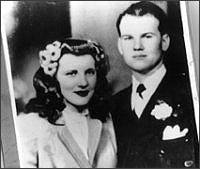
(Cleveland Press)
For the next month, the Sheppard murder case was to be the play story in virtually every edition of all three papers. Gradually, however, the tone of the stories changed.
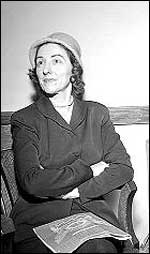
What they described at first was an idyllic family. Marilyn Sheppard, 31 years old, was a devoted wife and mother who taught Sunday school at Bay Methodist Church and was active in community affairs. At 5 feet, 7 inches and 125 pounds, with brown hair and hazel eyes, she was, in the jargon of the day, an “attractive suburban housewife.”
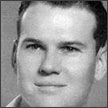
pathic college student
(Cleveland Press)
Samuel H. Sheppard, 30, was known to all as “Dr. Sam” to distinguish him from three other doctors in the family. With his father Richard and his brothers Richard and Stephen, he helped run Bay View Hospital, a 110-bed osteopathic hospital in an 80-year-old converted mansion.
While he was listed as a neurosurgeon, he was also skilled at emergency care. Only Saturday afternoon, he had struggled valiantly but unsuccessfully to save the life of a child who had been struck by a car. His work had earned him the good life —a lakefront home with a Lincoln Continental and a Jaguar in the garage.
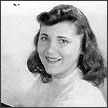
high school student
(Cleveland Press)
Sam and Marilyn had been childhood sweethearts at Cleveland Heights High School, where he was president of his senior class and quarterback of the football team. They were “deeply in love,” said Marilyn’s father. “Like sweethearts,” said their once-a-week maid. Marilyn was four months pregnant, though only close friends knew.
They were “popular among the younger set” in the clubby community, said neighbors — “beautiful people,” as one put it. Only a few days earlier, they had gone water skiing after midnight in the lake behind their home.
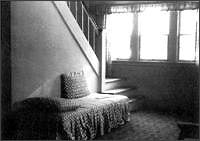
(Cleveland Press)
That peaceful existence was shattered early on the holiday morning, as Sam Sheppard groggily related it to police at 6 a.m. After the departure of their dinner guests, neighbors Don and Nancy Ahern, Sam fell asleep watching the late movie, Strange Holiday. Marilyn left him on the downstairs couch and went to sleep in the twin bed next to Sam’s.
Sheppard was to tell that story many times, always substantially the same. As he put it in a formal statement six days later, sometime after he fell asleep he awoke, believing he heard his wife calling his name.
He ran upstairs and saw “a form with a light garment, I believe, at the same time grappling with something or someone.” He heard moans or groans. Suddenly he was struck from behind.
When he came to, he was lying on the floor. His wife was covered with blood. He checked her pulse and felt none. He ran to the next room and saw that Chip was still sleeping soundly.
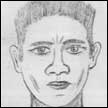
intruder” police sketch
Hearing a noise below, he ran down the stairs. The back door was open and he saw “a form progressing rapidly toward the lake.” It was somebody, as well as he could tell, about 6 foot 3, middle-aged, with dark bushy hair and a white shirt.
He chased the form across the lawn and down the wooden steps to the beach 50 feet below. Then, he said, “I lunged or jumped and grasped him in some manner from the back, either body or leg. It was something solid.” He struggled with the form, then felt himself “twisting or choking, and this terminated my consciousness.”
He could not say how long he was unconscious, but when he came to again he staggered up the stairs to the house and the bedroom in which his wife lay dead. “I believed or thought I was disoriented and the victim of a bizarre dream and I believe I paced in and out of the room and possibly into one of the other rooms. I may have re-examined her, finally believing that this was true.”
A phone number came to his mind, that of his neighbor, Bay Village Mayor Spencer Houk. He didn’t remember what he told Houk, but Houk did: “For God’s sake, Spen, get over here! I think they’ve killed Marilyn.”
Houk and his wife Esther dressed quickly and drove the short distance to the Sheppards’. Mrs. Houk ran upstairs and found Marilyn’s body in the blood-spattered bedroom. Houk called Bay Village police. It was 5:57 a.m.; the Fourth of July dawn was breaking.
The newspapers reported his tale of terror, the brutal tragedy that shattered this ideal family and the combined sympathy and horror it stirred in the quiet community. “They Shared Duties, Pleasures of Life,” said a headline about the couple. “Sheppards Face Tragedy Bravely,” said one about the family.
Gradually, though, the headlines were to change.
Patrolman Fred Drenkhan arrived at 6:02 a.m. Like the other four Bay Village policemen, he knew Dr. Sam well; Sheppard was police surgeon and often rode with officers on patrol.
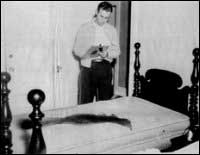
murdered (police photo)
Drenkhan ran upstairs to the bedroom and saw immediately that Mrs. Sheppard was dead. Her face was almost unrecognizable. Blood drenched the bed and was spattered on the walls.
He questioned Dr. Sheppard briefly and suggested to Mayor Houk that this was beyond the capacity of the Bay Police Department. Houk quickly agreed and called Cleveland police, who dispatched an expert from the Scientific Investigation Unit along with a crack team of homicide detectives, Robert Schottke and Patrick Gareau.
A Cuyahoga County sheriff’s detective also appeared, although the sheriff ordinarily investigated crimes only in the county’s rural townships.
Dr. Sam, meanwhile, disappeared; his brother, Dr. Steve, had driven him three miles to Bay View Hospital and put him in a bed for treatment of his injuries. The mayor disappeared too, but returned 15 minutes later saying he had gone back to lock his house. Young Sam was awakened and hustled out in his pajamas to Dr. Richard’s house.
Soon the house was crowded with reporters. Neighbors attracted by the police cars gathered in the yard, and some entered the house. Neighborhood boys were recruited to search the yard and, amid the weeds on the hillside leading down to the beach, the mayor’s 16-year-old son Larry found Dr. Sam’s medical bag.
In it were his wristwatch, fraternity ring from Hanover College and keys. Like a number of objects in the house, they were to be handled by several people before police could check for fingerprints.
It was never clear who was in charge of the investigation, but from the moment he appeared at 8 a.m. Coroner Samuel R. Gerber was the man around whom the reporters gathered.
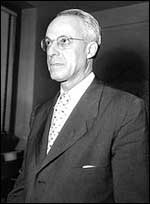
(CORBIS)
Dr. Gerber had been elected county coroner in 1936 and was to be coroner until he retired in 1986, having won 13 straight four-year terms. The diminutive 54 year-old had a national reputation as a forensic expert, having earned a law degree to go with his M.D. He was co-author of the book The Physician in Court and lectured at Case Western Reserve University and in other cities around the country.
He was also a favorite with reporters because of his willingness to give them the kind of quotes they needed. He estimated the victim had been killed between 3 and 4 a.m.; her watch was stopped at 3:15. He described 35 wounds to Mrs. Sheppard’s head and said of the killer: “He rained blow after blow on her with savage fury.” He also said there appeared to be no evidence of a break-in.
Gerber and Bay Village Police Chief John Eaton drove to the hospital, where Sheppard was being treated for bruises, chipped teeth, and what was reported as a fractured vertebra in his neck. Gerber got Sheppard’s story in more detail while Eaton waited in the car. Gerber asked to be given the clothes Sheppard had been wearing, then returned to the scene to relate the interview to reporters.
Schottke and Gareau, the Cleveland detectives, examined the scene, then came to the hospital with Chief Eaton to question Sheppard, who had been given sedatives by Dr. Steve. They returned to the scene and questioned neighbors.
Later they returned to question Dr. Sam again — a more accurate description, Sheppard said later, was to grill him. Among other subjects, they asked how he got along with his wife and about his relationship with a former Bay View nurse named Susan Hayes.
That police would be suspicious was hardly surprising. At least 30 percent of women who are murdered are killed by people they know, most often a husband or boyfriend. Crime was almost unknown in Bay Village, which then as now boasted of its safety.
In fact, there had been only six unsolved murders in Cleveland suburbs in the past 10 years, and five of those were in east suburbs on the other side of the county. Sheppard’s story of being knocked out, not once but twice, by a mysterious form was hard to believe.
What had happened in the two to three hours between Marilyn’s death and the call to Mayor Houk? Why was there no evidence of a break-in? Why were police unable to find fingerprints in the house?
How had Chip managed to sleep through his mother’s murder and his father’s struggle with the “bushy-haired intruder”? Why had the Sheppards’ dog not barked? Where was the T-shirt Dr. Sam was wearing when the Aherns left?
He could only say, “I don’t know.”
That evening William Corrigan, a noted Cleveland criminal attorney, visited Sheppard in the hospital. The news of that visit startled newspaper readers the next day. What they didn’t know was that at the end of the questioning, Schottke had told Sheppard: “I think you killed your wife.”
They also didn’t know, though they were to find out over the next few weeks, that Cleveland police had recommended to Bay Village police that they arrest Sheppard, but the mayor and police chief hesitated. Their hesitation was to last another 25 days — 25 days of headlines.
At the request of police, Dr. Charles Elkins, a noted neurologist, examined Sheppard in the hospital. He was also, as the Sheppards couldn’t help noticing, an M.D. — a medical doctor, as opposed to a doctor of osteopathy like the Sheppards. Today the two branches go to school and practice together, but in the 1950s M.D.s looked on D.O.s with contempt.
Dr. Elkins determined that Sheppard had suffered “serious damage to the spinal cord in the neck region” as well as bruises on the right side of his face and lacerations of the mouth. The extent of his injuries was to be an important point in the trial five months later.
On Tuesday Dr. Sam was taken to his wife’s funeral in a wheel chair wearing an orthopedic collar. He wept during the eulogy. By now law enforcement authorities were complaining about the insistence of Sheppard’s doctor — his brother Steve — that he was in no shape to answer questions.
“We expected cooperation from the family but we don’t seem to be getting it,” Dr. Gerber said. “Here’s a witness surrounded by his whole family of doctors.” Assistant County Prosecutor John Mahon declared: “In my 23 years of criminal prosecution, I have never seen such flagrant stalling.”
Sheppard, alarmed by the growing public sentiment, issued a statement announcing a $10,000 reward for the capture of the killer and declaring, “I have never refused to talk to any authorities or give them any information I had.
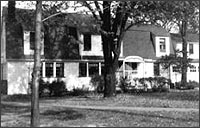
(Cleveland Press)
On Thursday Dr. Sheppard was taken back to his house to go through it with police — and news photographers. He was shocked to see spectators gathered in his yard. “They’re all over the lawn,” he protested. “I want them off my property. Marilyn wouldn’t like it.” He kept repeating, “Marilyn wouldn’t like it.”
The Press story of the tour of the house showed how the coverage had changed since the sympathetic early stories. It said: “Flanked by two lawyers, Dr. Samuel H. Sheppard today re-enacted his version of the murder of his pretty wife, Marilyn — and repeated it, detail by detail, word for word, over and over again.”
Dr. Steve finally allowed his brother to talk to a reporter. In an exclusive interview with the News, Dr. Sam said, “I was in love with my wife and she was in love with me. We got along wonderfully.” He broke into sobs when he told how happy they were to find out she was pregnant again and how they decided that if the baby was a boy they would name him Stephen after Sam’s brother.
Finally, Corrigan allowed authorities to question Dr. Sam in the hospital, and without the lawyer’s presence. The session lasted nine hours. It was clear now to Clevelanders that Dr. Sam was the prime suspect; many had come to that conclusion the first day. If the horrible event had happened to their family member, they told themselves, they would have talked to police as often and as long as police wanted and they would have quickly agreed to take a lie detector test.
Still, police picked up and questioned possible suspects. All were released. There were hundreds of calls from the public. Two separate people reported seeing a man in a white shirt near the Sheppard home in the early hours of July 4. On the other hand, a woman told of seeing lights on in the house, contrary to Sheppard’s story.
Belatedly, police closed the Sheppard home to all but official visitors. That included Sheppard, who was allowed to return only briefly to pick up clothes under the eyes of police.
Cleveland police continued to press Bay Village to arrest Sheppard “for questioning.” Under the law that would mean they could hold him for a reasonable period, usually three days, while they questioned him intensively in hopes he would break down.
On July 16, the Press ran an editorial titled “The Finger of Suspicion.” It protested that the case was marked by “the hostility of Bay Village officials to any ‘outsiders’ in this case” and “the unusual protection set up around the husband of the victim, the sole witness.” It declared: “Every further moment of fumbling is helping a murderer escape.”
On July 21 the Press followed up with another editorial, this time on Page One: “Why No Inquest? Do It Now, Dr. Gerber?” The same afternoon, Gerber announced he would hold an inquest.
The inquest was held in the auditorium of nearby Normandy Elementary School, packed by spectators the Plain Dealer described as “mostly Bay Village housewives.” There were four days of banner headlines on Page One and, inside, page after page of “Q and A” from the transcript.
Since this was not a court proceeding, Gerber ruled that Corrigan, Dr. Sam’s lawyer, could not participate. Since his client by now was obviously a suspect, Corrigan could have told him to refuse to answer questions on Fifth Amendment grounds. He didn’t.
After the Aherns, Spencer and Esther Houk, Drenkhan and others had given their accounts, the star witness was called. Dr. Sam once more told his story and was questioned at length by the coroner.
Two of his answers were to haunt him. He said he and Marilyn had not discussed divorce — “not in a serious fashion” — and that he never had a sexual relationship with Susan Hayes, though he admitted he had seen her on a recent trip to Los Angeles.
Gerber asked him: “You didn’t sleep in the same bedroom four nights in a row?” He replied, “No.”
On the last day of the inquest, attorney Corrigan tried to get the court stenographer to insert some material in the record. Gerber ordered him to stop and the two exchanged words. A Plain Dealer banner headline described the result: “CORRIGAN EJECTED AMID CHEERS.”
Said the story: “Spectators cheered wildly as William J. Corrigan, criminal lawyer representing Dr. Samuel H. Sheppard, was half-dragged from the room in the closing moments of the Marilyn Sheppard inquest in Bay Village.”
It was the afternoon headlines that sealed Sheppard’s fate as far as most Clevelanders were concerned: “SUSAN HAYES ADMITS AFFAIR, FLIES TO CITY.” A three-column picture showed prosecutor Mahon and detective Schottke boarding a plane with her at Los Angeles Airport.
Stories about and pictures of “brown-eyed Susan Hayes” filled 80 percent of Page One of the next day’s Plain Dealer. A News headline under a three-column picture said, “Tan, Freckles Give Susan Her Appeal.” She posed willingly, but let Cleveland Police Chief Frank Story do her talking.
It turned out she had been talking for herself on the flight from Los Angeles — and to a Press reporter: “DOCTOR LIES, SUSAN CHARGES; TELLS OF GIFTS, MARRIAGE TALK.” She told of trysts with Dr. Sam in his car and in rooms above the Sheppard Clinic in nearby Fairview Park starting three years earlier when she was 21, and of staying with him in Los Angeles earlier in 1954.
This time the Page One Press editorial said: “Why Don’t the Police Quiz No. 1 Suspect?” By now the Press editorials had become a subject of debate in the paper’s letters to the editor.
Some writers were horrified — “What is happening to our sense of justice?” — and some laudatory — “‘Somebody Is Getting Away With Murder’ certainly was a fine public effort on the part of the courageous Cleveland Press.'”
On July 29, 25 days after the murder, County Prosecutor Frank Cullitan gave Bay Village officials an ultimatum: If they didn’t arrest Sheppard, Cleveland police would withdraw from the case.
Bay Village Law Director Richard Weygandt took the facts under review. By now the pressure had gotten to Houk, a part-time public official whose full-time job was operating a meat market across the street from City Hall. He was in bed under sedation.
The Press editorial the next day was to live in memory. It ran full eight columns across the top of Page One: “Quit Stalling and Bring Him In!”
Dr. Sam was arrested that evening at the home of his father, next to Bay View Hospital. His father tried to chase away a crowd of reporters and photographers in his yard without success. The television lights attracted a crowd of neighbors.
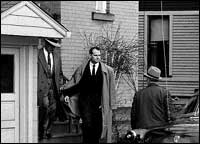
police officer (CORBIS)
While they watched and the photographers snapped pictures, Sheppard was led out in handcuffs, still wearing his orthopedic collar and, under television light, placed in a police car. He was taken to Bay Village City Hall where he was arraigned by Council President Gershom Barber; Houk had bowed out on the grounds he was a witness in the case. Then Sheppard was taken to County Jail. “Apparently the Press had its way,” he said as he was again placed in a police car.
Corrigan showed up at the jail at 12:45, law book in hand, but was denied admission. “No attorneys are allowed in here after 7 p.m.,” a deputy sheriff told him. He had gone first to Bay Village City Hall only to find it locked. Corrigan had a bitter statement: “We discovered that everyone had been notified by the authorities except us … newspapers, radio, television and the public were in the vicinity of where the arrest was made.”
****
Police were finally able to give Sheppard the “intensive” questioning they had in mind. He later wrote that four teams of detectives questioned him in relays for 12 hours: “Hour after hour, they shouted at me, accused me, insulted me and members of my family. They tried to trick me by questioning me about facts they knew were not correct. Each time I told them I didn’t kill my wife.” After three days, they gave up.
In Dr. Stephen’s 1964 book My Brother’s Keeper he tells a story that illustrates the state of mind of the family.
They were horrified to learn one evening that Sheppard had just been led out of the jail in handcuffs and hustled into a police car. Then they got a call that lights were on in the murder house and police were inside.
“Dad’s imagination conjured up the outlines of a police murder plot which, in view of all we had experienced at police hands, did not appear the least bit fantastic,” Dr. Steve wrote.
“Could it be, he asked himself, that the police, in despair of getting either a confession or a conviction, were taking him back to his home in the dead of night so they could shoot him on the pretext he had tried to escape?”
He and Dr. Richard jumped in their car and sped to the house, where the elder Sheppard pounded on the door. When police opened it he demanded to know if Sam was inside and shouted “Sam, Sam!” No one answered and the police assured him that he was not there; they were merely conducting an examination of the premises.
Dr. Steve, meanwhile, had grabbed his medical bag and driven downtown to the jail in the belief that “Sam was going to be in need of medical attention when, if ever, he got back to the jail.” He set up a vigil outside the rear door, but deputies brought Sam back through the front door. It turned out they had taken him to City Hospital for examination of his injuries by their doctors. Gradually the stories about the case — new suspects questioned and released, unsuccessful motions by Corrigan to release Sheppard on bail — moved to the inside pages of the papers.
****
Then came a shocking development: Spencer Houk, the mayor who had held out against the demands for Sheppard’s arrest, was picked up and brought to Cleveland’s Central Police Station. Chief Story said it was “for questioning as a suspect in the Marilyn Sheppard murder case.”
It turned out that Dr. Steve had given police “new leads” implicating Houk. When the osteopath was brought into the room, Houk leaped to his feet. “You liar!,” he shouted. Police questioned Houk for four straight hours, then released him. It wasn’t the last time he was to be mentioned as a suspect in the case.
As the trial date neared, the defense hired Dr. Anthony Kazlauckas, a pathologist and former deputy county coroner, as an expert and announced he would make an intensive search of the murder house. Assistant County Prosecutor Mahon said he would turn over the keys when asked, but the request never came.
The only explanation offered came years later from Sheppard. He wrote, “… this could only be done under the watchful eye of a police guard, who would just be a pipeline to the prosecutor’s office.”
At 9 a.m. on Oct. 18, 1954, Common Pleas Judge Edward J. Blythin called the case of State of Ohio vs. Sam H. Sheppard. Born in Wales 70 years earlier, he had served in the Cleveland Law Department and was law director when Republican Mayor Harold H. Burton was elected U.S. senator in 1940.
According to law that made Blythin mayor, but he was defeated for the post a year later by Democrat Frank Lausche. In 1948 he was elected judge. The luck of the draw put him in charge of the high-profile murder trial three weeks before he faced voters for re-election.
His reputation was as a careful and patient judge. “Slim, silver-haired and stern-visaged” was Paul Holmes’ description from the Chicago Tribune. Holmes was one of many out-of-town reporters sent to cover the trial and his 1961 book about it was tomake him a figure in the events.
The first question facing Blythin was where to put all the reporters. He set up a table inside the bar — the rail that separates the judge, jury and lawyers from spectators — for local reporters and assigned most of the seats in the cramped courtroom to out-of-town reporters. A nearby room was turned over to radio reporters.
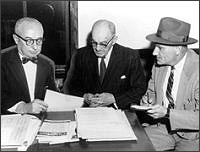
Sweeney (middle). (Cleveland Press)
On one side of the trial table sat Assistant County Prosecutor John Mahon, who was himself on the ballot for a judgeship in three weeks. Assisting him were Saul Danaceau and Thomas Parrino, who would both later use the public exposure to win their own judgeships.
Assisting Corrigan were Fred Garmone along with Arthur Petersilge, the Sheppard family lawyer; and William Corrigan Jr., fresh out of law school.
The first order of business was Corrigan’s motion for postponement of the trial and a change of venue because of prejudice against the defendant stirred up by the news coverage.
Blythin ruled the lawyers should first make an attempt to seat a jury from the panel of 64 veniremen — who were now celebrities in their home town, since the newspapers had printed their names and addresses. The two sides managed to agree on 12 jurors in less than two weeks without either side using all of its peremptory challenges.
Blythin had been re-elected and Mahon was a judge-elect when the trial began on Nov. 4. The first witness, Deputy Coroner Lester Adelson, described the autopsy of Marilyn Sheppard’s body and showed gruesome pictures of the blood-spattered death scene and her battered face. Sheppard would not look at them.
Corrigan got Adelson to admit he had made no analysis of the contents of her stomach, did not make microscopic study of the wounds and did not try to determine if she had been raped.
Don and Nancy Ahern told of their dinner with the Sheppards on July 3. Under Mahon’s questioning, Mrs. Ahern said Marilyn Sheppard had told her about marital difficulties, including Sam’s purchase of a watch for Susan Hayes, and she said a friend had said they were considering a divorce. The judge allowed that to stand as an exception to the hearsay rule.
Spencer and Esther Houk told of their early morning call from Sam Sheppard and what they found when they arrived at his house. Mrs. Houk went further, saying there had been “`rows” between the Sheppards. Patrolman Drenkhan identified photos of the murder scene. Chief Eaton and young Larry Houk told of their roles.
Dr. Gerber was the star witness. He described his extensive qualifications and meticulously went over his examination of the scene, his questioning of Sheppard and what he called lack of cooperation by the Sheppard family. His most damning observation came when he described the bloody pillowcase from the murder bed.
“In this bloodstain I could make out the impression of a surgical instrument,” he said.
Gerber did not say what kind of surgical instrument it could have been and didn’t produce any surgical instrument which could have made the mark. The closest he came was in response to a question from the judge. He said “I meant that the impression could only have been made by a surgical instrument.”
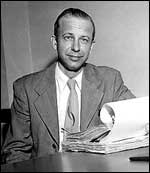
(CORBIS)
Detective Schottke read the statement Sheppard gave police July 10, including the last question. Q. “Have you been treated fairly during the course of this questioning?” A. “Yes, absolutely.”
Schottke said Sheppard’s story had changed in the first few days, but Deputy Sheriff Carl Rossbach, who testified later, surprised the prosecution by saying it had been substantially the same.
Dr. Lester Hoverston, a college classmate of Sheppard’s, had been a houseguest of the Sheppards in early July but was in Akron on the night of the murder. He testified that Sheppard had told him he was thinking of divorcing Marilyn.
He also said that in July after the murder he overheard Dr. Richard in the hospital tell his brother: “Let’s go over the sequence of events so you can get your story straight.”
Dr. Hexter, the neurologist who had been called in by Gerber to examine Sheppard on July 5, described his findings. On cross-examination, he acknowledged he did notice an absence of thigh and abdominal reflexes but minimized their significance.
Detective Michael Grabowski from the Scientific Investigation Unit and Mary Cowan, the coroner’s chief medical technologist, testified about the physical evidence, impressing the jury with their description of their scientific tests.
After moving quickly through several more witnesses, the prosecution called its star witness: Susan Hayes. She was on the stand only a little over an hour; prosecution and defense were both gentle in their questions. The answers, however, were damning to the defendant at whom she did not look directly.
She told about trysts above the Sheppard Clinic two years earlier, gifts she received from him and his talk of getting a divorce. She also said that Dr. Sheppard had called her earlier in 1954 when he was in Los Angeles for an osteopathic convention. He took her to a party at the home of Dr. Arthur Miller, where he was staying.
Q. And where did you remain that night?
A. At the Millers’.
Q. And where did Dr. Sheppard spend the night?
A. At the Millers’.
Q. Did you occupy the same room?
A. Yes.
Q. The same bed?
A. Yes.
Garmone had few questions on cross-examination. She was excused and escorted by bailiffs past the popping flash bulbs.
The prosecution rested.
Dr. Steve was the first witness when the defense began its case on Dec. 2. He took exception to Dr. Hexter’s diagnosis of his brother’s injuries as minor. He told of seeing a cigarette floating in an upstairs toilet.
Since the Sheppards did not smoke, he took that as evidence of an intruder. Later the cigarette had gone — an indication of police incompetence. He described Sam and Marilyn as happy in the weeks before the murder and said his brother never had fits of temper.
Steve’s wife, Betty, testified that Sam and Marilyn were a happy couple.
Dr. Richard backed Dr. Steve’s contention that Marilyn’s body had been moved before the pictures shown to the jury were taken. He denied emphatically Mayor Houk’s testimony that on the murder morning he had asked his brother, “Sam, did you do this?” He said, “I could not have because it never entered my mind that my brother could have killed his wife.”
Corrigan then called two hospital technicians and an x-ray technician who testified to Dr. Sam’s bruises and disorientation when he was brought to the hospital. The x-ray technician said he couldn’t open his mouth to drink water because of the pain.
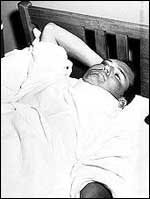
(CORBIS)
A radiologist and an ear, nose and throat specialist from the hospital testified about Dr. Sam’s injuries, as did a dentist. They said he had suffered a fractured cervical vertebra, a swelling at the base of his skull and chipped teeth.
Dr. Charles Elkins, an M.D. who had been chief neurologist at Cleveland’s noted City Hospital, testified Dr. Steve had asked him to examine Dr. Sam as an outside expert. He testified to the absence of reflexes and to neck spasms, which he said could not be simulated as evidence he had suffered a spinal cord injury.
Finally, Dr. Sam took the stand. He said he and his wife had never talked about divorce. Then he told the jury first hand about the events of the night of July 3-4. He told how after his arrest police tried for days to frighten or trick him into confessing.
On cross-examination Mahon got him to admit driving with one of his woman patients to a park where they sat in the car and kissed. He admitted going swimming with a woman in Los Angeles and visiting her in her home. He admitted having sex with Susan Hayes over a two-year period. But he vigorously denied killing his wife and injuring himself to establish an alibi.
“That’s absolutely untrue, sir, and I think it’s very unfair, he said.
Two separate witnesses testified they had seen a man with a white shirt and bushy hair near the Sheppard home, but admitted they did not report it till after they read of Sheppard’s $10,000 reward offer. Other witnesses testified that Sam was a man of good character and his marriage was happy.
Bay Village Sergeant Jay Hubach, called as a rebuttal witness by the prosecution, helped the defense by confirming Dr. Steve’s contention that there had been a cigarette in a toilet but it was gone later.
The judge gave each side five hours for summation. Parrino demanded to know “Where was the defendant, what was he doing, during two … long … hours?”
And he said, “If the burglar was in that room and took the time and trouble to strike all those vicious blows on Marilyn, I ask you why the assailant did not use that same instrument, not to hit Sam 35 times, but to strike one single blow against him. A burglar does not want to leave a living witness at the scene of a crime.”
Mahon made much of the bloody pillowcase. And, sarcastically, he told the jury “Be fair to the defendant. Show him the same mercy he showed his victim.”
Corrigan told the jury: “The fact that Sam Sheppard strayed is no proof that he did not love his wife, his child and his home.”
He was bitter about the media coverage and the “trial by newspaper,” adding “If you read a story like this about the People’s Court in China or behind the Iron Curtain it would raise your hair on your head. But this is something that happened in our own city of Cleveland.”
Corrigan charged that Schottke had decided Sam was guilty after spending “two or three minutes in the bedroom of Marilyn and about 45 minutes around the home of Sam Sheppard. … Can you, on that type of evidence, take away his life? Can you, on that type of evidence, take away his freedom?”
The judge read his charge to the jury, which, for the first time, was to be sequestered in a downtown hotel. And, after six weeks of testimony, the trial was over.
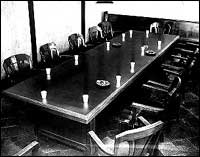
Sheppard’s trial (CORBIS)
The jury began its deliberations on Friday, Dec. 17, and worked through the weekend. By Tuesday, four days before Christmas, lawyers on both sides were starting to make plans for a second trial.
Then, after 100 hours of deliberation, the jury sent word: It had reached a verdict.
It found the defendant not guilty of murder in the first degree — Sheppard felt a momentary flash of elation — but guilty in the second degree.
Blythin asked the defendant if he had anything to say. Sheppard told him, “I would like to say, sir, that I am not guilty and I feel there have been facts presented before this court that definitely have proven that I couldn’t have performed this crime.”
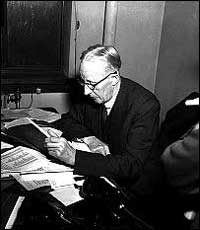
Over Corrigan’s objection, Blythin passed immediate sentence: life in prison.
It turned out the jury had taken 18 ballots. The first, on Saturday, was six to six for conviction, though none favored conviction for first-degree murder, the capital charge.
There was a sharp difference by sex. The men were six to one for conviction, the women four to one for acquittal. By Saturday, the voting was unanimous for conviction, but it took two more days before those favoring a second-degree conviction won over those holding out for the lesser charge of manslaughter.
Sheppard spent Christmas in county jail. On Jan. 7 his mother left a note for Dr. Steve: “I just can’t go on. … Thanks for everything.” They found her with a bullet in her brain.
Eleven days later his father died of a hemorrhaging gastric ulcer. His sons were convinced it was caused by the worry of the previous six months.
Corrigan meanwhile worked on his brief asking a new trial. It was to be the first of a dozen unsuccessful attempts to overturn the verdict.
****
As the millions who watched the O.J. Simpson trial on television are aware, high profile murder cases are full of mistakes by all involved. The U.S. Supreme Court listed numerous errors by Judge Blythin in overturning Sheppard’s conviction in 1966, and the mistakes of the prosecution were evident after the second trial.
But, with 20/20 hindsight, it is clear the defense also made serious mistakes. The biggest appears to be its failure to have its own expert examine the murder house. In their books, Sheppard family members said that was because police refused to turn over the keys to the house until after the trial.
That’s what Corrigan argued in his appeal, but the Court of Appeals noted that he had never asked for the right to conduct an examination. Prosecutors had been quoted in newspapers in early October saying they would allow such an examination if asked. Even if they had balked, the appeals court said, “it is inconceivable that a formal application to the presiding judge in the criminal branch of the Common Pleas Court would not have been granted.”
Corrigan maintained such an examination would have had to be done under the eyes of the police, who would inform the prosecution what it turned up. But if the evidence favored the defendant, that would have been a small price to pay. And, as Paul Holmes noted in his 1961 book, “this too might have been cured through an appeal to the courts for impartial supervision.”
When Dr. Paul Kirk, a nationally known criminologist, was allowed in the house after Sheppard’s conviction, he discovered evidence pointing to Sheppard’s innocence that the second Sheppard jury, 12 years later, found convincing.
The first jury was split evenly on its first ballot and came close to hanging before returning a verdict. Had it heard Kirk’s testimony — and his list of tests the coroner’s office could have made but didn’t — the results might have been different.
Corrigan also failed to sufficiently challenge Dr. Gerber’s claim that the bloody imprint on Marilyn’s pillow appeared to be from a surgical instrument. At the later trial Gerber was forced to admit he could not produce any surgical instrument which might have caused such an imprint.
Corrigan’s advice to Sheppard not to take a lie detector test was legally sound, even though it would have abated the outcry against him had he passed and could not have been used in court against him if he failed. But, having already fueled public suspicion by rejecting the test, why did he allow Sheppard to testify at the inquest?
He could have denounced it as a circus — as the Supreme Court was later to do — and announced he was ordering his client to assert his Fifth Amendment right to remain silent.
Sheppard’s perjury at the inquest — denying his affair with Susan Hayes — was the most damning event of the summer. As one newspaperman later observed, Sheppard was tried for murder and convicted of adultery.
Public opinion is not supposed to be a factor in a trial, but in the Sheppard case it clearly was, and Corrigan failed to speak up forcefully for his client. Ironically, Sheppard himself got sympathetic treatment in his few newspaper interviews.
But Dr. Steve, who alienated reporters, largely kept him from the press. Sheppard quickly lost the battle in the court of public opinion, which reached its own verdict long before the trial. An able lawyer, Corrigan never learned how to use the media.
That’s a criticism nobody ever made of the lawyer who was to succeed him. But then, in 1954 F. Lee Bailey was 21 years old and flying fighter planes for the Marines.
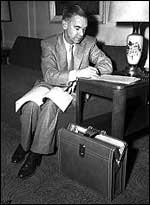
Corrigan’s appeals included a 56-page affidavit from Dr. Kirk — newly discovered evidence which justified a new trial, he said. He maintained that 29 of Judge Blythin’s rulings were errors, and charged that Coroner Gerber was unfair and biased.
He argued that prejudicial pretrial publicity had made a fair trial impossible and the judge should have granted a change of venue, and that the presence of so many reporters disrupted the trial.
In July, a three-judge panel unanimously denied the appeal. Kirk’s report, the ruling said, was not “newly discovered evidence” because his investigation could have been made before the trial.
If Gerber were biased, “cross-examination is the weapon to demonstrate that fact before the jury.” It said a change of venue was within the discretion of the judge and noted the defense failed to use all of its peremptory challenges.
And while it deplored the pretrial publicity — as did all the other courts that reviewed the case — it found no evidence that the jury was not fair and impartial.
“The very foundation of the jury system is founded upon the inherent honesty of our citizens in performing courageously such public service without fear or favor,” it declared.
In April 1956 the Ohio Supreme Court came to a similar conclusion, though two of the seven justices dissented. Justice Kingsley Taft wrote that the trial “was conducted in the atmosphere of a Roman holiday for the press.”
In November the U.S. Supreme Court refused to include the case among the small number of appeals it hears each term. In a rare memorandum opinion on such a ruling, Judge Felix Frankfurter noted Taft’s “Roman holiday” remark and observed that denial of Corrigan’s appeal “in no way implies that this court approves the decision of the Supreme Court of Ohio.”
“It means and means only that for one reason or another this case did not commend itself to at least four members of the court as falling within those considerations which should lead this court to exercise its discretion in reviewing a lower court’s decision.
In other words, it seemed at least one justice thought Sheppard had gotten a raw deal.
****
Corrigan continued to file for writs of habeas corpus on various grounds and continued to lose. Meanwhile, something happened which got little attention at the time.
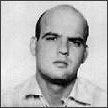
Eberling taken in 1959
(police photo)
In 1959 a window washer named Richard Eberling was arrested for stealing from customers. Among the things he had in his possession was Marilyn Sheppard’s ring. It turned out he had stolen it from Marilyn’s sister-in-law, to whom it had been given after her death. But when police questioned him, Eberling volunteered further information.
He had, he said, washed Sam and Marilyn’s windows days before the murder. In doing so, he cut his finger and he dripped blood down the stairs to the basement, where he washed the wound.
Bay Village police took his statement to John T. Corrigan, the county prosecutor. He showed little interest. Chief Eaton called it to the attention of Gerber, who said he would arrange to have Eberling take a lie test but then changed his mind. That was the last heard of the incident — until 30 years later.
****
Meanwhile, two books talked about the Sheppard case. In 1956 Louis B. Seltzer, editor of the Cleveland Press, published his autobiography, The Years Were Good
Seltzer was known as “Mr. Cleveland.” He had become editor in 1929 and made the paper, in the opinion of thousands of Clevelanders, champion of the underdog. His capacity for moral indignation led the Press to undertake crusade after crusade, and his talent for hard-hitting editorials made the Press endorsement the key to winning elections in Cleveland. Few Clevelanders were neutral about him; they loved or hated him.
In his book he gave his reasons why the Press on July 20 ran a Page One editorial, “Somebody Is Getting Away With Murder,” the first of the series. “It was a calculated risk,'” he wrote, “a hazard of the kind which I believed a newspaper sometimes in the interest of law and order and the community’s ultimate safety must take.
“I was convinced that a conspiracy existed to defeat the ends of justice, and that it would affect adversely the whole law-enforcement machinery of the county if it were permitted to succeed. Because I did not want anyone else on the Press staff to take the risk, I wrote the editorial myself.
“There were risks both ways. One represented a risk to the community. The other represented a risk to the Press. We chose the risk to ourselves. As editor of the Press I would do the same thing over again under the same circumstances.”
In 1961, seven years after the trial, Paul Holmes published The Sheppard Murder Case. The first two thirds were a balanced account of the trial. In the last third, he expressed his own opinions.
Holmes had not been in Cleveland in the months before the trial. But he recounted how when he arrived the cab driver who took him to the courthouse said, “So you’re here for the trial. There’s a guy who ought to get the chair if ever there was one. He’s guilty as hell and everyone knows it.”
Local reporters were also convinced of Sheppard’s guilt. Holmes’ opinion, after covering the trial and later reading Dr. Kirk’s report, was that “Sam Sheppard did not — could not have — killed his wife.” Sheppard was, he concluded, the victim of “a vicious, all-permeating propaganda buildup against Sam and his family.”
His final verdict: “I saw it all, and for what it is worth I think the whole business robbed luster from American jurisprudence, and is, in its most literal and reverent sense, a God-damned shame.”
He expressed one other opinion, a bitter one after describing the Court of Appeals ruling of the conviction. “So Judge Blythin did not abuse his discretion or commit prejudice, and Dr. Kirk will never be given a chance to interpret before a jury his scientific evidence,” he wrote bitterly.
He was wrong.
When Corrigan died in 1961, the Sheppard family turned to Holmes for help in finding somebody to carry on the fight. Holmes asked Bailey, whom he had only recently met, if he would be interested. Bailey read Holmes’ book about the trial; he reported his reaction to it in his 1971 book, The Defense Never Rests.
“I was furious,” he wrote.
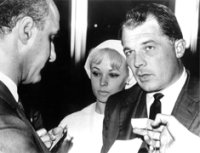
(Cleveland Press)
He flew to Cleveland and met Dr. Steve. The next day the two interviewed Sam in prison. “I’ll charge you a whopping fee,” Bailey told him, “but I’ll help you earn the money to pay for it.”
Bailey’s first move was to try to get a lie detector test — something Sheppard had refused to do seven years earlier but now was willing to try. Bailey needed permission of the governor to do it, and he went to see Louis Seltzer at the Press to seek editorial support.
When Seltzer refused, the brash young lawyer told him, “I’m going to beat you. And when I do, I’m going to hold you up to scorn and ridicule.” Or so Bailey wrote, adding that “Seltzer and his boys” denied the incident happened.
The state refused the lie test. But two young Harvard Law School students hired by Bailey as investigators turned up enough evidence that in April 1963 Bailey filed a habeas corpus motion in federal court.
He charged that Sheppard had been denied his constitutional rights. In particular, he raised the point that had attracted Justice Frankfurter’s attention — the media circus — and the failure of the judge to grant a change of venue or protect jurors from the barrage of prejudicial publicity.
The case was assigned to District Judge Carl Weinman of Dayton, who didn’t begin hearings until January 1964. Bailey’s case got a boost from a chance meeting with columnist Dorothy Kilgallen, who gave him an affidavit that Judge Blythin told her during the trial that it was “an open and shut case.” Asked why, she said he replied, “Well, he is guilty as hell. There is no question about it.”
Blythin had died in 1958, and his defenders refused to believe he would have made such a prejudicial statement, but it weighed heavily with the court.
***
While it wasn’t going to affect the law courts, sympathy for Sheppard was growing in the court of public opinion, helped by Holmes’ book and a number of magazine stories which appeared all over the world — most significantly, as it turned out, in Germany.
Bailey even made an appearance on the Mike Douglas television show, where he demonstrated a lie detector by questioning comedienne Dody Goodman.
The media event that was to have the most effect, however, was a television drama. From 1963 to 1967, The Fugitive kept audiences tuned to the adventures of Dr. Richard Kimble, played by David Janssen. He had been wrongly convicted of his wife’s murder but escaped and was trying to find the real killer — “the one-armed man.”
It was almost universally believed to be based on the Sheppard case, though its creator, Roy Huggins, insisted it wasn’t. When the show was cancelled in 1967, the New York Times suggested it was because its ratings had fallen following Sheppard’s release in 1966. In 1993, The Fugitive was made into a hit movie starring Harrison Ford.
***
On July 16, 1964 — 10 years and 12 days after the murder — Judge Weinman issued a blockbuster ruling. He ordered Sheppard released from prison. “If there ever was a trial by newspaper,” he wrote, “this is a perfect example. And the most insidious violator was the Cleveland Press.”
He found five separate violations of Sheppard’s constitutional rights. “Each of the aforementioned errors,” he wrote, “is by itself sufficient to require a determination that petitioner was not afforded a fair trial as required by the due process clause of the Fourteenth Amendment. And when errors are cumulated, the trial can only be viewed as a mockery of justice.”
Sam Sheppard was a free man. Bailey and Sheppard’s family were waiting for him. So was Ariane Tebbenjohans.
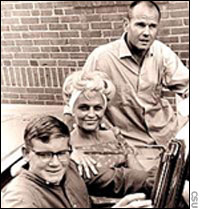
son in a car
If public interest in Sam Sheppard had waned, Ariane Tebbenjohans revived it. Bailey’s description of her outdid the newspapers: “At 33, she was a glamorous blond divorcee easily able to afford mink in the winter and the Riviera in the summer.”
Bailey first heard of her when she sent him a letter with 1,000 marks — about $250 — for the fight to free Sheppard. It was the largest contribution he had received.
Ariane’s indignation about Sheppard’s plight had been roused years earlier by a magazine she picked up in her dentist’s waiting room in Germany. After her divorce from a steel industry heir in 1957, she had begun corresponding with him.
Soon Sheppard was carrying a lock of her hair. In 1963 she received permission to visit him in the Ohio State Penitentiary and flew to Columbus. After a brief trip back to Germany, she returned to the United States to stay. She bought two cars — one for herself and one which she kept ready in a garage for Sam.
When Sheppard was released, he spent his first night of freedom in the Baileys’ Columbus motel suite. Ariane joined them.
The following night the four of them left with Paul Holmes, the Chicago Tribune reporter who had become a Sheppard ally. They didn’t say where they were headed, but they were followed by a cavalcade of 12 cars filled with reporters and photographers.
They managed to lose all but one along the way to Chicago, and that one was stopped by guards when it attempted to follow them into the Tribune parking lot. The others learned about their plans by reading the Tribune. They were going to be married in Chicago; flash bulbs popped when they got their marriage license.
But the others didn’t know where the wedding would be, so there was another movie-style chase through the streets to the Conrad Hilton Hotel, where a magistrate was waiting. They were married in a hotel room with Bailey and his wife as witnesses and Holmes on the phone dictating a running story to a rewrite man back in the city room.
***
Sheppard’s elation was short-lived. In May 1965, a federal appeals court voted 2 to 1 to reinstate his conviction. The count of state and federal judges ruling on his appeals was now 10 to 4 against him. He was allowed to remain free pending his appeal to the U.S. Supreme Court.
In 1956 the Supreme Court had refused to hear Sheppard’s appeal of his conviction in state court. This time the justices agreed to hear the federal case. They set it for trial in February 1968.
Bailey was making his first appearance before the justices. It was a court much more sensitive to rights of defendants than it had been 12 years earlier. Joshua Dressler, a professor at the Ohio State University Moritz College of Law, is an expert on the Warren Court. He believes the 1956 court might well have delivered a fatal blow to Sheppard’s cause.
“In the mid-1950s, not only was the Warren Court not due process-conscious, but even Chief Justice Warren was still feeling out his own views on criminal justice,” Dressler said.”There probably wasn’t the kind of law on the books to cause the court to overturn the Sheppard conviction.”
Now the present justices listened sympathetically when Bailey told them he was not trying to silence the press.”What I mean,” he said, “is that although trial by newspaper represents a serious problem, we have sufficient remedies within the law which were not exhausted in this case without coming to the question of what must be done to silence the press.”
Ohio Attorney General William Saxbe and Cuyahoga County Prosecutor John T. Corrigan argued the trial had been fair. “We have on trial the jury system of the United States,” Corrigan declared.
The Supreme Court delivered its decision on June 6. D-Day.
“The massive, pervasive and prejudicial publicity attending petitioner’s prosecution prevented him from receiving a fair trial consistent with the Due Process Clause of the 14th Amendment.”
With that sentence, Sam Sheppard, after 12 years — 10 of them in prison — was legally an innocent man
Justice Tom Clark read on: “Despite his awareness of the excessive pretrial publicity, the trial judge failed to take effective measures against the massive publicity which continued throughout the trial or to take adequate steps to control the conduct of the trial.”
Speaking for eight of the justices — all but Hugo Black — Clark listed a litany of errors. He said Blythin should have postponed the trial or moved it to a county “not so permeated” with publicity.”
He noted that, weeks before the trial, newspapers published the names and addresses of those called for jury duty. “As a consequence, anonymous letters and telephone calls, as well as calls from friends, were received by prospective jurors.” The jurors were “thrust into the role of celebrities.”
Witnesses and jurors alike “ran a gantlet of reporters and photographers every time they entered or left the courtroom.” Although Blythin barred witnesses from the courtroom, “during the trial the full verbatim testimony was available to them in the press. This completely nullified the judge’s imposition of the rule.”
One end of the press table was less than three feet from the jury box. The presence of reporters inside the bar “precluded privacy” between Sheppard and his attorneys. (Clark liked alliteration, witness “pervasive publicity attending petitioner’s prosecution prevented….”
The media carried rumors such as Walter Winchell’s broadcast that a New York woman said she had borne Sheppard’s child. They carried stories about damaging testimony that supposedly would be presented but never was, such as evidence that Sheppard had affairs with various women and that Marilyn had told people he was a “Jekyll-Hyde.”
Even if Blythin hadn’t sequestered the jury, the opinion said, he should have given jurors stronger warnings than “I would suggest to you and caution you” not to read or listen to coverage because “I am sure we will all feel much better.”
And when Corrigan objected that jurors had heard the Winchell broadcast Blythin should have done more than say, “Well, even so, Mr. Corrigan, how are you ever going to prevent these things in any event?”
The justices’ opinion accepted the Dorothy Kilgallen claim that the judge had told her Sheppard was “guilty as hell” and the defense contention that Coroner Gerber had said on the morning of the crime, “Well, men, it is evident the doctor did this, so let’s go get the confession out of him.”
trial. (Cleveland Press)
And, counter to the statements of law enforcement officials and newspaper editorials, it declared: “Sheppard made himself available for frequent and extended questioning without the presence of an attorney.”
The opinion went on for 11,000 words. At the end it directed the District Court to order “that Sheppard be released from custody unless the state puts him to its charges again within a reasonable time,” and with the ring of finality with which the Supreme Court, speaks, it concluded:
“It is so ordered.”
Sam Sheppard was free. Sam Sheppard was innocent — until proved guilty. Now he faced another trial. It could happen again.
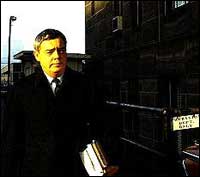
Francis Talty, the Cuyahoga County Common Pleas Court judge assigned to the second Sheppard trial, was determined to avoid Blythin’s fate. He issued a set of orders which met the criticisms of the Supreme Court and then some.
There were to be no cameras on the premises of the court building and not even sketch-makers in the courtroom. No press table inside the bar. No room for radio equipment. No freedom to move about the courtroom — nobody could enter or leave while court was in session. No statements to the press by lawyers or witnesses.
He cut the number of benches for spectators and reporters to three — 42 seats. And he determined which media would be given seats. There were four for the two Cleveland newspapers (the News had folded in 1960), eight for local radio and TV stations and one each for the Associated Press and United Press International. There were none for out-of-town newspapers, for national publications or for television networks.
The media were upset at the order, which threatened to set an ominous precedent. But, still smarting from their tongue-lashing by the Supreme Court, they didn’t challenge it.
Paul Holmes was back, having retired from the Chicago Tribune a few months earlier. Now he was both an author planning a sequel to The Sheppard Murder Case and a member of Bailey’s investigative team.
Even though Holmes was a lawyer, Talty refused to let him sit at the trial table because of his former newspaper connection. Unofficially, though, Holmes, along with a Columbus reporter and backup reporters from AP and UPI, was allowed to sit in the seats supposedly reserved for spectators.
Leo Spellacy assisted County Prosecutor Corrigan (no relation to William Corrigan, Sheppard’s first lawyer). Bailey was assisted by Russell Sherman of nearby Elyria. Bailey opened the proceedings with a motion for a change of venue. Talty might have played it safe and granted it but, like Blythin before him, he said he would wait to see if a jury could be empanelled.
As in the first trial, it was done quickly. Seven men and five women, plus three alternates, were seated — and then given the news they would be sequestered in a downtown hotel for the duration of the trial. A bailiff would monitor their phone calls and their only news would come from newspapers from which stories about the trial had been clipped.
****
On Nov. 1, 1966 — 16 days short of 12 years after the first trial — the State of Ohio vs. Sam Sheppard began again.
Prosecutor Corrigan’s brief opening statement was notable for what he did not mention — no faked injuries, no “surgical instrument” and, most striking, no Susan Hayes or talk of divorce.
Bailey raised eyebrows when he told the jury, “You will be satisfied that Sam Sheppard did not kill his wife and you will have a pretty good idea who did.” Earlier, he had dropped hints the real killer was a left-handed woman.
(CORBIS)
Deputy Coroner Lester Adelson, who had spent two days testifying in the first trial, was on and off the stand in less than an hour. Before the first day was over, Corrigan had also disposed of Spencer and Esther Houk, Doris Bender (the woman who had noticed lights on in the house in the early hours) and Fred Drenkhan, who since the first trial had become Bay Village police chief.
There was nothing unexpected in their testimony, but some of Bailey’s questions took a new tack. In answer, Spencer Houk denied he had ever been in Marilyn’s bedroom or been given a key to the house.
And Esther Houk — now Spencer’s ex-wife — recalled lighting a fire in the fireplace on the fateful July night — she said it was chilly — and conceded it was possible to get from the Houk home to the Sheppard home by walking on the beach.
When Drenkhan told of questioning Dr. Sheppard, he said, “We then asked him if he had any extramarital affairs and he said the only one he had was with Susan Hayes.” Bailey jumped to his feet with an objection and Judge Talty ordered the answer stricken.
When Detective Schottke testified the next day, he read Sheppard’s July 10 statement to police in which he had denied having an affair with Susan Hayes and said they were just good friends. It was the last mention of her during the trial and the only one that survived into the official record.
Nancy Ahern, the dinner guest, testified but was not asked about Marilyn’s talk of divorce. (Its admission in the first trial was criticized as hearsay by appeals courts.)
Dr Gerber, the star witness of the first case, was more subdued this time. He avoided using the words “surgical instrument” in talking about the bloody pillowcase — only “There was an outline or impression of some object in the stain.”
Bailey wouldn’t let it drop. On cross-examination he got Gerber to say the instrument was “similar to a pair of pliers — or a surgical instrument.”
Bailey jumped on that and got Gerber to admit “I hunted all over the United States for an instrument that would fit” but couldn’t find one. It was a point William Corrigan had failed to press in the first trial.

(CORBIS)
Mary Cowan, the coroner’s medical technologist, came up with the only new prosecution contention. She said the blood on Sheppard’s wristwatch was not from contact with a wound but was caused by blood in motion — spattering blood. That had to mean Sheppard was there when she was beaten to death.
The prosecution rested after nine days. On Nov. 10, Bailey called his first witness, Jack Krakan, who in 1954 had been the Sheppards’ “bread man.” In those days bakeries and dairies delivered to homes, and Krakan worked for the Spang Baking Co.
He said that twice he saw a “distinguished- looking” man in the Sheppard home whom he assumed to be Dr. Sheppard until he observed Marilyn giving him a key with the admonition “Don’t let Sam see this.”
Bailey didn’t follow up on that during the trial; later, he wrote that the judge wouldn’t let him introduce the evidence he wanted to produce.
It was time for the star defense witness. In the first trial the jury was impressed by the scientific testimony of detectives and Cowan; William Corrigan presented no expert witness to rebut it. This time Bailey called Dr. Paul Kirk, the nationally known criminologist who had examined the Sheppard house after the first trial.
Carefully retracing his steps, he explained his conclusion that one blood spot was from someone other than Sam or Marilyn and that the killer was left-handed. He offered as his expert opinion that the blood on Sam’s watch came from touching the body, presumably when he felt for a pulse.
The closing arguments came Nov. 15. Corrigan held up the watch to the jury. “This watch tells more than time,” he said. “It tells who the murderer of Marilyn Sheppard is.”
He graphically described the brutal murder, creating an imaginary bed and flailing the air with his arm as he imitated the killer striking Marilyn “over — and over — and over.”
Bailey also described the killer: “Somebody had an awful hate for Marilyn,” he said. “Somebody had hate this defendant could never have known —and that person spread that hate around Marilyn’s room in her blood.
The story the murder room had to tell went unheard because nobody listened to it,” he said. “Society has given Sam Sheppard a promissory note and it is payable now.”
****
The jury began deliberations after lunch on Friday, Nov. 16. Sheppard and his lawyers waited nervously. The jury went to dinner and came back to the jury room. The wait continued.
At 9:20 Judge Talty called the lawyers to come to his courtroom while he dismissed the jury for the night. At 9:30, as they were on their way, the jury buzzer rang in the courtroom. A bailiff brought the judge a note: “We have a verdict.”
The judge wasted no time in reading it: “We the jury duly empanelled in the above case find the defendant not guilty.”
Sheppard started to jump to his feet, but his lawyers restrained him until the judge left the courtroom. Now Sam jumped to his feet and shouted “I want my wife!” — just as a fictional Rocky, 10 years later, was to stand in the ring shouting “Adrienne!”
Jurors revealed that their first ballot had been seven for acquittal, four for conviction and one undecided. Gradually, the minority — mainly older jurors who remembered their first impressions of the case — gave way. The jurors said they thought the police investigation had been sloppy and they were troubled that the prosecution hadn’t suggested a motive why Sam would kill his wife.
After the trial, Bailey revealed in a letter to Bay Village police what he had been unable to present at the trial. He said Jack Krakan, the bakery driver, had seen Spencer Houk kissing Marilyn Sheppard.
He also said Sam had been examined under hypnosis and remembered feeling his neck crushed under someone’s foot and hearing someone talk about whether to kill him. He said the person walked with a limp — as did Spencer Houk.
A grand jury called witnesses, including the Houks, but declined to bring charges.
The case made Bailey’s reputation. The reversal of the first conviction showed him to be a legal strategist well versed in the law. The second trial showed him to be a brilliant trial lawyer.
Thus, people assumed his decision not to have the defendant testify was merely an astute appraisal of the way the case was going in The Defense Never Rests, written after Sheppard’s death, Bailey revealed the real reason. His client had deteriorated badly since his release under the influence of “booze and pills.”
Bailey told Sheppard he wouldn’t put him on the stand because he had already told his story over and over and the prosecution could take potshots at him.
“Both these arguments were legitimate,” he wrote, “but the real reason was his condition. Hardly anybody knew it, but during the trial there were times when Sam was unaware of what was going on around him. I couldn’t let him take the stand.”
Sheppard’s life went quickly downhill. Readmitted to the practice of medicine, he was sued for malpractice in the death of a patient. In 1968 Ariane filed for divorce, saying that under the influence of alcohol and drugs he had stolen her money, threatened her and thrown empty bottles at her.
for his wrestling match
(CORBIS)
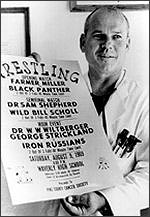
He moved to Columbus and for a while appeared as a pro wrestler, featuring his “nerve hold,” which he had supposedly learned as a neurologist. In 1969, he and Colleen Strickland, the 20-year-old daughter of his wrestling manager, announced they had been married on a motorcycle trip to Mexico.
No documentation of the marriage was found after Sheppard died, but Colleen wouldn’t have inherited anything anyway; he was insolvent.
On April 6, 1970, Samuel Holmes Sheppard was found dead in his and Colleen’s home. The cause was ruled liver failure; he had been drinking as much as two fifths of liquor a day.
Twenty-five years later, a book co-authored by his son put it more kindly: “Medical terms don’t fully capture what killed Dr. Sam. He really died of a broken heart and a spirit that found no solace.”
****
What of “Chip” — or, as he preferred to be called as an adult, Sam Reese Sheppard? Reese was Marilyn’s maiden name, so the name commemorated both of his parents.
He had been raised by his Uncle Stephen and his wife, living as normal a childhood as a child can live knowing that people are whispering “That’s the son of the doctor who killed his wife.” Even as a teenager at Culver Military Academy, he knew the whispers went on. He and his father wrote regularly, and he visited Sam Sr. in the penitentiary as often as he could. He indignantly rejected suggestions that he change his name to avoid being identified with the family stigma.
He was a junior at Culver when his father was freed and afterward went to live with him briefly. At Bailey’s suggestion, he entered Boston University and lived with Bailey’s family, though he returned for a brief appearance at the second trial.
That was mainly to show the jury that he believed and supported his father, though he knew what the jurors didn’t: that his father was deteriorating mentally and physically.
After Dr. Sam’s death, young Sam slipped willingly into obscurity. As a dental technician in Boston, he refused to talk about the bad memories and, as much as possible, think about them. But in 1979 he was moved by Norman Mailer’s book “Executioner’s Song,” about the execution of Gary Gilmore in Utah.
Then, in 1985, he happened on a newspaper photo: The children of Charlie Brooks were standing outside the fence of a Texas prison where their father awaited execution. What he felt comes through even in the wooden prose of his co-author: “Sam R. knew that it could have been his dad who was sentenced to die. … The terror of Brooks’s sons swept through Sam R.”
He became active in a group of families of murder victims who opposed the death penalty. In 1989 he spoke out publicly at a rally in Albany.
The director of the Cleveland City Club, Alan Davis — his father’s lifelong friend — invited him to speak at the club’s nationally broadcast City Club Forum in October. He accepted.
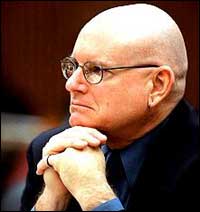
At the age of 42, he was coming home. Not to the city where he could never feel comfortable, but to the cause which would become his life work.
“The Fourth of July, at dawn,” he began his speech, “my mother lay dead, just down the hall from me as I lay asleep. On the shore of the lake below our house, my father lay half in and half out of the water, viciously knocked unconscious.”
Later, he said, “My father sat in the Cuyahoga County Jail, weathering one of the most potent blitzes aimed at any one individual by the news media in modern times.”
Noting that the state originally sought the death penalty, he said his father’s death would have killed him too. “I feel it, and I will feel it for the rest of my life, how close we came to death — my father and I — 35 years ago in this city.”
Now, he said, law enforcement authorities were once more “dragging their feet” in finding the real story of what happened July 4, 1954. They were not pursuing leads about the connection of someone who had recently been convicted of another murder. “I have reason to believe this individual conspired with others in the murder of my mother,” he said.
He did not use a name. Those in the audience who had been reading the papers knew who he meant.
The window washer.
Richard Eberling.
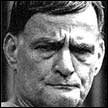
Richard Eberling had come far since his 1950s days as a window washer and petty thief. By the 1970s he was a patron of the arts, welcoming public officials and society leaders to lavish parties in his showplace home.
His taste was such that Cleveland Mayor Ralph Perk put him in charge of a $100,000 renovation of the mayor’s suite in City Hall. By the late 1980s, Eberling was living on Lookout Mountain in Tennessee in a 27-room mansion stuffed with works of art.
And then, one day in 1987, police in the Cleveland suburb of Lakewood got a call from a woman who said she wanted to let them know about a forged will.
Eventually, Patricia Bogar told them more. She had helped Eberling and his long-time companion, O.B. Henderson, forge a will naming Eberling as the heir of Ethel Durkin, an elderly Lakewood widow for whom he was caretaker.
Durkin died in January 1984 as the result of what was ruled — without an autopsy — an accidental fall. Her relatives were shocked to learn she had left 70 percent of her $1.5 million estate to “Dearest Richard, a gentleman who was to me the son I always wished for.”
Under questioning, Bogar revealed she had also helped Eberling stage a series of phony burglaries, including one of her own home, to collect insurance. Her reason for blowing the whistle: Eberling had failed to come through with her promised share of the Durkin estate.
Beverly and Dale Scheidler, who had witnessed the signature of the will, confessed to their part in the scheme, and during a lie detector test, Beverly Scheidler broke down: She revealed that Durkin’s death was actually caused by Eberling.
Police went to the Tennessee mansion where Eberling was living with Henderson and found it filled with antiques, oriental rugs and figurines — all stolen. Eberling had even stolen a painting from City Hall and passed it off as a portrait of his uncle.
toupee after arrest
(AP)
Eberling denied killing Durkin, but when her body was exhumed the coroner examined the injuries and proclaimed the death a homicide. In July 1989 Eberling and Henderson were convicted of Ethel Durkin’s murder and sentenced to life in prison.
So the man who admitted dripping blood in the Sheppard home two days before the murder was actually a murderer himself. Reporters began digging into Eberling’s background — but, young Sam noted bitterly, law enforcement officials didn’t.
After his City Club speech, young Sam took some time for a pilgrimage: He visited his father’s grave near Columbus and, while he was in the city, went to the old Ohio Penitentiary, now closed, where as a boy he used to visit his father.
When he got back home to Boston, he found a letter waiting for him — from Lebanon Correctional Institution in Ohio.
It was from Richard Eberling.
“Sam, yes I do know the whole story…,” it said.
****
Young Sam and Cynthia Cooper, an investigator who was to join him later, wrote about what happened in the 1995 book Mockery of Justice. The title is taken from Judge Weinman’s ruling freeing Dr. Sam in 1964. In the book he is called Sam R. or “young Sam,” though by 1995 he was 48.
In the exchange of letters that followed the first one, Eberling told stories about the Sheppard family, such as a time when, he wrote, Marilyn asked Eberling to keep an eye on young Sam and his cousin while she went out. He sent a very accurate diagram of the rooms in the Sheppard house.
With poor spelling and punctuation, he teasingly hinted of his inside knowledge: “The true facts of Marylin Sheppards’ murder have remained a secret to the public, reason being it could injure the reputations or careers of living persons. My reason for speaking out now. Is to help her son understand what happened.”
Finally, young Sam went to see Eberling in prison. Over the next five years, Eberling would meet nearly a dozen times with Cooper and send over 230 pages of letters. The story he told was an amazing one:
Marilyn Sheppard, he said, had been killed by Esther Houk. Sam Sheppard and Spencer Houk together staged a cover-up.
He told of coming to wash the Sheppards’ windows on the morning of July 2 and being invited by the doctor and his wife to have a sweet roll with them in their kitchen. Five minutes later Spencer Houk walked in carrying a package of meat from his butcher shop, put it in the Sheppards’ refrigerator and, after some small talk, left. Sam then left.
While Eberling was washing windows, he heard a voice from another room. It was Esther Houk’s, and she screamed “If you don’t leave him alone, I’ll kill you.”
He said Marilyn took Esther downstairs and gave her a cup of tea. Later, Marilyn told Eberling that Esther was on medication and had been drinking, but was really “a sweet gal.”
Later she served him lunch. She complained her husband was a workaholic and said Esther was upset because she had seen Spencer come to the Sheppard house in the morning. She said she would have to stop having her meat delivered.
It was that afternoon, Eberling said, that he cut his finger and dripped blood while going to the basement to wash it off.
There was more: Spencer Houk was actually gay, Eberling said, and Sam was bisexual. Esther thought her husband was having an affair with Marilyn, while actually he was having an affair with Sam.
After the murder, Eberling said he was washing windows at the home of Dr. Richard when Sam came in. Eberling offered his condolences then told him about Esther’s threat. Sam’s reply: “Don’t let that be a problem. It’s all taken care of.” He added: “Richard, leave it alone!”
Eberling said he took that as an order, and didn’t mention it to police or anybody else.
Years later, in 1969 or ’70, after Sam’s acquittal at his retrial, Eberling said, he ran into Sam at a local delicatessen. Sheppard told him to sit down and they talked for 40 minutes.
“Dr. Sam told me who murdered Marilyn,” Eberling said.
Here’s what really happened on the night of July 3, 1954, as Richard Eberling said Sam Sheppard related it to him 15 years later and as young Sam reported it in Mockery of Justice in 1995:
“Spen came over after the Aherns left. Esther was half-bombed. Esther snuck over. Sam went to sleep. Spen gave a hug. [Apparently to Marilyn; the quote isn’t clear]. Esther just went wild.”
When Sam awoke, he went on, it was Esther who was upstairs yelling “Help me!” She fell into Sam’s arms, saying she had gone temporarily insane and suddenly realized what she had done. Sheppard felt sorry for her. Houk talked Sheppard into a cover-up and Sheppard went along.
In the next couple of hours Houk got rid of the murder weapon — a “patty shell iron” from Esther’s kitchen — and burned her bloody clothes in his fireplace (Hence Bailey’s question about the fire at the second trial) while Sheppard faked the burglary, never realizing he was setting himself up as a suspect.
Sheppard had told him the story, Eberling said, because he was an old friend and because he had kept quiet about Esther’s threat to kill Marilyn.
****
It was a wild story. But it did nicely tie together some things that had never been adequately explained. And it could have accounted for Houk’s reluctance to arrest Sam when Cleveland police demanded it.
What’s more, it seemed to tie in with rumors, which had been prevalent in Bay Village. Later, when young Sam established a telephone number for people to call with tips about the case, Houk was mentioned by caller after caller: “I think the mayor did it. …” “The mayor at Bay Village, he killed her, I have no doubt….” “I was a friend with a man who was a part-time policeman. The feeling of the police was that the mayor was a prime suspect.”
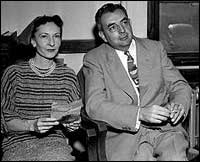
The Houks had been Lee Bailey’s suspects in the second trial, though the grand jury had looked into the facts after Sheppard’s acquittal and declined to take action. Young Sam took the suspicions seriously enough to develop two scenarios, which are laid out in the book.
Scenario 1 has Houk seeing the light on in the Sheppards’ dressing room — a “signal” that Sam is not home — and sneaking over, not realizing Sam is asleep downstairs. He awakens Marilyn, who screams. Houk panics and begins to hit her with a flashlight or screwdriver. Sam runs upstairs and Houk knocks him out.
Houk runs down to the stairs to get to his house along the beach. Sam catches him and he knocks him out again and leaves him lying in the shallow water. When Sam calls him at 6 a.m., Houk is amazed he is still alive and pretends he has no idea what happened.
Scenario 2: Houk sneaks over to Marilyn’s bedroom. Esther trails him, armed with a weapon. Esther dashes into the room and begins beating Marilyn. Marilyn cries out.
Sam runs into the room and Houk knocks him out. The Houks fake the burglary. Esther, a smoker, forgetfully throws a cigarette into the toilet. When Sam comes to, he doesn’t see Esther and chases Spen down the stairs and onto the beach.
Young Sam weighed the scenarios — and decided there was a better suspect.
****
Young Sam had trouble believing Eberling’s claim that his father was homosexual. His book notes that, if anything, “his overagressive heterosexuality seemed to be what had caused so much difficulty.”
Problems with Eberling’s version quickly came to light. He said Bay Village police had questioned him about the Sheppard murder in 1954; police had no record.
He described himself as such a good friend of Sam Sheppard that Sheppard confided in him alone the story of the murder. Sheppard relatives said Sam was usually at work when Eberling came to clean windows and may not even have known him.
Eberling’s story changed as he repeated it over and over. Bay Village police listened to it and said they doubted it.
Then young Sam got a letter from a man named Vern Lund, who said he wanted to tell him something before he died.
Lund was now dying of cancer, but he said in 1954 he worked for Eberling’s company, Dick’s Window Cleaning, and that on July 2 it was Lund, not Eberling, who came to wash the windows. Eberling was not in the house.
Lund repeated his story to Cynthia Cooper in a videotape and signed an affidavit to its truthfulness before he died.
****
photo (AP)
Prosecutors and Cleveland police still showed no interest in Eberling, but reporters did, especially Cindy Leise of the Elyria Chronicle-Telegram.
Her Page One five-part series revealed another trail of blood — a long string of suspicious deaths: suspicious deaths which had marked Eberling’s path.
What’s more, it included an interview in which Eberling said, as the headline put it, “I Know Who Killed Marilyn Sheppard.” He would not expand on the statement except to say it was someone who lived nearby.
Both Young Sam and Dr. Steve told Leise they did not believe Eberling’s boast. Dr. Steve, however, did say something that would be significant in view of Eberling’s interview with Young Sam six months later.
He said that Eberling was homosexual; police thought that too, though Eberling vigorously denied it. And he said his brother might have been bisexual, that womanizers (which he seemd to concede Sam was) were sometimes also homosexual. He called it “the Don Juan complex.”
Other reporters jumped on the story, as did Cynthia Cooper, a New York lawyer and author who became an investigator for the Sheppards and later co-authored Mockery of Justice with him.
Here’s what they turned up:
Richard Eberling had been born George Lenardic in 1929. His unmarried mother abandoned him at birth. He was raised by a series of foster families.
His last foster father, George Eberling, died in 1946 when he swallowed poison which had somehow wound up next to the cough syrup he thought he was taking.
George Eberling had refused to adopt Richard Lenardic, but after his death Richard legally changed his name to Eberling and became caretaker of his foster mother, Christine Eberling — just as he would later become caretaker of Ethel Durkin. When Christine died, her children discovered Richard had obtained title to most of the family farm.
His connection with the 1954 murder of Marilyn Sheppard didn’t come out until 1959, when he was arrested with her ring among other items he had stolen from his window washing customers. That was when he volunteered to police that he had dripped blood in the Sheppard home two days before the murder.
In 1959 a girlfriend, Barbara Ann Kinzel, was killed in an auto accident in which Eberling, the driver, was not injured. Strangely, she had been a nurse at Bay View Hospital at the time of the Sheppard murder.
In 1962 Myrtle Irene Fay, Ethel Durkin’s sister, was strangled and smothered in her Cleveland apartment. It went as an unsolved homicide. In 1970, Sarah Belle Farrow, Ethel’s other sister, died in a fall at the Durkin home in what was ruled an accident.
Both had disliked Eberling and tried to get Ethel to fire him, but no one saw any reason to be suspicious — at least until after Ethel’s “accidental” death was changed to homicide.
In 1996, publicity about Eberling brought forward a woman named Kathie Collins, who had been a night nurse for Ethel Durkin. She said that in 1984, on a night when she and Eberling had both been drinking heavily, Eberling asked her, “Have you ever heard of Marilyn Sheppard?” and said he killed her, adding “The bitch bit the hell out of me too, but I got her ring.”
Collins said that when she told the story to her mother, her mother said, “Don’t worry about Dick. He’s a crazy fag.”
So she didn’t tell anybody else. In 1989, when the case was back in the news, she said she tried to tell a Cleveland detective. He brushed her off.
****
Young Sam now had a cause — proving that his father was more than just “not guilty,” as the second jury had found, but that he was innocent — that he could not have killed his wife and young Sam’s mother.
The second jury in 1966 had declared Samuel H. Sheppard legally not guilty. That wasn’t good enough. Certainly not in Cleveland, where most people old enough to remember the case believed the first jury had gotten it right.
Determined to prove his father was not only not guilty but innocent, Sam Reese Sheppard kept looking for evidence. In 1993 he got a big boost when officials of AMSEC became interested in the case. The Washington area investigative firm worked mainly for large corporations, but it agreed to send professional investigators to help Sheppard.
They soon hit paydirt.
Among exhibits from the trials they found a small vial with a tiny sliver of wood inside. It was State Exhibit 84, a wood chip with blood on it — a part of the “trail of blood” down the stairs. It had attracted little notice at the trial but, they realized, it was something that in 1993 could be tested for DNA.
They also turned up a man named Ed Wilbert who, like Vern Lund, had worked for Eberling’s window washing company. Contrary to Eberling’s description of himself as almost a member of the Sheppard family, Wilbert said Marilyn Sheppard had caught him stealing and disliked him.
Wilbert also said that when the Sheppards weren’t home they would leave an outside basement door unlocked for the window washer.
John T. Corrigan had retired in 1991 and been replaced by Stephanie Tubbs Jones, the first black and first woman county prosecutor. Hoping that she would have a more open mind than Corrigan, AMSEC prepared a 160-page report and Terry Gilbert, the lawyer now representing the family, took it to her with a request that her office reopen the investigation.
It was a hot potato, but after studying the report for months Tubbs Jones agreed to cooperate with the Sheppard investigators.
In 1954 and 1966 prosecutors were not required to turn over to the defense “exculpatory” evidence — something that might help the defense case. That was one of the defendants’ rights established by the Supreme Court afterward.
Now the investigators discovered that among the police evidence never introduced at trial was a plaster impression of a freshly made tool mark in a door at the foot of the basement stairs. The detective’s report said it “appeared to have been made by a chisel or wedge-like tool.”
A key prosecution contention in both trials had been the lack of evidence of forcible entry into the house. A key defense contention had been that police made no attempt to pursue evidence that might have cleared Sheppard. An AMSEC investigator called the suppression of the tool mark evidence a “smoking gun.”
****
In October 1995, Gilbert filed suit on behalf of Alan Davis, administrator of Sheppard’s estate. It asked Cuyahoga County Common Pleas Court to formally declare Sam Sheppard innocent — not just not guilty — of the murder of his wife.
The petition declared: “The evidence will show that Eberling had the motive, opportunity, identity and access to kill Marilyn Sheppard” and that Dr. Sheppard “could not have murdered his wife, had no reason to murder his wife and was a victim of a misdirected, overreaching prosecution.”
A victory in the suit would clear the way for the Sheppard family to sue for wrongful imprisonment and collect payment — possibly millions of dollars, given the income he lost during his years in prison. Newspapers gleefully looked forward to the “third Sheppard trial.”
In February 1996 Gilbert won a court order for Eberling to provide a blood sample so that his DNA could be tested against the blood on the stairs of the Sheppard home and other evidence from the murder scene.
With modern techniques, the blood from the stairs could also be tested against Marilyn’s DNA, taken from a sample of her hair preserved as evidence, to test the prosecution contention that that it was her blood dripping from the murder weapon. Gilbert’s experts also believed they had Sam’s DNA, taken from stamps he had licked in sending love letters to Marilyn before their marriage.
Dr. Mohammed Tahir, a forensic scientist from Indianapolis, ran extensive tests on the samples. In February 1997 he presented his findings.
The blood on the stairs was not Marilyn’s. That meant it hadn’t dripped from the murder weapon, as police believed. But it could have come from the killer, who Dr. Kirk theorized had been bitten by Marilyn.
The blood apparently was not Dr. Sam’s, though it was difficult to tell because the saliva from the stamps had been contaminated. This was not a surprise: There was no indication Sam was bleeding on the murder morning.
The DNA was consistent with Richard Eberling’s DNA, a type believed to be shared with only a small percentage of the people in the world (Dr. Tahir would not estimate the percentage; figures quoted in news stories have varied widely).
This was not a surprise to the extent that Eberling had volunteered to police after his 1959 arrest that he had cut his finger while washing windows in the house shortly before the murder — an account contradicted by Vern Lund’s dying declaration. But it did establish, if Dr. Kirk’s theory was correct, that Eberling’s DNA was consistent with the killer’s DNA.
The most surprising finding was that testing of seminal fluid taken from Marilyn with a vaginal swab in 1954 showed DNA which matched Eberling’s. News reports said there also appeared to be DNA from semen of a second man.
Carmen Marino, the first assistant prosecutor who was a holdover from the Corrigan administration, said he personally had become convinced Sam Sheppard was not guilty. But the office was in a bind; besides its duty to prosecute criminals, it also represented the county in civil matters. It filed motions challenging young Sam’s right to bring an action, especially 25 years after his father’s death.
While the suit slowly made its way through the courts, young Sam, who was now living in Oakland, Calif., had his father’s body exhumed so that a conclusive comparison of DNA could be made. When Sam was reburied, it was next to Marilyn, her family having resolved its doubts about Sam’s connection with her death.
****
In June 1997 Cuyahoga County Common Pleas Judge Ronald Suster overruled the objections of the prosecutor’s office and set the suit for trial. The prosecutor’s office appealed.
In January 1998, the Ohio Supreme Court heard oral arguments and took the case under advisement, indicating it would rule in the spring. The following month Judge Suster filed as a candidate for the Supreme Court seat of Justice Paul Pfeiffer.
In March, more than a year after Dr. Tahir’s first DNA report, lawyer Gilbert called a news conference to release his latest findings.
Dr. Tahir repeated that the blood on the stairs could not have been Marilyn’s but could have been Eberling’s.
Having Sam’s DNA, he could now say the blood on Sam’s pants — which had been assumed to be Marilyn’s from when he bent over to take her pulse — did not match Marilyn’s but did match Eberling’s.
He now said the DNA in the semen appeared to match a combination of Eberling’s and Sam’s. Sam had told his lawyers before the first trial that he and Marilyn had sex on Friday night, a little more than 24 hours before the murder.
And Dr. Tahir had a surprise: A recent search had turned up additional blood samples saved by Dr. Kirk in 1954. One of them was from the spot which Dr. Kirk said appeared to be the killer’s blood, having flown off his hand as he yanked it — along with two teeth — from Marilyn’s mouth.
He said it appeared to be a combination of Marilyn’s and Eberling’s.
However, this was the blood that Dr. Kirk had said was Type O. Eberling’s was Type A positive. If Dr. Tahir was right, the Sheppard’s original expert must have been wrong. Dr. Tahir’s contention was that DNA typing is more accurate than A-B-O blood typing and that the latter was in its infancy in 1954.
Also, Dr. Tahir conceded, the evidence was old and might have been contaminated. That appeared to cast doubt on its admissibility in court. In addition, there might be a problem establishing the “chain of custody” documenting that the recently found sample was the same sample taken by Dr. Kirk in 1954.
Pointing out that the DNA samples were all consistent with Eberling’s DNA, Gilbert called on Prosecutor Tubbs Jones to reopen the investigation of Marilyn Sheppard’s murder, still unofficially an unsolved crime.
She refused, attacked the DNA findings as inadmissible and accused Gilbert of holding the news conference to influence the Ohio Supreme Court. “Shame on you, Terry Gilbert,” she said.
****
Spring turned into summer with no ruling from the Supreme Court. Then, in July, Justice Pfeiffer suddenly announced he was recusing himself — withdrawing from the case — because it involved a ruling by Suster, his opponent in the November election.
That meant an acting justice must be appointed, further delaying the decision. Pfeiffer did not say why he had waited five months after Suster announced his candidacy to withdraw.
However, in a column in the Cleveland Plain Dealer, Brent Larkin reported what purported to be the inside story, though he gave no sources whatever.
He said the Supreme Court had taken a straw vote on the case shortly after the January hearing and it was 4-3 to affirm Suster’s ruling and let the case go to trial. Chief Justice Thomas Moyer appointed justices to write the majority and minority opinions.
Pfeiffer was one of the three who voted to reverse Suster. But since he was on the losing side, he saw no need to withdraw when Suster announced his candidacy the following month.
But when the draft opinions were circulated, one of the four judges in the majority was so impressed by the minority reasoning that he switched sides. That meant the vote was now 4-3 to overrule Suster and throw out Gilbert’s attempt to have Sheppard declared innocent.
Pfeiffer had now cast the deciding vote. (Of course, the same thing could be said about three of his colleagues.) He might even, Larkin noted, have been the author of what was now the majority opinion in a politically explosive case. He withdrew.
****
On July 25, Richard Eberling died in prison at the age of 68. He was subsequently reported to have told fellow inmates that (1) Sheppard had hired him for $1,500 to kill Marilyn but didn’t pay him after he did it; (2) he raped and killed Marilyn, wearing a wig so as not to be recognized by Sheppard, and when Sheppard came to her aid knocked him out twice; (3) Esther Houk killed Marilyn and Spencer Houk and Sheppard covered up for her — the same story he told Sheppard’s son in 1990.
Since he was the last of the suspects still alive, Eberling’s death ended any chance that there will be another criminal trial. But the civil suit filed by Sheppard’s estate was still alive. In July 1998, Chief Justice Moyer named Richard Knepper, an appeals judge from the Toledo area, to replace Pfeiffer.
On November 3, Pfeiffer defeated Suster to keep his Supreme Court seat. Tubbs Jones was elected to Congress to replace the retiring Louis Stokes.
On December 2 — 11 months after arguments were heard, but more significantly a month after the election — the Ohio Supreme Court announced its decision on whether the case should continue.
It was the Energizer Bunny of murder cases. After 46 years, the Sheppard case was still in the courts of law and public opinion.
The decision of the Ohio Supreme Court released December 2, 1998, guaranteed it would keep going into the new millennium.
Francis Sweeney, Alice Resnick
The 4-3 ruling was that the suit filed by Sam Sheppard’s estate to clear his name could go forward. But it was based on a technicality, and the three dissenters implied it was an attempt to duck the hot potato for another two or three years.
“I believe the majority has based its decision on something other than the law,” Justice Andy Douglas wrote. “Unfortunately, and for whatever reasons, the majority has elected to sidestep the patent and unambiguous requirements of [the pertinent statutes].” Justices Francis Sweeney and Alice Resnick joined in the dissent.
Stephanie Tubbs Jones
(OH-11), serving the
greater Cleveland area
The majority ruled that the issues raised by County Prosecutor Tubbs Jones should properly be raised in an appeal after the trial rather than in a motion to prohibit a judge from holding the trial, which is what she filed.
In the majority opinion, Justice Evelyn Stratton said Tubbs Jones (“the relator”) had sought a writ of prohibition on the grounds that the statute of limitations had expired and the law did not give the right to file such a suit to the administrator of Sheppard’s estate.
“A writ of prohibition is not a substitute for an appeal,” she wrote. “The issues raised by relator…are ones properly addressed by trial court or upon appeal, not by way of a writ of prohibition.”
Thomas Moyer, Deborah Cook
She was joined by Chief Justice Thomas Moyer and Acting Justice Richard Knepper. Justice Deborah Cook concurred except for two parts of the opinion, but did not spell out her disagreement with them.
Knepper, an appeals judge from Toledo, was named to the panel when Justice Paul Pfeiffer suddenly withdrew from the case in July. The mystery was why Pfeiffer waited six months after hearing arguments in the case and five months after Ronald Suster, the trial judge, filed as a candidate for Pfeiffer’s seat.
The 4-3 split gave credence to the inside story reported by columnist Brent Larkin — that the court’s first vote was 4-3 to let the suit go forward, with Pfeiffer in the minority.
But, Larkin wrote, one of the four-member majority switched sides, leaving Pfeiffer in the uncomfortable position of casting a deciding vote against his opponent in the election — and maybe even having written the majority opinion.
If so, Pfeiffer’s withdrawal had the ironic effect of reversing the decision and tossing the case back to Suster, who remained on the Common Pleas bench despite his loss for the Supreme Court.
In September Suster, the trial judge, set the case for Jan. 31, 2000. It had been scheduled for October, but Bill Mason, who succeeded Tubbs Jones as county prosecutor, asked for the delay.
He said he planned to exhume the body of Marilyn Sheppard and — something which had not previously been made public — a fetus believed to be buried with her.
Mason would not say what evidence he was seeking. Speculation was that the DNA tests might show who, if anyone, Marilyn bit during her struggle. And they could show who was the father of the unborn child she was carrying when she was killed. Rumors in 1954 were that it wasn’t Sheppard.
The plaintiff technically was Alan Davis, the longtime friend who became executor of Sheppard’s estate when he died in 1970. In effect, though, it was Samuel Reese Sheppard, who would be eligible to sue the state for damages if his father were ruled legally innocent rather than simply not guilty.
Previous judgments for wrongful imprisonment have all been won by living ex-convicts. They were able to show that somebody else had subsequently been convicted of the crime for which they had served time, or else that DNA evidence showed they could not have been the perpetrator.
DNA evidence cannot prove that somebody was the person committing the crime. But it can show that the defendant and the criminal were among a small number of people sharing the same DNA type. Added to other evidence, that has been enough to send a number of defendants to prison.
Thus the case appeared to hinge on how much, if any, of the DNA evidence against Eberling was admissible, with the prosecutor producing experts to counter the testimony of Dr. Mohammed Tahir, Sheppard’s expert.
****
That appeared to have already been done, thanks to a remarkable decision by Sheppard and lawyer Gilbert. In effect, they put their case on television three months ahead of the scheduled court date. That may have been a good move in the court of public opinion. But, with the prosecutor watching, it was a questionable move strategically.
On Oct. 16, the Public Broadcasting Service “Nova” show was devoted to the case. It showed a model of the murder room and experts demonstrating blood spatter patterns from a simulated skull.
The show appears sympathetic to Samuel Reese Sheppard and Gilbert’s argument for Dr. Sam’s innocence and Eberling’s guilt. Clips show Sam Reese Sheppard saying, “My mother was murdered. I want my mother’s murder solved” and “My dad, Dr. Samuel H. Sheppard, was innocent of the crime that he was wrongly convicted of.”
The narrator seems to agree: “The DNA results have corroborated the most important part of Gilbert’s case.”
So, in a clip, does lawyer Barry Scheck, who defended O.J. Simpson against DNA evidence: “Kind of a nightmare, isn’t it? That a man could be accused and convicted of killing his wife and be innocent?”
But after more than 45 minutes, the show takes a sharp turn. The narrator says, “But the evidence against Eberling is weaker than it seems.” Scheck declares, “Legally, it’s worthless because certain controls failed, and you’re not going to get it into court.”
The narrator says the samples were degraded by age and Tahir was able to test only eight alleles, or pairs of genetic markers — not enough for a positive identification.
He adds: “The samples were collected decades before DNA testing was developed. Anyone who handled them over the years could have left their own DNA from a sneeze, a drop of sweat or even a flake of skin.”
The previous quotes of Dr. Keith Inman, a criminalist, have seemed to support the evidence. Now he says: “Given what we now know about most of the evidence, its history of handling and passing from one person to another, the results that we have, in my mind, are essentially worthless.”
The PBS cameras were present when Gilbert demands that police reopen the case on the basis of DNA evidence. Tubbs-Jones tells off Gilbert. The narrator declares: “But the strategy backfires. The prosecutors, Stephanie Tubbs-Jones and Carmen Marino, are furious at Gilbert’s grandstanding.”
Later, he says, “Gilbert may have miscalculated. By trying to force their hand, he may have pushed the prosecutors into fighting the case even harder.”
The show closes on a quote from Gilbert: “In spite of our beliefs and our strengths, you know, we don’t know what will happen. But we’re thankful we’re going to be able to present the case. Maybe that’s as good as it gets.”
The Case of Dr. Samuel Sheppard
The Final Verdict?
The “third trial” — the civil suit to declare Sam Sheppard innocent rather than merely not guilty — started Jan. 31, 2000.
Even before the first witness was called, Judge Ronald Suster delivered two rulings that hurt the Sheppard estate’s case. Neither was unexpected.
Suster would not let lawyer Terry Gilbert introduce evidence about Richard Eberling’s 1984 murder conviction, or about other deaths of which Eberling could be suspected.
That’s in keeping with the standard rule that a suspect must be tried on a specific crime, not on his past conduct in other cases.
The judge also allowed the state — represented by county Prosecutor Bill Mason — to introduce testimony from the 1954 trial transcript.
Gilbert argued that the Supreme Court had overturned Sheppard’s conviction in that case, but Mason pointed out the reversal was because of pretrial publicity, not the trial testimony. Suster did refuse, however, to allow testimony from the coroner’s inquest at Normandy School — the one at which the doctor had denied having an affair with Susan Hayes.
****
Selection of the eight-member jury began Feb. 7. Since this was a civil trial, only three-quarters — six jurors — needed to agree on a verdict. However, the burden of proof was now on the plaintiff. Gilbert had to show Sheppard’s innocence by a preponderance of the evidence.
F. Lee Bailey, the lawyer who won a “not guilty” verdict in the 1966 retrial, was the first witness on Feb. 14. He testified he remained convinced of Sheppard’s innocence.
But on cross-examination, he declared, “I did not then or at any other time form a belief that Richard Eberling killed Marilyn Sheppard.” He said he believed a woman killed her. He did not mention the name Esther Houk.
A friend and Marilyn’s sister-in-law both testified that the Sheppard marriage was stable. This was to be contradicted later by a secretary for Mrs. Sheppard who said she was furious about a letter from Susan Hayes that she intercepted.
It was a pattern of contradiction that was to persist, with the state repeatedly calling witnesses to testify to the opposite of Gilbert’s witnesses.
The next witness, a trauma expert, testified that Sheppard’s injuries could not have been faked. That was contradicted when the state presented its case by noted neurologist Robert White.
Sam Reese Sheppard then told of his 11-year crusade to clear his father’s name. “My father’s life was destroyed by the state of Ohio,” he said. “Any son that would sweep that under the rug is not worth their salt as far as I am concerned.”
Kathleen Dyal, the former Kathy Collins, repeated her statement that Eberling told her in 1983 he had killed Marilyn. “He said the bitch bit the hell out of him and he got her ring and someone else paid the bill for it,” she testified.
Gilbert called Dr. Mohammed Tahir, the noted forensic scientist who had conducted 1997 and 1998 tests on the blood evidence. He said DNA indicated that none of the blood in the murder room was Sam’s.
That included a spot on Sam’s pants. It was also not Marilyn’s, as previously thought. That indicated, Tahir said, the presence of a third person in the room.
He also said DNA consistent with Eberling’s DNA was in the blood on the closet and in semen from Marilyn’s vagina. An expert for the state would later contend that the blood evidence was too old to be of use, was contaminated and even if valid that thousands of Americans had the same type of DNA.
Psychiatrist Emmanuel Tanay said the murder was typical of a sexually sadistic assault, not a husband-wife slaying. A former FBI agent later testified it was typical of a domestic homicide.
Coroner Cyril Wecht of Pittsburgh said Cuyahoga County Coroner Samuel Gerber botched the 1954 investigation of the crime. State witnesses, including the present county coroner, defended Gerber. Gilbert later put in the record Gerber’s 1966 admission that he had been wrong in saying a bloodstain on Marilyn’s pillow came from a surgical instrument.
Gilbert called experts who said the evidence showed Mrs. Sheppard had bitten her attacker and badly scratched his arm, breaking her own fingernail. Eberling carried a scar on his wrist that could have been caused by the scratch. State witnesses later contended the broken fingernail was caused by a blow and so were her broken teeth.
A blood expert said the lack of blood on Sam Sheppard showed he had not been in the murder room and a blood spot on a closet door did not come from either of the Sheppards, indicating a third person was in the room.
He said Paul Kirk, the defense forensic expert in the second trial, had misclassified the spot as Type O rather than A positive (Eberling’s type) because of its age. State witnesses later said Sam Sheppard had blood on his watch and old blood can still be correctly typed.
Gilbert also produced a police report indicating that detectives had decided the doctor was the killer after less than three hours.
****
The defense — meaning the state of Ohio — began its defense on March 6. Mainly it consisted of experts who disputed, point by point, the testimony of plaintiff’s witnesses.
Significantly, it also included the woman who in 1954 had been 24-year-old Susan Hayes — “pretty, slender Susan Hayes,” the newspapers called her. Then she told the jury of her three-year affair with Sam and his talk of divorcing his wife to marry her.
She was strangely absent from the 1966 retrial, leaving jurors wondering what motive Sheppard might have had to kill his wife.
Now she was Susan Benitez, 68 years old and a grandmother of four. She agreed to testify on videotape on the condition it not be broadcast on television.
The tape showed her repeating her 1954 testimony. She said, “He loved his wife very much, but not as a wife. He was thinking of divorce, but he was sure his father wouldn’t approve.”
Asked if she believed that Sheppard loved her more than his wife, she answered “No.”
Also testifying for the defense — the state — was Jane Reese, Marilyn Sheppard’s 92-year-old stepmother. She said Sheppard’s brothers would not let her see him and threw up a cordon to protect him. She also said the 1954 trial, counter to Gilbert’s contention, was orderly.
Phyllis Moretti said Sheppard had autographed a copy of his book for her in 1969 and when she wrote, “Did Sam do it?” had written the word “Yes” visible on the flyleaf. Gilbert scoffed at the suggestion that Sheppard, who had steadfastly asserted his innocence, would confess in an autograph.
Electrician Paul Gilbert testified that days before the murder, he had fixed a lamp for the Sheppards and replaced it on a table in the bedroom. The table was empty when police were called. Prosecutors suggested the lamp was the murder weapon.
The trial did explode two well-publicized charges, one by each side.
As to the Sheppard house having been wiped clean of fingerprints, Detective Grabowski testified that he found no identifiable fingerprints. The doorknobs and doorjambs were layered with prints and the etching of the athletic trophies made prints unreadable.
As to the pry marks that AMSEC had trumpeted as the “smoking gun” proving that there had been a break-in, Grabowski testified that they were actually on a basement door leading into a windowless crawl space.
Closing arguments were March 8. Gilbert described the long fight to clear Sheppard’s name. “Because he lied about an affair doesn’t mean he committed a murder,” he said.
“Go to the science,” he told the jury. “It’s the science that tells you the truth.” He called the DNA evidence “powerful and compelling.
“Give us justice, please,” he pleaded.
In his summation, Prosecutor Mason repeatedly referred to Sheppard as a “Playboy of the Western World” who told an unbelievable story about the murder night.
He said the DNA evidence could be used to place 90 percent of Americans at the murder scene. Instead, he urged the jury to use its “reason and common sense.”
The case went to the jury on March 13, 41 days after it began and 26 days after opening arguments. It was said to be the longest civil case in county history.
****
At the 1954 trial, the jury had stayed out five days before finding Sheppard guilty. It was said to be the longest jury deliberation in Cuyahoga County history.
The jury at the 1966 retrial had needed only one afternoon to find Sheppard not guilty.
This time the jury was back in barely three hours. The bailiff handed the verdict to the judge, who read it. It was for the state, and it was unanimous, signed by all eight jurors.
Sam Sheppard had been found, as newspapers across the country put it, “not innocent.”
Terry Gilbert gasped, and put his head in his hands. Sam Reese Sheppard held a tight smile. The two embraced.
Television, newspaper and radio reporters crowded around the principals outside the courtroom.
“That verdict we had today shows that the system of justice in this country does work,” said Prosecutor Mason. “I think we have finally put this case to rest once for all.”
Gilbert was dismayed that the jury had spent so little time looking at all the evidence it had received. He refused to criticize the judge’s rulings that had limited his case.
Sam Reese Sheppard said, “The Sheppard family may be bloodied but we are unbowed.” He maintained the evidence had shown his father’s innocence.
Gilbert declared, “We will always hold our heads up high and know that we did the right thing.”
Sheppard told the throng of reporters: “My father’s life was destroyed by the state of Ohio. I will never forget that. I will never let you forget that.”
Jane Reese, Marilyn Sheppard’s stepmother, said she was glad she had testified for the state.
“I’m happy they got the right killer,” she said.
****
On Feb. 22, 2002 a three-judge panel of the Eighth District Court of Appeals rejected Gilbert’s appeal of the verdict. They held that the case should not have gone to trial because only a person who has been incarcerated can file a wrongful imprisonment suit, and the right dies with him. That made arguments about the verdict moot and the judges did not address them.
The ruling was unanimous. Nevertheless, Gilbert and Sam Reese Sheppard said they would play their last card — an appeal to the Ohio Supreme Court. They faced long odds.
At least three Ohio Supreme Court justices were on record from 1998 as holding the same view as the Court of Appeals. The trial went forward because four others — including an acting justice named to replace Paul Pfeiffer — made the unusual decision that the issue of whether the trial should be held would be decided after the trial had been held.
The Energizer Bunny of murder cases was still going, but it was starting to slow down.
****
The Sheppard murder filled the front pages of three Cleveland daily newspapers throughout 1954.
The Aug. 14, 2002, story was in The Plain Dealer, the only remaining newspaper of the three. It ran at the bottom of Page B3 under a two-column headline: “Sheppard Case Closed 48 Years After Murder.” Few out-of-town papers bothered to pick up the Associated Press version.
The story said that the Ohio Supreme Court had, in a one-sentence ruling, refused to hear the appeal of the civil suit verdict. The ruling had actually been delivered a week earlier, but nobody had noticed. In effect, the court said what three —very likely, four — justices wanted to say two years earlier: that Sheppard’s estate had no right to sue and the case should not have gone to trial.

Sheppard (AP)
Sam Reese Sheppard still insisted, “My dad was innocent.” Lawyer Gilbert said he was grateful for “the chance to show the world the evidence” that Sheppard did not commit the crime.
“History will be the final judge,” he said.
History was already stepping in. There had been two new books, one of which fingered a new suspect.
The Case of Dr. Samuel Sheppard
Who Killed Marilyn?
It’s more than a century since Jack the Ripper stalked London slums, but nearly every year a new book purports to solve the crimes and reveal his identity.
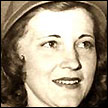
The case of Marilyn Sheppard hasn’t reached that stage yet, but it’s getting there.
In April 2002 Bernard F. Conners, an FBI agent turned novelist, published Tailspin: the Strange Case of Major Call. In it he pins the Bay Village murder on James Call, an Air Force pilot who in 1954 deserted and embarked on a burglary spree across the nation.
Call had said he was prepared to kill anybody who got in his way, and on Aug. 5 he did kill a policeman who surprised him during a burglary in Lake Placid, N.Y.
Conners cites evidence that about the time of the Sheppard murder Call visited his sister in Mantua, Ohio, 30 miles southeast of downtown Cleveland. A woman from that town called police the day after the crime to report that on the day after the murder she had seen a man who matched the sketch of the “bushy-haired intruder” catching a bus out of town
The Sheppard murder fit Call’s M.O. The crowbar he carried could have been the death weapon and the Luger he also carried could have made the bloody imprint on Marilyn’s pillowcase. Fingerprints taken after his arrest for the Lake Placid murder indicated a recent injury to his forefinger that was similar to a bite mark. He was limping at the time (like Sheppard’s description of the intruder) as the result of a recent injury. He smoked, which could explain the cigarette in the Sheppards’ toilet. He could have taken Sheppard’s T-shirt to replace his own bloody shirt.
Call did not have an alibi for the July 3-4 period. He said he had been alone on New York State’s Adirondack Trail at the time.
What’s more, Conners found Dr. Gervase Flick, who the day after the murder picked up a hitchhiker heading east from Ashtabula, Ohio. The man had blood on his shoes (from kicking a dead dog off the road, he said), asked if Flick had heard about the Sheppard murder and seemed intent on radio newscasts. In 1997 Flick picked out Call’s photo as that of the hitchhiker.
In September 2000 Conners found Richard and Betty Knitter, who had seen a bushy-haired man on Lake Rd. shortly before the murder but had been unable to identify him from a book of “mug shots.” They identified Call’s photo as “the closest resemblance to the man we saw as ‘the bushy-haired man.’ We were surprised when we saw the pictures and they were so much alike that it was amazing.”
However, pictures of Call from the time that Conners reproduces do not show him with hair anywhere near as high as the three or four inches the Nickersons described. Dr. Flick said the hitchhiker he picked up had combed-back hair.
Despite many similarities, Conners cites no direct evidence tying Call to the crime.
At this late date, it appears impossible to prove somebody guilty of the crime beyond a reasonable doubt. In any event, all the suspects are dead; Call was killed in an auto accident in 1970.
That means murder fans are free to let their imaginations run wild. Conners’ book — the second on the Sheppard case in six months — means the floor is open for nominations.
Aside from Call, three possibilities stand out.
****
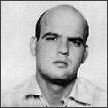
1959, police evidence
Despite the civil jury’s finding, Richard Eberling remains a strong suspect. The jury did not hear about the long string of suspicious deaths with which he was involved. In particular, jurors did not hear about his conviction for the brutal 1984 murder of Ethel Durkin.
Eberling was very familiar with the Sheppard house, including the basement entrance, which was often unlocked. On the other hand, there is no evidence he was in the vicinity of the house at the time of the murder except a vague resemblance to a man in a white shirt that several passing motorists saw. The Nickersons recently identified Call as the man they had seen.
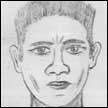
haired intruder in 1954,
police evidence
He fit the general description of the “bushy-haired intruder” with whom Sheppard wrestled. On the other hand, why didn’t Sheppard recognize the window washer who regularly came to his home? But then Sheppard may have been away when he came to wash windows.
The “trail of blood” down the steps is almost certainly Eberling’s. He volunteered to police in 1959 that he dripped blood in the house; if he hadn’t, he might not have become a suspect. On the other hand, he could have been guiltily trying to set up an explanation. And his former employee signed a dying declaration that Eberling had not been at the Sheppards’ on the date he stated.
Had DNA testing been available in 1984, it could have solved the case quickly.
Today police follow careful procedures in collecting and preserving DNA evidence. They keep the evidence dry and at room temperature, wear disposable gloves while handling it, avoid coughing or even talking, and seal it in paper — not plastic — envelopes sealed with tape rather than staples. Those procedures weren’t followed in 1954 because nobody knew there was such a thing as DNA evidence. Dr. Tahir acknowledged there was a possibility of contamination in some of the samples he tested.
Eberling was capable of violence, as the Durkin murder showed. But, in nearly all the suspicious deaths with which he was connected, he stood to gain monetarily through inheritance; if they were murders, they were planned murders.
He stole repeatedly over the decades and may also have burglarized homes with which he was familiar. However, there is no evidence he was ever involved in a sex crime. He was believed to be homosexual.
Also, Dr. Kirk said the killer was left-handed; Eberling is right-handed. And expert witnesses for the Sheppard family differed as to whether the blood type of the spot on the closet door could have been Sheppard’s.
Finally, a 2001 book on the case, James Neff’s The Wrong Man: The Final Verdict on the Dr. Sam Sheppard Murder Case, concluded that Eberling was the killer.
Neff based his opinion on much the same evidence in Mockery of Justice, plus a delphic final interview with a dying and possibly delirious Eberling.
To save delays involved in applying as a reporter, Neff signed in as a visitor and did not bring a tape recorder. He describes an obviously sick Eberling whose “conversation that morning wandered, like a radio signal scanning the dial, coming in and out of reception.” Then:
Suddenly Eberling took himself back to 1954. He described himself as snapping to alertness and finding himself in the Sheppards’ blood-soaked bedroom. He saw a crimson mess everywhere. He was horrified. “My God, I had never seen anything like it,” he said. “I got out of there.”
“I asked a follow-up question but Eberling wouldn’t answer. Catching himself, he wouldn’t talk about it anymore.
It turned out to be as close to a confession as I would get. Richard Eberling died before I could return.
That’s dramatic, but Eberling, a pathological liar, had previously given more explicit “confessions” — including one also implicating Sheppard — between repeated assertions of his innocence.
****
That the mayor of Bay Village and/or his wife killed their neighbor is a fantastic theory. Still, all the theories about how the murder happened strain credulity, and one of them has to be true.
The story that Richard Eberling told Sam Reese Sheppard in prison — after Eberling himself became a suspect — is a pastiche of many things that had been said or written before, including Dr. Steve’s speculation that his brother might have been bisexual.
But suspicion of the mayor goes back to August 1966 when he was unceremoniously brought to Central Police Station for questioning as a result of leads Dr. Steve had given police. The Houks were F. Lee Bailey’s suspects at the second trial, and Bailey was driving to show something similar to Eberling’s version before the judge cut him off.
Before the trial, Bailey had hinted to reporters that the killer was a left-handed woman (Unlike William Corrigan, Bailey knew how to use the media).
During cross-examination he brought out that the Houks were familiar with the Sheppard home, could get between their house and Sheppard’s via the beach and had set a fire in their fireplace on a July night when the overnight low was 64 degrees. Had he been allowed, he would have called the bakery driver to testify he saw Houk kissing Marilyn.
After Sam’s acquittal, Bailey got Bay Village police to look into the evidence against the Houks, but the Grand Jury, after hearing witnesses, took no action. Grand jurors doubted that Houk, who walked with a limp, could have been the man who ran from Sheppard. And why wouldn’t Sheppard have recognized his neighbor? Sheppard may or may not have known Eberling well, but he certainly knew Houk.
In 1982 the owners of what had been the Houk property found a pair of fireplace tongs buried four to five inches under their back yard. They were nearly two feet long, weighing one and three-quarters pounds, and appeared to match some but not all of the wounds in Marilyn’s head. However, Mockery of Justice reports that they did not match the bloody imprint on the pillow and a metallurgist said the absence of corrosion indicated they could not have been buried for 28 years.
Even after Dr. Tahir said his DNA findings implicated Eberling, Bailey remained dubious. He said Eberling could have been the killer, but he still thought Esther Houk was the more likely suspect.
Young Sam at one time indicated he had a tape of an interview with Spencer Houk made shortly before his death in 1980 which appeared incriminating. In any event, he took the accusations seriously enough to lay out two scenarios, one in which Spencer Houk was the killer and one in which it was Esther. He stopped pursuing them only when the evidence against Eberling began to mount.
Still, suspicions about the Houks continued — and in other places besides the phone line for anonymous tips.
Paul Holmes avoids speculation through most of The Sheppard Murder Case, but in the end suggests a “hypothesis” in which Marilyn is killed with a flashlight by a woman whose husband fakes a burglary to cover up for her and inadvertently sets up Sheppard as a suspect. They get away with it: “No one will ever look for ashes in their grate or examine their car for bloodstains.”
Jack Harrison Pollack’s 1972 Dr. Sam: An American Tragedy contains a final chapter called “The Guilty.” He reports that Harold Bretnall, a private detective who worked for the Sheppards, had planned before he died to write a book about the “explosive new findings” he had uncovered.
In his notes Bretnall had written, “Marilyn Sheppard was murdered by someone who was a frequent visitor to the Sheppard home.” Pollack says, “After carefully ruling out all other possibilities, Bretnall concluded that Marilyn’s killers were a woman and a bushy-haired man living in bondage with their awful secret.”
Pollack was impressed by Bretnall’s findings. His own conclusion:
The finger of suspicion, according not only to Bailey but also to more impartial observers, still points most stubbornly to a couple — a woman and a man.
Could it be that the man was having an affair with Marilyn, that his wife found about it and tried to kill her, only to be interrupted by her husband, who, out of guilt, rushed to her aid and “finished the job”?
This theory may have much to recommend it, not least the gossip of Bay Village. And it may not be coincidental that a tooth chip belonging to neither Marilyn nor Sam was found in the bedroom after the murder and that the teeth of one Bay Village resident were reportedly extracted immediately after the crime. [Pollack does not document or give a source for the last statement]
The Houks were both dead when the accusations resurfaced in the 1990s, but their grandchildren rushed to their defense. They said their grandparents could never have committed such a horrible crime. Among other things, they said Esther was not left-handed, as had been often reported.
And they said that as Esther lay dying in 1982, she called her daughter to her bedside and told her, “After I’m gone, if they accuse me of the Sheppard murder, promise you’ll defend me.”
Finally, in 1994 on the 40th anniversary of the crime, the Plain Dealer ran the usual big anniversary spread. Sheppard’s life-long friend Alan Davis wrote one of the pieces. He called Sheppard “my best friend” and said young Sam was almost a son to him.
Yet he revealed that he had his own suspicions of the story Sam and his brothers had told about the murder. He wrote:
Maybe for their own reasons, the three Sheppard brothers decided not to reveal everything they knew, not even to me….But, putting some pieces together, I do have my own answer to who killed Marilyn Sheppard.
Will I name names? No, and for these reasons: What am I to say to accuse someone for whom Sam was willing to spend 10 years of his life in prison rather than reveal the name? Again, who am I to accuse someone without stand-up-in-court proof, which I do not have?
****
Finally, there remains one suspect. Especially among Clevelanders.
the trial (AP)
In 1966 Sam Sheppard was found not guilty “beyond a reasonable doubt.” Local opinion, not bound by the law, was free to use a lesser standard. The 2000 jury, bound to rule on “the preponderance of the evidence,” found him “not innocent.”
While there had never been direct evidence linking Sheppard with the crime, what had aroused suspicion — first that of the police, then that of the newspapers, then that of the public — was the story he told.
It was so hard to believe — the intruder who attacked his wife while he was asleep downstairs without waking his son in the next room, the shadowy form which knocked him out not once but twice, the long delay in calling police, the missing T-shirt, the lack of corroborating evidence, the many questions to which he could say only “I don’t know.”
What cooked his goose with the public was denying having an affair with Susan Hayes, then having Susan Hayes fly home from Los Angeles, with flash bulbs popping, to say they had had an affair and he spoke of divorcing his wife and marrying her.
That — along with Gerber’s description of the murder weapon as similar to a surgical instrument and the lack of expert testimony to counter the laboratory technologists — also damaged his standing with the first jury.
Yet it is highly questionable that Sheppard faked his own injuries, as the prosecution charged in the first trial. Several doctors testified they were genuine, and one said he had risked paralysis if he deliberately injured his neck. Tellingly, doctors who had examined him in jail at the request of prosecutors were not called to testify. Dr. Robert White, who testified for the state in the third trial, had not examined Sheppard.
Prosecutors did not challenge his injuries in the second trial. More puzzling was their failure to call Susan Hayes, bring in any evidence of other women in his life or attempt to introduce testimony the Sheppards had considered divorce (It might or might not have been admissible).
That testimony had been damning at the first trial — it was said that Sheppard was tried for murder and found guilty of adultery — but was missing from the second, leaving the jurors to scratch their heads about a motive for Sheppard to kill his wife. Similar testimony was ruled admissible in the civil trial over the objections of Terry Gilbert. It’s a point which can be raised again on appeal.
Ironically, it was the story Sheppard told that was suspicious. Even his best friend doubted it.
And, ironically, years later it is the story Richard Eberling told police in 1959 that made him a suspect.
The definitive history of the Sheppard case has yet to be written, largely because it is the Energizer Bunny of murders. Five of the books which have been written are by people who were involved on the Sheppard family’s side — Sam, his brother, his son (with an investigator his son employed), his lawyer (one chapter of a book) and a reporter who became an investigator for the Sheppards.
The Sheppard Murder Case by Paul Holmes (1961) is a straightforward account of the first trial (Holmes did not arrive in Cleveland until the trial) followed by Holmes’ own observations, which led to his later becoming personally involved in the Sheppard team. Indexed.
My Brother’s Keeper by Stephen Sheppard (1964) is Dr. Steve’s account (with Holmes’ help) of Sam’s — and his relatives’ — ordeal. Judge Weinman’s District Court ruling reversing the verdict came in time for a three-page epilogue. No notes or index.
Retrial: Murder and Dr. Sam Sheppard (1966) is Paul Holmes’ sequel. It suffers from being rushed into print within weeks of the verdict. Only 88 of the 240 pages (in the small hard cover edition) are devoted to the trial, and 50 of those are transcripts of testimony by Mary Cowan and Paul Kirk which had already been summarized; apparently they were added to fill the book. No notes or index. The book is hard to find.
Endure and Conquer: My 12-Year Fight for Vindication by Dr. Sam Sheppard (1996) is the defendant’s own story (written, according to his son’s book, by “a ghostwriter with Dr. Sam’s notes”). Includes his prison experiences. No notes or index.
The Defense Never Rests by F. Lee Bailey with Harvey Aronson (1971) includes, with four other cases, seven chapters and an epilogue on “The Exoneration of Sam Sheppard.” No notes or index.
Dr. Sam: an American Tragedy by Jack Harrison Pollack (1972) is by a writer who became interested in the case when he wrote a sympathetic article about Sheppard shortly before Sheppard was freed. Nevertheless, it is a straightforward, basically objective account of a story which appeared to be over after 18 years. The book has 16 pages of photographs and an index. It served as the basis of a 1976 television movie called Guilty or Innocent? The Sam Sheppard Case starring George Peppard. The movie was released on video in the late 1980s but is virtually impossible to find in video stores.
Mockery of Justice: The True Story of the Sheppard Murder Case by Cynthia L. Cooper and Sam Reese Sheppard (1995) is, while naturally written from the family’s viewpoint, the most comprehensive summary so far, with 328 pages of text, 21 illustrations, 40 pages of end notes and a 15-page index. Its frequent flashbacks and flashforwards and switches between past and past perfect tenses make it difficult to follow, and the passion that the younger Sheppard obviously felt fails to come through the third-person references of his collaborator.
Chapter 26 of The Years Were Good by Louis B. Seltzer (1956) is devoted to the Sheppard murder case and the Cleveland Press editor’s reasons for his series of editorials about the case. Index, no notes.
Crime and Science: The New Frontier in Criminology by Jurgen Thorwald, translated by Richard and Clara Winston (1967) devotes five of its 63 chapters to the Sheppard case and Dr. Kirk’s investigation. The author, a German writer specializing in medical subjects, maintains that Dr. Gerber was incompetent and quotes Sheppard as saying things Sheppard did not mention in his own book, but he does not give sources for them. The author gives no indication that he visited the U.S. in researching the book. Index and bibliography, but no notes.
Murder One by Dorothy Kilgallen (1967) describes six murder trials the veteran reporter covered, with “When Justice Took the Day Off” as the last and longest chapter. The book, published shortly after her death, is a more colorful and readable account than Holmes’. She calls the case “the most extraordinary murder trial of the century” and offers her opinion that the decision of the jury was “incomprehensible…I was aghast.” No index or notes.
The Wrong Man: the final verdict on the Dr. Sam Sheppard murder case by James Neff (2001) is the latest — and very likely last — book on the case. Neff, a former Plain Dealer reporter, had worked on the book for years, but was outrun by events, notably the civil trial, that kept postponing its publication. He reconstructs the crime readably, points out the weaknesses in the case against Sheppard, dismisses the Houks as suspects out of hand and settles on Eberling as the killer. He bases this on substantially the same evidence as in Mockery of Justice and on an interview with a dying and possibly delirious Eberling. His coverage of the civil trial scants the state’s case: His report on the testimony of Gregg McCrary, the key state witness, is almost entirely devoted to disputing McCrary’s statements, and he does not mention the videotaped testimony of Susan Hayes, whose absence from the 1966 trial left the jury puzzled as to a possible motive.
Dr. Sam Sheppard on Trial: The Prosecutors and the Marilyn Sheppard Murder, by Jack P. DeSario and William D. Mason (2003), is — after 49 years — the first book to argue that Sam Sheppard was guilty. Mason is the Cuyahoga County prosecutor who defended the state against the 2000 civil suit to declare Sheppard innocent. DeSario is a political science professor at Mount Union College. Note to the squeamish: The book includes photos of Marilyn’s battered, bloody body and a color autopsy photo of her head that were too gory for newspapers to use. Three quarters of the book’s 327 pages are a chronological account of the trial, much of it in Q and A that keeps readers turning the page. It is reasonably balanced, at least until the last two witnesses. Among tidbits: Sam Reese Sheppard’s comment on AMSEC’s supposedly jimmied door — the “smoking gun” that showed a break-in -“Ah, yes, it appears we were incorrect about that point.” The prosecutors thought they had lost when the jury came in after only a few hours, especially since Sheppard and his attorney were all smiles. Jurors said they were especially influenced by the testimony of FBI veteran McCrary and neurologist White and by the fact that the Sheppards’ dog, Koko, didn’t bark. Two of the eight would have given Sheppard the death penalty. Nine appendices, index, no notes.
A Question of Evidence: The Casebook of Great Forensic Controversies from Napoleon to O.J. by Colin Evans (2003 edition) has a chapter on “Medical Malpractice and Dr. Sam.” The case is “a story of two Dr. Sams,” Evans says. As to the guilt or innocence of Sam Sheppard, “The short answer is: Nobody knows.” But he has a verdict on Sam Gerber. Apparently drawing on previous books, he reports that the “tetchy coroner” was a “venomous and vindictive” man who “from all accounts hated the Sheppard family” and “had been spearheading an anti-Sheppard witch-hunt of quite appalling savagery. He filled acres of newsprint and sold thousands of extra copies with his lurid speculations.” As Evans describes the civil trial in 2000, the attempt to implicate Richard Eberling fell apart — “What looked good on paper backfired horribly in the courtroom. … Few doubted which way the jury would jump.” Despite the “appropriately ambiguous verdict,” Evans concludes, “there wasn’t a scintilla of hard evidence in 1954 to prove that Sam Sheppard killed his wife. There still isn’t.”