
Drugs, Sex, and Murder in 1920s Tinseltown — Hooray for Hollywood — Crime Library
Bizarre events in Hollywood have been going on for a long time. We are fascinated by scandals in the movie industry. None of the present-day events — illicit romances, drug charges, accidental overdoses — can meet the mystery of a famous case of 1922.
Hooray for Hollywood
That screwy, ballyhooey Hollywood!
Where any office boy
Or young mechanic
Can be a panic
With just a good-looking pan
And any barmaid
Can be a star maid
If she dances with or without a fan.
— Lyrics by Johnny Mercer
Johnny Mercer’s teasingly cynical lyrics about the Hollywood that he knew so well capture the spirit of the capitol of filmdom in the 1920s and 1930s. With a little gentle tweaking, one might add a variation that would suggest some of the elements of the most famous unsolved murder case in Hollywood history — the murder of director William Desmond Taylor.
Hooray for Hollywood
That phony, super Coney, Hollywood
Where any movie goddess
Can be an addict
Or be ecstatic
With just a pusher or two,
And any starlet
Can be in the market
To keep her honey from being blue.
— Parody lyrics by Russell Aiuto
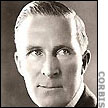
Taylor
The case has all of the elements of the unreal world of Hollywood. It has a famous director of silent films shot in the back. It has, among the suspects, a dope-possessed movie star, several sex-crazed female movie stars, a young up-and-coming screen goddess with an insatiable lust for the director, the starlet’s monster of a stage mother, hitmen, drug pushers, and the victim’s brother. If this were not enough, there’s an embezzling chauffeur, a gay housekeeper, charges of gay and bisexual escapades, hysterical and dishonest movie executives, and a district attorney who seemed to want to produce a cover-up.
Place all of these characters in the context of 1920s movie scandals, prohibition, and the raffish characters that made up the movie industry at that time, and you have a story of passion, greed, and, most of all, a very mysterious murder.
This case anticipates film noir by nearly a quarter of a century. If it had been made into a silent film at the time, it would have been sensational. In many ways, it is a script.
Shooting script. Scene One. Long shot pans a tall distinguished man walking with a very pretty, curly-haired young woman down a walk towards a parked limousine. They reach the car and the man opens the door for the young woman, whose eyes appear glazed, as if she were slightly drunk or drugged.
She gets in. He closes the door. She rolls down the window. They exchange pleasantries. Close up on girl. Subtitle: “Goodbye, Dear Billie. I’ll see you soon.” Close up on man. The man’s lips move. Subtitle: “Goodbye, my little Mabel. Take care.”
The car pulls away as the man waves and the woman blows kisses at him through the open car window. He turns and walks back to his house, the end unit in a set of apartments in a U-shaped complex. He is carefree, and he walks with a certain zest.
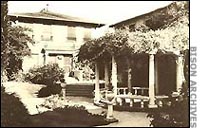
He reaches the front door of his bungalow, pauses because he had closed the door, and it is now open. He looks puzzled. He shrugs and enters. He walks toward his desk at one end of the living room, intent on returning to the work he had left. He is completely unaware that anything is amiss.
He hears a noise, and before he can turn to confront its source, we see the smoke from a gunshot. He is hit in the back, and falls to the floor. An unidentifiable hand drags him by his left foot a short distance from where he fell. We cannot tell if it is the hand of a woman or a man. The camera moves in for a close-up on the fallen victim. He is lying face-down. He is clearly dead.
The murder of William Desmond Taylor is thought to have occurred shortly after he had said goodbye to his friend, the movie comedian Mabel Normand, at approximately 7:45 p.m. Almost 12 hours later, Taylor’s body was discovered by his butler, Samuel Peavey.
Within minutes, a number of people were at Taylor’s apartment. None of them were police. The frantic Peavey let in William Eyre, a studio executive, Taylor’s creative colleague, Julia Crawford Ivers, and her cameraman son, James Van Trees. Also present was a doctor, or so he identified himself, who declared that the cause of death was a heart attack. If any one of them had turned the body over, they would have seen a very distinct bullet wound. The doctor disappeared. The studio people began removing material from the apartment, incriminating letters, as well as a pink, monogrammed nightie. Only then did the police appear. If there were clues to be found, the murder site had been so compromised that it would be impossible to find any.
Neighbors gave their accounts. A neighbor across the way from Taylor’s apartment, Faith Maclean, testified that she had heard a shot around 8:00 p.m., looked out, and saw a young man on the porch. He looked directly at her, went back inside, returned in a minute, and walked away, behind Taylor’s apartment.
The contents of Taylor’s pockets were inventoried. A pocket watch, a wallet with $78, and, on his left wrist, a watch. He wore a large diamond ring.
This, then, was the substance of the murder scene.
What was going on? What on earth could William Desmond Taylor have in his home that would induce such a frenzy of cover-up?
It certainly wasn’t a robbery. Taylor’s jewelry and money had not been taken, and nothing valuable seemed to have been removed from the house. The scavenging studio people — there were at least three going through drawers and closets — must have believed that something would direct suspicion toward someone. The questions were: Who was that someone? Why would it matter?
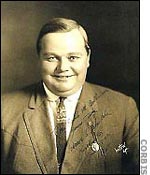
The movie industry was run by a nervous group of moguls. If there was one thing they feared, it was scandal. Each unfortunate episode created terror in the money men of Hollywood. The famous rape case in which the popular comedian Fatty Arbuckle was the accused generated a great deal of adverse publicity. The screen idol Wallace Reid, weakened by his addiction to morphine, died of a heart attack.
General
Coupled with these sensational cases and other reports of orgies and dope parties was the appearance on the Hollywood scene of Will Hays. Hays was no stranger to licentious living, having recently been a member of the Cabinet of Warren G. Harding. Hays, hired by Hollywood to improve its image, to censor the racy bits in films, and to monitor its employees’ behavior, was in full tilt at the time of the Taylor murder.
Another scandal would have been one too many.
In addition to the mysterious man seen leaving the Taylor apartment by Faith Maclean, there were a number of other suspects. Foremost among these were Taylor’s ex-valet, Edward Sands, and his current valet, Henry Peavey.
They were convenient suspects. For one thing, the district attorney was eager to protect the movie industry. For another, Edward Sands was a nefarious character with a less-than-admirable past.
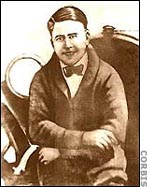
Somewhere around 1920, Sands was hired as Taylor’s valet and man of many talents. No doubt, Taylor’s acceptance of Sands was that they shared English accents. What Taylor did not know was that Sands had been born in Ohio, and very probably never visited England. Sands (real name: Edward Snyder) had served three times in the United States Navy (using three different names), and ended a strange military career (again, under a false name) as an Army clerk. This bizarre background included one prison sentence (one year for embezzlement), and three desertions. One could safely say that the genial Edward Sands was a first-rate con man.
About six months before Taylor’s murder, Sands disappeared after forging several checks with Taylor’s signature and taking off with his employer’s valuables and car.
He was searched for immediately after his disappearance in 1921, and again after Taylor’s death. He was never found.
Also, as attractive a suspect as he was, he was never charged with murder.
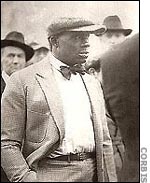
Sands was replaced by Henry Peavey, a tall, robust black man who had been arrested (while in Taylor’s employ) for lewd behavior, very likely for soliciting young boys. On the day of Taylor’s death, Taylor was to have appeared in court on Peavey’s behalf.
The first assumption was that Peavey was a likely suspect because he was having an affair with Taylor, or because he may have been soliciting the young boys for Taylor. These speculative leaps fell apart with further investigation, and Peavey was soon dropped as a suspect.
Two suspects down, and at least five more to go.
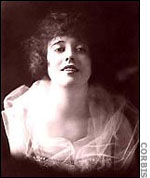
The friendship of famous film comedian Mabel Normand and William Desmond Taylor, noted director, was an intriguing element in the case. A glamorous killer is always more interesting than a valet.
Normand was a drug addict. It was well known that Taylor attempted to cure her of her drug dependence. It was further known that Taylor was protective of Mabel and was trying to separate her from her drug suppliers.
Most of all, Mabel Normand was the last person known to have seen Taylor alive. Those who were close to the victim in both relationship and time were inevitably suspected.
What was the relationship between this beautiful suspect and the victim? Taylor was 20 years older than Normand and could have been her lover. More likely, they were friends, with Taylor assuming the roles of confidante, escort, and mentor. Mabel was vivacious, pretty, and certainly a good companion. Beyond that, one can only speculate, and speculation would only carry investigators so far. For one thing, Normand had a solid alibi.
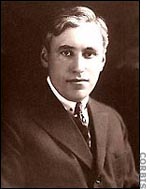
A fourth suspect was Normand’s lover, the highly successful comedy director Mack Sennett. The two — Mack and Mabel, immortalized in a Broadway musical of the 1960s — had motives, so the speculation went. Mabel was jealous of Taylor’s involvement with other women, and, unable to rekindle his interest in her, killed him. Or Sennett was jealous of Taylor, because he was still very much in love with Normand. But because he was estranged from her, he killed Taylor in a fit of jealousy. It seems that the soap-opera environment of 1920s Hollywood fostered such theories.
But, like Normand, Sennett had an iron-clad alibi.
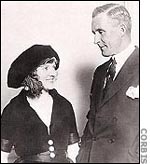
Mary Miles Minter
Another suspect was the young blond movie star Mary Miles Minter. Several pieces of evidence led investigators to believe that she was the murderer.
First, there was a love note of adolescent enthusiasm, complete with symbols of love and kisses, found in Taylor’s apartment. Second, there was the pink nightgown, conveniently monogrammed with “MMM.” Minter, a mere 19-years-old, had all of the characteristics of a swooning teenager. Coupled with the fact that Taylor reportedly repulsed her enthusiastic advances toward him was the knowledge that she was clearly unstable. She had attempted suicide (albeit clumsily) and she was a first-class neurotic prima donna on movie sets. What more likely suspect than a slightly wacko movie ingénue?
Further, Minter had a classic stage mother, an avaricious control freak who kept her in an emotionally childish state. Charlotte Shelby, Minter’s monster of a mother, was extremely protective of her daughter. Mary Miles Minter was, after all, the source of the wealth that Shelby needed to maintain her Hollywood lifestyle. She wasn’t an unlikely suspect herself.
Fortunately, Minter and her mother were able to provide each other with alibis for what was believed to be the time of the murder.
What is fascinating about Minter as a suspect is that the first district attorney, Thomas Lee Woolwine, charged with investigating the case apparently ignored the evidence against Minter. It is likely he engaged in a cover-up. Woolwine not only suppressed pieces of evidence (such as the pink nightgown and Minter’s ownership of a .38 revolver), but lost them. Why?
Even more curious is that Woolwine’s successors as district attorney, Asa Keyes and Burton Fitts, both reopened the case during the next seven years after the murder, and, despite the evidence that Minter had a strong motive and had given conflicting accounts of the hours surrounding the murder, dropped their inquiries. Again, one has to ask why. Who wanted Minter protected? Could it have been that all three district attorneys were so politically ambitious that they bowed to pressure from one or more of the powerful movie studio heads? After all, the larger-than-life Samuel Goldwyn was in love with Minter. Did he have the influence to protect her?
Taylor was a man of mystery. Did his complicated past relate to his murder?
William Desmond Taylor was not his real name. It was William Deane Tanner. A member of the movie business changing his name is not all that remarkable, but when high profile speculation is running rampant, the smallest tidbit can be used to build a major case.
The clear implication was that Taylor (or Tanner) had something to hide. This idea was reinforced by the fact that Taylor, in 1903, abandoned a wife and baby daughter in New York and struck off for points west. “Abandoned” is rather a strong term for Taylor’s act, since his wife had a wealthy father and was not economically inconvenienced by her husband’s leaving. She married a well-off man not long after she divorced Taylor, and she appeared to not harbor any particular anger at her errant husband. Hence, Taylor’s flight from domestic bliss doesn’t seem to be a reasonable explanation for changing his name. It is more likely that “William Desmond Taylor” had more of a theatrical flourish to it than (in his view) the more prosaic “William Deane Tanner.”
Interestingly, Taylor’s younger brother, Denis Cunningham Deane-Tanner, also abandoned his wife. Other than suggesting that a lack of marital commitment seemed to be hereditary in the Tanner family, there was not much there either.
William Desmond Taylor’s past, then, was more of an irritation to the case than a reasonable cause for his murder. There were a number of years (between his leaving New York and arriving in Hollywood) that were sketchy, but no more so than the average itinerant actor of the first years of the Twentieth Century. And if Taylor was vague or intentionally deceptive about his background, it was more likely to be the mystique that movie people liked to create.
It is true that Denis Dean-Tanner’s abandoned wife recognized Taylor in a movie, and that Taylor, when confronted, denied that Denis was his brother. But it is also true that he relented and helped to support his sister-in-law for the rest of his life. At one point, there was speculation that Denis Deane-Tanner was really Edward Sands, but the two men looked nothing alike. The only thing that Denis and Sands had in common was that they both disappeared, Sands in 1921 or 1922, and Denis some time before 1930. This coincidence has fed the fires of conspiracy.
The problem with suggesting that Taylor’s murder was somehow connected to his past didn’t seem to hold water. Even the questionable suggestions that Taylor was gay or bisexual could not be tied to a possible explanation of why he was murdered.
There was some evidence that Sands committed suicide in 1923. The district attorney was informed by the Connecticut State Police that a body, with a clearly self-inflicted gunshot wound, had been identified as Edward Sands. Los Angeles D.A. Woolwine, again behaving strangely, (as he had during this entire case), suppressed this information, and left Sands as a fugitive and suspect.
As for Denis, all that was left was a ghost who haunted the case, a troubled young man who dropped out of view.
An interesting conclusion to all of this is the fates of the principal characters. Mabel Normand died in 1930, comparatively young (in her thirties) of tuberculosis. She lived the last eight years of her life as a murder suspect, complicated by several escapades that kept her in the public view.
Charlotte Shelby died in 1960, a bizarre enigma to the end. Henry Peavey had died almost thirty years before of tertiary syphilis.
Mary Miles Minter retired from acting in 1924 and lived until 1984. She died a grotesque version of her younger self. She kept her doll-like face and blonde ringlets, but in her mature years, she became obese. Despite a husband and a number of lovers (including Charlie Chaplin), she claimed that she was a virgin.
William Desmond Taylor had a brilliant career cut short. Had he lived another ten years, he would have practiced his craft of movie-making into the Talkie Era. He might very well have made the transition from silent to sound movies with distinction.
However, he was prevented from realizing this possibility, in all likelihood, by a foolish, childish, and love-struck actress.
There have been several suggestions for the murder of William Desmond Taylor, some more plausible than others.
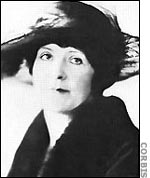
The first possibility is that Charlotte Shelby killed Taylor. Her motive was that she could not afford to have her daughter deeply involved with a man — any man. Her alibi was contrived, and she spent the rest of her life paying the man who supported her alibi, to keep his mouth shut. On the other hand, the payments may have been to protect her daughter. Elements of this scenario may be true.
The second solution suggested is that Taylor was killed by a hitman hired by drug pushers to silence him. This proposal exists because none of the principals in the case can be easily pinned down as the possible killer. While an interesting theory, it may make too much of Taylor’s protectiveness of Mabel Normand.
The third theory is that Mary Miles Minter killed Taylor, probably accidentally. This theory suggests that Minter sneaked out of her house after midnight. She went to Taylor’s house, with the gun that she had used in her earlier bungled suicide attempt. She confronted Taylor with undying devotion, waved the gun in order to convince him that if he did not return her passion she would kill herself. The gun went off. Helpless, she tenderly positioned the mortally wounded Taylor, watched him expire, and returned home. Very likely Minter told her mother, and Charlotte devised the cover-up.
This theory proposes that Taylor was not killed at 8:00 p.m. on Feb. 1, but shortly after midnight on Feb. 2. This proposition is consistent with some of the observations at the crime scene, as compromised and confused as it was.
Although the case has irrelevant issues (conspiracies, homosexuality, Taylor’s past, and so on), this explanation seems to fit a straightforward interpretation of the facts. Coupled with the observation that District Attorney Woolwine and his corrupt successors all seemed to be covering up the likelihood of Minter as the killer, this seems to be a reasonable interpretation of the mystery.
The mystery of the murder of William Desmond Taylor is not the only mystery. Equally as mysterious is how so many for so long could carry out such an inept investigation. What makes the Taylor case so mysterious is the ineptitude of those who reported it.
One can begin with the press. Following the Fatty Arbuckle case, a climate of sensationalism gripped the Los Angeles journalistic community. Facts became inconsequential, and the fabrication of facts in order to enhance the juiciness of the reporting became common. The newspaper reports on the case are essentially useless. Added to this low level of accuracy in reporting were the columns by various Hollywood gossip mavens, such as Adele Rogers St. John, which alluded to salacious aspects of the murder and put forth — if not explicit accusations — innuendo about favorite suspects. The official records of the police and district attorneys were incomplete, missing, altered, or suppressed. Even the so-called interviews of officials conducted by the three principal authors of the books on the Taylor murder were tainted. The King Vidor transcriptions of the police and D.A. files were made from audiotapes while the documents were being read, and are themselves suspect.
There’s also the unfounded bravado of the authors Sidney Kirkpatrick and Charles Higham, and, to a lesser extent, the more tentative Robert Giroux. Using tainted records, both journalistic and official, they leap to astonishing conclusions, particularly when one realizes the meagerness of their sources. Further, the interviews they conducted with survivors of the era are bizarre examples of how not to obtain information. Their primary approach was to allow each interviewee to put forth their respective theories of the murder. Second, each author would seize on one or two statements and shoehorn them into his overall theory of the case. Giroux is the most cautious (and the best writer), but even he relied on the gossip dredged up by unreliable participants, and then many years after the fact. Given the relative unreliability of his interviewees’ recollections and the paucity of the record, Giroux came to a vague conclusion, that the murder was a drug-related hit, carried out because of Taylor’s interest in helping Normand break her habit.
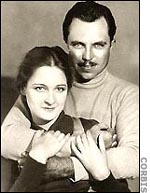
Boardman
Fitzpatrick’s Cast of Killers is almost a work of fiction, supposedly based on the extensive files of King Vidor, a man with a rich, self-aggrandizing imagination. It contains information on Vidor, his romances, and his dogged determination. The most recent book, Higham’s Murder in Hollywood, has more research than the other two, and has a somewhat stronger conclusion — Mary Miles Minter accidentally shot Taylor, and then spent a lifetime (along with her mother) covering up the event. Higham’s deduction is plausible, although tainted by his reliance on the suspect King Vidor materials.
The problem with all of this material is its lack of coherence. Facts are contradictory, such as who were actually in the bungalow that morning; whether Taylor was straight or gay (and what relevance that question had to the solution to the crime); and even Taylor’s actual date of birth. These contradictions themselves form a conundrum, in that what is important and what is irrelevant is never made clear.
Finally, the entire case was rife with conspiracy theories. Cover-ups by the three principal district attorneys; the collusion of Minter, her mother, her grandmother, and her sister to cover up the crime; the attempt by the Hollywood studios to suppress damaging information; and the assumption that Taylor’s brother might have been Edward Sand — all of these, in addition to blackmail and gay sex, complicated a rational investigation of the murder. The case was never solved.
There are three major books on the William Desmond Taylor case. The earliest, by Kirkpatrick, is the weakest. The next, by Giroux, is well-written and well-thought-out. The last, by Higham, is the most analytical, although a bit breathlessly written. Other mentions of the case appear in biographies of Samuel Goldwyn, Mabel Normand, and Mack Sennett, although most of these can be classified as gossip.
There are two unpublished sources upon which the three principal authors rely. The most important of these is the account by King Vidor, “Who Killed William Desmond Taylor?” For the most part, Vidor’s manuscript has been reproduced in its essentials in all three books. The second source is by the art director George James Hopkins, entitled “Caught in the Act: A Memoir.“ It is used heavily by Higham, and forms the basis of the speculation about Taylor’s purported homosexuality.
Berg, A. Scott. 1989. Goldwyn: A Biography. Knopf.
Fussell, Betty. 1982. Mabel. Ticknor and Fields.
Giroux, Robert. 1990. A Deed of Death. Knopf.
Higham, Charles. 2004. Murder in Hollywood. Wisconsin.
Kirkpatrick, Sidney J. 1986. A Cast of Killers. Dutton.
Sennett, Mack, and Cameron Shipp. 1954. King of Comedy. Doubleday.
Sherman, William T. 1994. Mabel Normand. Cinema Books.