
Murder, Inc. — Prologue — Crime Library
Harry Strauss was frustrated.
Strauss, better known to his chums as “Pep” or “Pittsburgh Phil,” was on a contract job in Jacksonville, Florida but the bum he was supposed to take out wasn’t making it easy.
A fashion conscious man who always traveled with a clean shirt and spent an hour with his barber each morning, Pep had flown down from New York at the request of the Florida mob to take care of a wiseguy who had been causing some problems for the underworld. Phil had been told by his local contacts that it would be an easy job.
“He comes out of his house same time every day,” the local hoodlum who met Pep’s plane told him. “You’re lucky, it’s an easy pop.”
But Phil wasn’t convinced. There was no escape route; no hot getaway car; no plan. The man left his house at the same time each day, sure, but it was 11 o’clock in the morning and his house was on a busy street.
“These guys are farmers,” he said to himself after dismissing the local hood. They had no idea how an artist like Pittsburgh Phil liked to work. After all, wasn’t he the guy who had mugged Harry Sage with an icepick and dumped his body in an upstate New York lake? And wasn’t he the one who had buried Meyer Shapiro, the boss of the Brownsville section of Brooklyn, while Meyer was still alive?
Yeah, Pittsburgh Phil was a real artist with a taste for blood and a talent for killing. It didn’t matter how the target was killed when Phil was involved. He was an expert with a icepick (that’s how he offed George Rudnick, a New York hood who was suspected of being a stoolpigeon), the gun (he killed Joe Kennedy, another gangster), and rope (he strangled Puggy Feinstein and then set him on fire).
“It’s okay to do murder,” Pep once said. “As long as I don’t get caught.”
And for a long time Pittsburgh Phil didn’t get caught. He had been arrested 29 times in 13 years and “had never been convicted of so much as smoking on a subway platform,” wrote Burton Turkus, the assistant D.A. who finally sent Phil to the chair.
But this Florida bum — gangland victims were always referred to as “bums” by their killers — was making Phil’s job difficult. Phil followed the guy from his house, sat next to him while the man ate lunch and generally turned himself into the guy’s shadow, but the opportunity to do a little murder never presented itself.
It frustrated Phil, but he wasn’t ready to give up.
“Even if it takes all day, I’ll tail him and find the right spot,” he pledged.
Finally, the mark went into a movie theater. It was crowded, but Phil was up to the challenge. He wasn’t carrying his gun on him and this wouldn’t be the right place for an icepick or rope job.
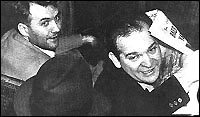
Goldstein
Phil looked around…there, against the wall was his weapon: a fire axe.
“I take the axe and sink it in the guy’s head in the dark,” he thought. That would cause a huge racket and in the ensuing commotion, Phil — who was a stranger in Jacksonville — would just run out with the rest of the panic-stricken crowd. Typical Pittsburgh Phil brilliance.
But, as Pep would later tell his friends, the guy was “a seat-hopper.” Just as Phil was ready to do the job, the man jumped up and moved to a better seat. For Phil, that settled it. This was a bad job and he wanted nothing to do with it. He left the theater, flew home to Brooklyn and admitted failure.
Whether that meant a reprieve for the man who had brought down the wrath of the Florida mob will never be known. Phil might have been disappointed on this trip to Florida, but he certainly got more than his fair share of kills. According to Turkus, Phil killed more than 30 men in a dozen cities. He begged for contracts and took great delight in a job well-done. Pittsburgh Phil wasn’t a serial killer, though. He was just another slayer in the stable of Murder, Inc., the enforcement arm of America’s crime Syndicate. With mobsters like Bugsy Siegel, Joey Adonis, Albert Anastasia, and Kid Twist Reles, “Pittsburgh Phil” formed the firing squad of a national underworld cartel that controlled gambling, unions, loansharking and narcotics from the end of Prohibition through the 1950s.
This is the story of Murder, Inc. from its beginning as the brain child of Johnny Torrio and Lucky Luciano to the death of Albert Anastasia, the “Lord High Executioner” of the Syndicate in 1950s.
At the height of its efficiency, Murder, Inc. was probably responsible for a thousand killings from coast to coast. Guns and knives were used, of course, but so were more imaginative methods like cremation, slow strangling, quicklime and live burial. Some killers liked the icepick — properly inserted into the ear, a skilled killer could scramble a bum’s brains and make it look like a cerebral hemorrhage. One gangster who had cheated his compatriots out of their take of a gambling operation was stabbed and then tied to a pinball machine and dumped into a lake. Until it was broken by a stool pigeon with first-hand knowledge of dozens of killings, Murder, Inc. operated quietly and ruthlessly, rubbing out gangsters who had run afoul of the cartel and lawmen who threatened its existence.
This is a story of remorseless killers and tough, fearless lawmen; of unbelievable brutality committed in the name of greed and of devotion to the rule of law.
“The protection that clears a killer of murder in New York cannot get Mr. Milquetoast out of a traffic ticket in Kansas City. But Lucky had the key to transform local crime into a national menace that would make the Borgias look like Sunday-school teachers and the Medicis angels of mercy. And this key was syndication.” ( Sid Feder and Joachim Joesten, The Luciano Story )
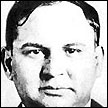
By 1922, Giusseppe Masseria had become the head of the Mafia in New York City. Riding high on the fruits of the liquor rackets, “Joe the Boss” had ruthlessly murdered his rivals and consolidated his power by assembling a crack team of bloodthirsty killers. Masseria, who had stepped in to fill the shoes of Ignazio “Lupo the Wolf” Saietta, was a stumpy, stern-faced killer who had been patient enough to wait until his army was strong enough to withstand an all-out gang war before making his move to replace Lupo. But Masseria was also a “Mustache Pete” — an old-school Mafioso — who did not have a vision for the future and believed that Sicilians should only do bsusiness with Sicilians.
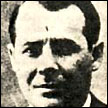
Not all of Masseria’s lieutenants supported their boss’s view of things, however. Men like Lucky Luciano, Lepke Buchalter, and Joe (Joey A.) Adonis had been talking of a cartel of sorts to keep bloodshed between gangs to a minimum and to ensure that supply of liquor did not exceed demand.
Joe the Boss’s chief lieutenant was Charles “Lucky” Luciano (born Salvatore Lucania) and he had a plan. Like Lupo, Joe the Boss and Sal Maranzano, Lucky believed that New York needed a single boss to keep the rackets moving smoothly and to halt the internecine warfare between the various clans. And Lucky knew that one day, he would be that boss.
As the Roaring 20’s ended, the various gangs came together in a liquor cooperative they called “The Big Seven”: Masseria’s mafiosi were represented by Lucky, with Joey Adonis and Johnny Torrio for help; Irving Bitz and Salvatore Spitale — who later played a role in the Underworld’s fruitless search for the Lindbergh baby — represented the New York independents; Bugsy Siegel and Meyer Lansky were members, as were Longy Zwillman of Newark and King Solomon, Danny Walsh and Cy Nathanson.
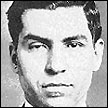
(POLICE)
Together, the Big Seven controlled all rumrunning on the Eastern Seaboard. The group had its own ships and trucks, set up offshore loading bases in the Bahamas and had an extensive radio communications network. Everything, including the price of booze and the bottles that would be used were controlled by the Big Seven. And Lucky was the nominal head of the group.
This monopoly was a far cry from the national Syndicate which would control all aspects of organized crime in later years, but for bright guys like Lepke, Meyer Lansky and Lucky Luciano, it was clear that they were on to something. Cooperation, not conflict, was the way to go.
But Joe the Boss didn’t see the advantage of working in cooperation with these other gangs and his ignorance sealed his fate. His credo was “An organization works on its own and knocks off anyone who gets in its way,” wrote Sid Feder and Joachim Joesten in The Luciano Story. Joe would have to die and it was up to Lucky to take action.
After a traditional Italian dinner at Masseria’s favorite hangout and a couple of games of cards, Lucky excused himself from the table and went to the bathroom. While he was in washing his hands, three gunmen, reportedly Joey A., Bugsy Siegel and Albert Anastasia, walked into Scarpato’s restaurant and opened fire on Joe the Boss. More than 20 bullets were fired by the three men, five of which found their mark.
When Lucky emerged from the bathroom, he found Masseria slumped over the card table, his outstretched hand still gripping the ace of diamonds like he was ready to make a play. But Lucky wasn’t boss yet.
While it was clear to most that the younger faction of the mob was taking over, there were still several Mustache Petes — especially Sal Maranzano — who had to go. Maranzano and Masseria had been at each other’s throats in what came to be known as the Castellamarese War — named for Maranzano’s backwater home village in the mountains of Sicily. With Masseria dead, Lucky assumed control of the Mafia and made “peace” with Sal. The peace didn’t last long and just five months after Masseria died, Bo Weinberg and four other gunsels from the Bug and Meyer mob entered Maranzano’s real estate office in New York City and eliminated the elderly Sicilian. Now, Lucky was boss.
Wiith Prohibition gone, the mobs had to turn to new ways to make a buck. Lepke was making a mint extorting money from labor unions and business; Dutch Schultz was doing well with a restaurant protection racket and everyone was running gambling houses. Narcotics was big, too. The Bugs and Meyer Mob was cleaning up as an unofficial murder-for-hire organization.
Johnny Torrio, who had gotten his start in the New York rackets, moved to Chicago and then turned that operation over to Al Capone, had an idea: the time had come for a national crime Syndicate. Before a group of the most powerful mobsters in the country, Torrio shared his vision.
“See what you think of this,” he told the assembled hoods. “Why don’t you guys work up one big outfit?”
Wait a minute, came the reply. Didn’t we just go through two top bosses in less than a year? We’re independents, the mobsters argued. We don’t work together. One big gang wouldn’t change anything and no boss wanted to take a backseat now.
“You don’t have to throw everything into one pot; each guy keeps what he’s got now, but we make one big combination to work with,” Torrio countered.
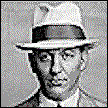
Lepke and Luciano jumped on the idea. In order for such an idea to work, the inter-gang warfare had to stop. No independence would be sacrificed, and no one would be the capo di tutti capo — the boss of bosses.
The Syndicate would work like a corporation of sorts. There would be a board of directors where everyone was equal and such a board would moderate disputes between gangs, set general policy and have the final say over inter-mob dealings. Each mob would have its own territory, its own soldiers and its own rackets. Inside the mob’s territory and operations, the head of the gang ruled supreme. No killings would be allowed unless he gave his okay, and no one could crowd in on his action unless he approved. The only time when the boss’s word was not inviolate was when he was overruled by the board of directors. And even then, no decision would be made until after that boss had presented his side of the beef.
Lucky, Frank Costello, Lansky and Siegel, Joey A., Longy Zwillman and Lepke Buchalter all signed on to the new cartel. The only one left out was Dutch Schultz, who was regarded by his colleagues as a loose cannon who could not be trusted and whose “mad dog” reputation would only bring down heat on the new Syndicate.
Later, meetings would be held around the country and everywhere the response was the same. Detroit signed on and the Purple Gang was integrated into the Syndicate. Kansas City joined up, so did Chicago, Cleveland, St. Louis, New Orleans. The Syndicate quickly went nationwide. It was a brilliant set up, one which Burton Turkus called a “more perfect union — for crime.”
Killing is an essential part of an organized crime racket — for criminals understand only the law which comes from the barrel of a gun. Every mob must, from time to time, mete out its own justice, either to a member of the gang or someone who threatens the gang’s security. But sometimes, a local gunman isn’t right for the job. It could be because the killing will immediately point to the mobster who ordered it or for some other reason that makes it inopportune for the local killers to take the contract. Over the years, various mobs had traded favors by sending someone to take out the bum, like Pittsburgh Phil and his trip to Florida. Other times, freelancers could be found to take the job.
The Syndicate board of directors needed the ability to enforce its edicts. Bugsy Siegel and Meyer Lansky had a number of hired guns, but they had other interests, as well. The Bugs and Meyer mob wanted more than just to do the crime Syndicate’s dirty work. It was essential that such an enforcement arm be skilled, relentless and willing.
Thanks to Joe Adonis, the dapper gangster with the movie star looks who sat on the national Syndicate board of directors, a group of killers in the Brownsville section of Brooklyn began to pick up some of the contracts. And over time, the Syndicate members began to realize that the Brooklyn gang was almost always successful.
“The precision-like technique they had perfected came to be looked on with great respect and approbation by mob moguls the country over, for the painstaking attention to detail and its neat finality of accomplishment,” Turkus wrote.
Lepke Buchalter, for example, used the Brooklyn boys exclusively, paying a flat-rate $12,000 annually for their services. “Those kids in Brooklyn got it taped real good,” Lepke once told a pal. “That Reles and Pittsburgh Phil, and that Maione know how to cover up a job so nobody knows a thing.”
Abe “Kid Twist” Reles, one of the killers whom Lepke so admired, was a cunning, wire-haired fireplug of a man, a bootlegger who rarely touched alcohol and was tough enough to take two bullets — one in the gut and another in the back — as he ascended to his leadership role in the Brownsville mob. Kid Twist had hands that could strangle a man — and often did. His fingers were broad and flat at the ends and “one could almost imagine this low-browed bandit driving rows of nails into a board merely by snapping the fat heads of his fingers down, one by one,” Turkus recalled.
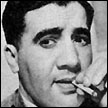
Kid Twist and his mobster buddy Buggsy Goldstein had been living a charmed life, by crime standards. Together, they had been arrested more than 70 times and had only served 50 months behind bars between the two of them. Unlike Pittsburgh Phil and Happy Maione, who killed merely because they liked to kill, Kid Twist only killed when necessary. He was Brooklyn’s Public Enemy Number One from 1931 to 1940, when he strolled into a borough police station and started what would become the downfall of Murder, Inc.
Kid Twist was small in stature, but large in ego. He wasn’t afraid of the law and was often openly defiant when he appeared before a court. In 1934, when he was sentenced to three years for assault, the soda-jerk-turned-crime-lord was castigated by the judge.
“Reles is one of the most vicious characters we have had in years,” said the judge. “I am convinced he will either be sentenced to prison for life or be put out of the way by some good detective with a couple of bullets.”
Reles sneered at the judge and whispered to his attorney, who then turned to the court. “I will take on any cop in the city with pistols, fists or anything else,” Reles said. “A cop counts to fifteen when he puts his finger on the trigger before he shoots.”
He was, Turkus claimed, a moral imbecile. Reles admitted to 11 killings and the law could link him to 14 others. In one of those, Reles protested, he had only held one end of the rope and didn’t pull it, so it couldn’t possibly be considered a murder count against him.
Reles and Buggsy had taken over Brooklyn, Inc. in 1931, after killing the Shapiro brothers, who had visciously raped the woman who would later become Reles’s wife, to send the headstrong Kid Twist a message. Meyer, the elder of the Shapiros and the reigning gangster in Brownsville, escaped the Reles death squad a remarkable 19 times but succumbed in the end. He was found under the beach in Canarsie; an autopsy revealed sand in his lungs. Reles had buried the gangster alive.
By the mid 1930s, Luciano’s national Syndicate had almost complete control over the rackets in New York City. Prostitution had been organized, as had hijacking and extortion, and the unions of New York’s garment workers, longshoremen and restaurants were under the control of the gangs.
At the same time, Murder, Inc. was running at full steam. Luciano had sent Bugsy Siegel out west to organize the Los Angeles mob and integrate Jack Dragna’s gang into the Syndicate. Lucky appointed Lepke Buchalter as head of Murder, Inc. and named Albert Anastasia as the boss of the Brooklyn boys.
Buchalter had been a member of the Amboy Dukes — so named because they came from Amboy Street in Brownsville — and was the dominant player in the mob that ran the city’s garment industry. Born LouisBuchalter in 1897, Lepke (Yiddish for “Little Louis”) had never known an occupation other than crime.
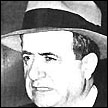
Lepke’s police record stemmed back to 1913, when he was arrested with his partner Gurrah Shapiro for shaking down pushcart operators in Brooklyn. He had served an apprenticeship with Li’l Augie Orgen in the 1920s and helped Li’l Augie gain control of the garment workers unions. In 1926, the bantamweight Lepke decided with the help of Gurrah to push out Orgen and his lieutenant Jack “Legs” Diamond. They succeed in killing Orgen and wounding Legs Diamond, who would eventually be killed by some of Dutch Schultz’s gang in 1931.
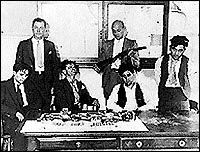
Vito Gurino, Abe Reles, and Happy
Maione
Lepke was not just an industrial mobster, he had his fingers in other traditional mafia areas, as well. During Prohibition, Lepke was a rumrunner (or rather his gangsters were), and had developed an intricate narcotics smuggling operation, receiving a cool 33 percent of the profits from any drugs brought into the country. Once the drugs were in the U.S., they belonged to Lucky Luciano
As the supreme head of New York’s industrial rackets, Lepke needed a stable of gunmen to preserve order. That’s where gunsels like Kid Twist, Mendy Weiss, Happy Maione and Buggsy Goldstein came in. Lepke culled his gunmen — mostly Jewish — from other mobs. By the time his good friend Lucky Luciano became capo di tutti capo, Lepke had an army of more than 200 of the most vicious killers in the city.
And kill they did.
Lepke’s overseas buyer Curly Holtz, who once arranged six quick shipments of morphine and heroin and earned his boss $3 million profit in just 10 days, got greedy. He pocketed part of the buy money on a trip to Europe and tried to cover up the theft by tipping authorities to the shipment. He was caught by his friends and paid for his greed with his life.
Lepke had been one of the early proponents of a national Syndicate to bring “peace” to the rackets, but he was greedy, too. A cartel, he had argued at the summit meeting with Johnny Torrio, would make intergang warfare a thing of the past. But that didn’t mean that he didn’t covet things belonging to other gangsters.
Thanks in part to the efforts of a an ambitious prosecutor and a precocious New York County grand jury, Judge Lepke (who earned that moniker as a result of his seat on the national Syndicate’s tribunal), got his chance to move in on Dutch Schultz’s operations.
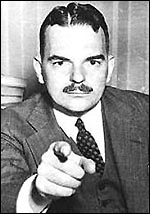
The Dutchman, excluded from the Syndicate because of his uncontrollable nature, was in trouble. He was on the lam from a sharp federal attorney named Thomas E. Dewey who wanted to put Schultz away because of income tax evasion. Dewey was as ambitious in the political arena as his targets were in the underworld and he knew that nailing a big time hoodlum like Schultz would go a long way toward furthering his own career.
In 1934, with Dutch underground, the Syndicate went to the acting boss of the Schultz operation, Bo Weinberg, and told him to bring his mob under the control of the crime cartel. Bo, who never expected Dutch to beat the federal tax rap, didn’t need to be told twice. Lepke took over the Dutchman’s restaurant shakedowns and Lucky got the Harlem numbers rackets.
But thanks to some expert legal maneuvering, which got his trial moved out of New York City to upstate, and some creative philanthropy on his part, Dutch beat the tax rap and returned to find his empire in a shambles. He took out his rage on poor Bo Weinberg, who reportedly rests at the bottom of the East River in New York wearing a cement overcoat.
Dutch, settled in Newark and powerless against the Syndicate and Murder, Inc., began to operate a number of small rackets with Longy Zwillman’s permission. Dutch wasn’t broke, either. He reportedly had millions stashed away from the salad days of Prohibition, when his Needle Beer was one of the bestsellers in the City.
Dewey, who had been embarrassed by his failure to convict the stocky former printer-turned-bootlegger, got a second chance to save his political career. In 1935, a grand jury in Manhattan decided it wasn’t getting the cooperation from District Attorney William C. Dodge, who reportedly received a $30,000 campaign contribution from Dutch Schultz’s mob.
Dodge had pulled an effective assistant D.A. off the case just as the grand jury was ready to hand up some indictments against “important” people. Dodge took over the case himself and the investigation bogged down. The grand jury, which had the power to order the prosecutor to pursue any matter it feels necessary, demanded that Dodge be replaced.
Governor Herbert Lehman appointed Thomas E. Dewey who immediately began looking into Dutch’s numbers rackets.
The Dutchman was livid.
“That Dewey,” Schultz cried. “He’s my nemesis. He’s got to go. He’s got to be hit in the head.”
The Syndicate board listened to Schultz, and some members agreed with the bootlegger, but in the end decided to table the matter for more discussion. The board assigned Murder Inc.’s Albert Anastasia to track Dewey in case the order came down to rub him out. Weeks later, Anastasia reported back to the Syndicate directors that the hit was do-able. Dewey was a man of routines and there was an opportunity every morning to kill the special prosecutor as he made his way to work.
In the end, it was the limitations of Dewey’s mandate that saved his life from Albert A.’s plan. “The best Dewey can do is try to go after the New York rackets,” Lepke argued. “He can’t touch anything outside of New York.”
Besides, Lepke continued, his investigations will collapse when the witnesses disappear.
Lepke went on, “If we knock him off, even the federals will jump on the rackets. We’ll be chased out of the country.” Killing the prosecutor would be bad for business, the Syndicate decided. Dewey would not be hit. Dutch went ballistic.
“I still say he oughta be hit,” Schultz screamed. “If nobody else is gonna do it, I’m gonna hit him myself. Schultz boasted further that the D.A. would be dead within 48 hours. He stormed out of the meeting
“This is no good,” Lepke said. “The Dutchman is just daffy enough to do it.” Lepke then moved that for the sake of the Syndicate, Dutch Schultz should die. The motion carried.
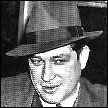
Killing the Dutchman would require a special touch because he was always heavily armed and on guard. Two of Murder, Inc.’s best killers would be required for this job. Lepke contacted Mendy Weiss and Charlie “The Bug” Workman for the rubout.
Mendy Weiss was a strangler and had worked his way up through the strong-arm labor rackets. A flashy dresser, Mendy was a thick-lipped, redheaded bruiser who liked diamonds and new cars and acted as underboss for Lepke when Judge Louis had to go underground.
Mendy stayed by the door to cover the Bug’s exit and Workman made his way into the restaurant. The Bug strolled through the diner and went to the men’s room in the back. He opened the door and saw a man washing his hands. Something about the guy looked familiar — one of Dutch’s bodyguards, he guessed — so Charlie opened fire. The man dropped in his tracks.
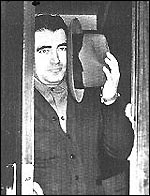
Emerging from the bathroom, the Bug moved to where Schultz and his gang had been meeting. He started shooting at the men sitting there and killed Lulu Rosencrantz, Dutch’s chauffeur, Abbadabba Berman, his numbers expert and Al (Misfit) Landau, a gunman for Schultz.
“Where’s the Dutchman?” the Bug asked himself. “I gotta get him.”
Then he realized…the man in the washroom had been Dutch Schultz.
The Bug returned to the bathroom and after rifling through Schultz’s pockets for any cash the gangster might have been carrying, made his way to the front of the restaurant. Mendy was gone. So was Piggy and the getaway car. Charlie ducked into an alley, hopping over fences and running through fields, and eventually made his way back to New York.
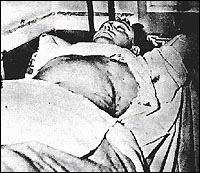
Dutch Schultz wasn’t killed that night in the Palace Steakhouse. It took him 48 hours to die, and he raved like a mad man as he hovered near death. Even in periods of lucidity, he refused to name his killers, only saying that “the Boss” had ordered it.
Mendy had some explaining to do. As a staff gunman for Murder, Inc. it was a capital offense to run out before a job was complete. A trial was convened before the Syndicate tribunal but Mendy had an excuse.
“When the Bug went back to rob Schultz, that made it personal business,” he explained. “I was there through the hit — which was Syndicate business. I did my job. But when Charlie decided to rob Schultz, that was personal. I didn’t have to stay.”
His argument held sway, even the Bug couldn’t argue with it.
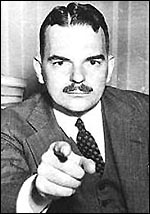
Having taken over a good chunk of Dutch Schultz’s operations, Lepke became a prime target of law enforcement. But that didn’t concern Judge Lepke too much, for he had friends in high places. Buchalter and Gurrah Shapiro were two of 158 people named in a 1933 federal indictment on racketeering charges. They were quickly tried and convicted of the crime and immediately appealed the verdict. The trial judge denied bail, but U.S. Circuit Court Judge Manton overruled the judge and allowed Lepke to post $3,000 bail. The Honorable Martin T. Manton would eventually be removed from the bench because “his decisions were frequently influenced by something more than legal merits,” Turkus wrote. Lepke wasn’t too worried by the appointment of Thomas Dewey as special prosecutor and he always seemed to be one step ahead of the law. A bug in his office was thwarted by a loud radio; he would meet his underlings only after he was sure he had lost the tails that Dewey set on him; he only answered his phone when someone called for “Murphy.” And Lepke was a firm believer in taking care of problems at their source. If there was a potential witness and that witness couldn’t be trusted, eliminate him.
But by 1937, the heat was on Lepke and he decided to lam. He turned over day-to-day operations to Mendy Weiss and decreed an all-out “war of extermination” to halt the Dewey probe. With no canaries to sing, the D.A. would have no case, Lepke believed.
“What followed was a bloodbath,” Turkus wrote. “That was when he was officially labeled ‘America’s most dangerous criminal.'”
Throughout the Northeast, gangsters scrambled for cover like cockroaches when a light is turned on. Not only were they on the run from the law, they were looking over their shoulder lest another mobster be gunning for them. In 1939 alone, Lepke ordered the boys from Brooklyn to make more than a dozen hits, Turkus said. Sometimes he would have two Murder, Inc. crews on the road at a time looking for mobsters who might squeal.
Ironically, it was Judge Louis’s bloodbath that helped Dewey and Turkus the most. Low-ranking mobsters who had been marked by Lepke for death ran straight into the arms of the law for protection.
Joe “The Baker” Liberto, the night attendant at a garage owned by Vito Gurino, a Murder, Inc. soldier and friend of Lepke’s, wasn’t a mobster, per se, but he knew where the bodies were buried. Sometimes Joe the Baker helped Murder, Inc. get a hot car for a job and as such was dangerous to Lepke. He was one of the many walking dead who turned from being a Murder, Inc. helper into a target. Happy Maione, picked up in one of the early raids on Murder, Inc., ordered his brother-in-law, Joe Daddonna, to silence Joe the Baker before Liberto could talk. Daddonna kidnapped Liberto and held him in a house in rural Long Island, but Liberto managed to escape by diving out a window. The Baker made his way back to Nassau, Long Island where his mother lived, but Daddonna tracked him down. However, before Daddonna’s Murder, Inc. buddies could show up to finish the job, the cops — tipped by someone — showed up and took the Baker into protective custody.
Even in custody, Joe the Baker wasn’t safe from the long arm of Murder, Inc. Vito Gurino showed up several times at the Queens County Civil Jail wanting to know if Joe had talked and telling him that “if he wanted to go for a ride, that could be arranged.” Gurino had carte blanche access in the Queens County jail, but he knew his face was too well known to pull the job on Joe the Baker himself. He hired a helper for $100 to fulfill the contract. The accomplice went straight to the D.A. instead and that was the last time Murder, Inc. had a shot at Liberto.
Armed with the knowledge that Gurino was gunning for Liberto, Turkus was able to offer protection in exchange for testimony. “The mob itself had unlocked the lips of the Baker,” Turkus said.
Big Julie Catalano was another low-level mobster who rushed to the law for help. Picked up on vagrancy charges early in the Dewey probes, Big Julie was bailed out by his brother against his wishes and put back on the street. He was outside for three weeks before Turkus realized that Julie was more valuable dead than alive to the mob because of what he knew.
A day after his brother posted bail — the mob forced him to do so — Big Julie received a visit from Gurino who told him that Happy Maione, languishing in the Tombs, wanted to see him.
“Vanish,” Hap told Big Julie. “Make yourself scarce from the neighborhood.”
Big Julie wasn’t too bright and the last thing he wanted to do was leave home. So he went home and sent Happy a wire telling him he had no intention of taking it on the lam. His suspicions aroused, Happy told Vito to silence Big Julie.
Vito showed up at a wedding where Big Julie was celebrating. “Let’s go for a ride,” he said. “I’m gonna help you hide out.”
Big Julie knew what that meant and stalled for time. “I’m going to tell my wife I’m leaving,” he said.
“No,” Vito told him. “Don’t tell her anything.”
“Then I need some clothes,” Julie replied. Vito acquiesced and told Big Julie to go home, get his stuff and meet him in an hour.
As he was weighing his options at home, salvation arrived in the form of two policemen acting on Turkus’s orders to pick him up. Big Julie nearly leapt into their arms, he was so overcome.
Gangsters on the lam presented no problem for the gunmen of Murder, Inc. Even when the law couldn’t find a hoodlum, the tenacious killers from Brooklyn could track down anyone who was hiding out — either from the police or from fellow gangsters.
Witness the death of New York bootlegger Abe Wagner.
In 1932, Wagner and his brother Allie controlled a modest, yet profitable bootleg operation on the Lower East Side of Manhattan. Faced with rising competition from the upstart Mazza Gang, Wagner had survived a blistering barrage of gunfire on crowded Suffolk Street and was anxious for peace.
“Wagner was not a trigger-happy gangster who would immediately start a gory underworld war because of such pointed animosity,” wrote Turkus. “His maxim was that it was better to be a live coward than a dead gang boss.”
Wagner decided to sue for peace and sent his brother Allie to meet with the Mazzas who had the backing of Luciano. Instead of peace, Allie turned up dead and Abe decided to take it on the lam. He packed up a few possessions and with his wife, Goldie, decided to head west.
Ironically, the police gave the Mazza gang its first tip about Abe’s whereabouts. While searching for clues about the Lindbergh kidnapping, New Jersey State Police commander Norman Schwartzkopf (father of the Gulf War general) made it known that Wagner had been seen around Hopewell, New Jersey. The Mazzas sent a gunman to finish the job on Wagner, but the bootlegger was wary and spotted the killer first. Instead of making a contract, the Mazza killer wound up dead himself.
Abe and Goldie then fled to St. Paul, Minnesota, where Wagner changed his name and occupation. He was found by Murder, Inc. operating a fruit stand in the Midwest capital and slain while he ate dinner in the Midway, between St. Paul and Minneapolis.
“Deliberately, the gunmen pumped seven bullets into the incognito bootlegger,” Turkus wrote. “And as he lay there, they clobbered his head with pistol butts. They were unhurried. They had orders to get the job done; get it done, they did.”
The gunmen — reportedly members of the Bugs and Meyer Mob — were so intent on their work that they were caught in the act by local police. A fortune was spent on saving the men from the electric chair and they both received life terms in Stillwater Penitentiary.
Murder, Inc. is also responsible for the first “real” organized crime slaying in Southern California. The killing of Big Greenie, nee Harry Greenberg, demonstrates the inherent danger of a gangster knowing too much for his own good. Lepke’s admonition that “investigations collapse when no witnesses are around,” is a double-edged sword in gangdom, for many times the only witnesses to crimes are criminals themselves. This is good if the witnesses can be trusted to keep their mouths shut, but when powerful mobsters realize that the small fry can be convinced by law enforcement to spill their guts, odds are that the small fry will pay with their lives.
The 1939 slaying of Big Greenie was one such case. Greenberg — who also went by several other aliases, including Harry Schacter and Harry Schober — had been an insider in Lepke’s union operations and was a Bugs and Meyer gang alumnus. When Dewey began his probe of Lepke’s operations, Big Greenie was sent underground and was hiding out in Montreal. But the cost of lamming is expensive. If the reward posted by the law is high, there is a great incentive on the part of cohorts to sell out their hidden brethern. Big Greenie started to run low on money and warned his gangland buddies not to forget him.
Mendy Weiss, who had taken over the day-to-day operations while Lepke hid, viewed Greenberg’s note as a threat — pay up, or else. He ordered his gang to take out the union goon. Allie Tannenbaum took the contract and headed to Canada to rub out Big Greenie.
But the bird had flown. Perhaps Big Greenie realized that his note had not been well-received, or he had heard that Lepke was ordering a general purge of prospective witnesses. Nevertheless, Greenberg fled west to Detroit, where he had friends in the Purple Gang. The Motor City mobsters gave Greenie a warm welcome, a little too warm for his tastes; he suspected a set-up.
Greenie fled further west to Southern California, where Bugsy Siegel had established a Syndicate franchise. Allie boarded a plane in Newark and headed to Hollywood, where Greenie had been spotted. Frank Carbo, a former boxing manager and mobster was asked to help out and Bugsy added his own specialist, Whitey Krakow, Siegel’s brother-in-law.
Things went well this time, and “Big Greenie, lamster, became Southern California’s first important gang cadaver,” according to Turkus. Despite eyewitnesses and corroborating testimony, no one was ever convicted in the Harry Greenberg killing.
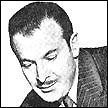
The handwritten note held by Burton Turkus didn’t look like much, but it was the thread that, when pulled, would eventually unravel the fabric of Murder, Inc. Written on the stationary provided to inmates at New York’s Riker’s Island City Workhouse, it read:
“Dear sir:
I am doing a bit here. I would like to talk to the District Attorney. I know something about a murder in East New York.”
It was signed “Harry Rudolph.” Rudolph was well known to the New York law enforcement community. Detectives called him “a full mooner” someone whose mental faculties are not all together.
Harry was serving a short stint for a misdemeanor, so he wasn’t looking for a sentence reduction in exchange for cooperation. Turkus and his investigators, who had been working on nearly 200 unsolved homicides believed to be connected to organized crime, decided to talk to Rudolph. “We have nothing to lose,” Turkus thought.
“Those rats killed my friend Red Alpert,” Rudolph alleged. “Those Brownsville guys — Reles and Buggsy and Dukey Maffetore. They took Red when he came out of his house.”
Nineteen-year-old Alex “Red” Alpert, a small time hood had been shot at the edge of his house in 1933. He apparently had been involved in a jewel heist and tried to fence some goods to Pittsburgh Phil. The two men had been unable to agree on a price for the gems and Pep was angry over Red’s insolence.
Murder, Inc. was called in and Red paid with his life. For more than six years the crime had remained on the unsolved list.
Rudolph’s allegations were good enough to allow Turkus to get a grand jury indictment of Reles, Dukey and Buggsy Goldstein. Turkus didn’t hold out a lot of hope of getting a conviction of the men on just the testimony of a “full mooner” like Rudolph, but he got the indictment because “at least it would keep them off the streets — until a trial anyway.”
The cops picked up Dukey the afternoon the indictments were handed up. Word went out that Reles and Buggsy were wanted men and surprisingly, they turned themselves in the next morning.
“The same old crap,” they crowed. “Here we are. This is the old walk-in-and-walk out.”
Ironically, the two men who had beaten so many raps before turned themselves in on the one murder charge that stuck.
Maffetore wasn’t the brightest bulb in the Brownsville mob. A “sleek young flyweight,” Dukey was an avid reader of Li’l Abner and Superman comics, but like the rest of the gang wasn’t afraid to kill. His English left a lot to be desired and he was more comfortable talking in Italian. Turkus and the police decided to lean on Dukey because they were convinced Kid Twist and Buggsy would never talk. But Dukey was tough. The law tried everything to get him to open up, but Dukey knew what happened to stoolpigeons. Nowhere would be safe if he squealed. A guy could get a shiv in the neck in the prison exercise yard just as easy as he could go down in a burst of gunfire in the street.
A break in the case came from Harry Rudolph.
“It’s worth five grand to me if I pin this on Dukey and square it with Kid Twist and Buggsy,” he told Turkus. There were corroborating witnesses who also told Turkus that Reles and Goldstein planned to sell out Dukey.
The assistant D.A. lost no time in telling Dukey how his friends were willing set him up. That broke Maffetore’s will and he sang for more than an hour about what he knew of the mob and Murder, Inc. But it was clear that Dukey was a fringe player and a higher-up was needed to fill in the gaps.
“You should go get Pretty,” Maffetore told the law. “He’s smart. He knows a lot more than me.”
Pretty Levine, a killer with big blue eyes and curly hair, had been involved in half-a-dozen slayings by the time he was 23. A newlywed, Pretty and his wife Helen tried to make a break from the underworld and had almost made it when Helen gave birth to their first child. Pretty had been driving a truck and hauling garbage, but he wasn’t rich. When the hospital demanded payment before it would discharge his wife and child, Levine was forced to go to Pittsburgh Phil and borrow $100 at “6 for 5″— $1 a week interest for every $5 borrowed. Of course, over time, Pretty couldn’t make his “vig” — interest payments — so he was forced into working back for the gang to stay alive.
When Turkus went out to pick up Pretty, Pep was gunning for him, as well, because he thought both Dukey and Pretty would be valuable to the law. Fortunately for both men, Turkus and the New York City police beat the Murder, Inc. gunmen to Pretty’s house.
Downtown, Pretty was putting up a good front. He stonewalled Turkus for days and forced the assistant D.A. to take desperate measures. Turkus knew he was onto something big — just what and how big he didn’t know — but he was determined not to let Pretty set the agenda.
“Bring in his wife,” Turkus told his investigators. The lawmen picked up lovely Helen Levine and with her 16-month-old daughter, and took her downtown to see her husband. Helen begged her husband to tell what he knew, but Pretty stayed tough.
“They’ll kill me if I talk,” he told her. But then he relinquished a little. “I’ll talk about what I’ve done. I won’t talk about anymore than that.”
As his wife stood by and his daughter, Barbara, played at his feet, Pretty spilled his guts about the crimes he and Dukey had done, including one in which the two punks stole a car for someone and had it returned with a body in it.
“Now send me to jail,” he challenged.
Turkus played his trump card.
“You’ll go to jail all right,” the D.A. said. “And so will your wife. She heard your confession and now she’s a material witness.” Turkus ordered the woman sent to the Women’s House of Detention.
It took Pretty another couple of days before he finally cracked and implicated Pittsburgh Phil, Happy Maione, Dasher Abbandando, Louis Capone (no relation to Al) as well as Buggsy and Kid Twist in a number of slayings.
Pep, Reles, Louis Capone and Buggsy had killed Red Alpert, Pretty told the law. Pretty, Gangy Cohen, Pittsburgh Phil and Jack Drucker, a Brooklyn killer murdered Walter Sage, who had been skimming off the gang’s slot machine rackets. Sage was strangled, icepicked and tied to a pinball machine which then dumped into a Catskill Mountain lake.
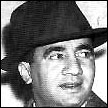
While this stuff was good, Turkus needed a big fish to start talking. He figured Buggsy or Happy Maione would break sooner or later and implicate their cohorts.
Imagine his surprise when Mrs. Abe “Kid Twist” Reles walked into his office and announced that her husband wanted to talk to the law.
If anyone knew where the bodies were buried, it was Kid Twist. After all, if he hadn’t been in on the slaying, he knew who did it and why. Turkus and Dewey wanted Kid Twist’s scalp and were slowly gathering enough evidence to pin something on him — probably something that would send him to the chair. The law never expected that Kid Twist would sing, even if the alternative was a one-way trip to the Sing Sing death house. Reles was tough, he was egotistical and he was smart. He knew the law better than most gangsters and felt he was a match for any attorney or detective.
Kid Twist had a long police record, but few convictions. He had six times been charged with homicide and never convicted. He was arrested nine times on assault charges and had one conviction. Between 1932 and 1940, the lisping gangster was arrested on the average once every 78 days, but his longest sentence had been two years for assaulting a parking attendant with a bottle. From 1932 to 1934, the law had picked up Kid 23 times but he had spent just 30 days in jail.
Despite having a string of call girls, Reles was reportedly a devoted family man. When his gangland career ended, he had a six-year-old son and his wife was pregnant.
Kid Twist voluntarily surrendered along with Happy Maione for the slaying of Red Alpert, confident that once again, he would walk. “Don’t worry,” he told Hap as they were separated in police headquarters, “it’ll be all right.”
After sitting in the Tombs in downtown Manhattan for a couple of weeks, Kid Twist got a visit from one of his lawyers who told him that Murder, Inc. was unraveling. Realizing that the next stop on the Murder, Inc. express was Sing Sing’s electric chair, Reles sat down and wrote a note to his wife, Rose, telling her to seek out the D.A.
Abe Reles was still cocky when he sat down with Turkus and Brooklyn D.A. William O’Dwyer. He was without remorse and laughed out loud when Turkus started talking about the Alpert killing.
“You think any jury would convict even a cat on what that bug Rudolph says?” he asked. “You ain’t got no corroboration.”
Reles demanded to speak to O’Dwyer alone.
“I can make you a big man,” the criminal told the prosecutor. “But I walk.”
O’Dwyer and Turkus knew that Kid Twist would give them enough to break the murder mob, but they were reluctant to deal with such a cold-blooded killer. Eventually, though, a deal was reached. Kid Twist would testify before grand juries and at trials, but he would not waive his immunity from prosecution. The law couldn’t prosecute him for the killings he admitted, but if something else came up, it was fair game.
“Reles’ song was a full-length opera,” Turkus wrote. ” ‘I can tell you about 50 guys that got hit,’ he said. ‘I was on the inside.'”
Kid Twist talked for two weeks straight. His memory was amazing. He remembered who was hit, who hit them and why. No details were left out. Before he was finished, Reles helped the police close the books on 85 separate killings in Brooklyn alone and for the first time revealed the organization and structure of the national Syndicate. He testified at trials in Los Angeles, Newark and New York City; his information would send four men directly to the chair — including the biggest fish of them all, Lepke Buchalter.
Lepke Buchalter was on the run, both from the feds, who wanted him for a narcotics charge, and the New York authorities, who were desperate to nail him for his Murder, Inc. and Syndicate activities. From time to time reports would surface that Lepke was in Cuba, or that he had been seen in South America on a yacht or in Poland at a spa. There was a $50,000 reward out for Lepke, but for two years he remained free. Once he had escaped a sure pinch when ignorant cops busting a nickel-and-dime bookmaking operation didn’t recognize him. As police around the world searched for Lepke, he was hiding out right under their noses, for Judge Louis had never left Brooklyn.
Then, Lepke turned himself in.
The authorities were confounded. Why would a smart guy like Buchalter do something so stupid? After all, his New York activities could land him in the death house.
Lepke was a cool customer as he hid out with Reles and Albert Anastasia. Unlike many mobsters who tended to get a little buggy when they were on the lam, Lepke was smart enough to know that as long as he kept a level head, controlled who had access to him and tied up loose ends, he would be all right. But Lepke was also smart enough to know that he was causing a lot of gangsters a lot of discomfort. As long as he was hiding out, doing Syndicate business was hard. Many of his friends were already in custody and others were forced into hiding by the pressure that Dewey and J. Edgar Hoover were applying. Sooner or later, the Syndicate board would have to give him up. After all, the cartel was a utilitarian organization — the good of the many clearly outweighed the good of the one. And even if that one was Louis Buchalter, the guy who helped Lucky Luciano build the Syndicate, the national crime cartel would survive at any cost.
Moey Dimples, the Saratoga numbers man who had been a friend to Lepke since their days strong-arming cart vendors, was one of the few people who Lepke still trusted. So Lepke had little reason to doubt Dimples when he approached Judge Louis with some good news.
“A deal has been struck,” Moey told his old pal. “If you surrender to Hoover, the feds won’t turn you over to Dewey.”
Lepke was ecstatic. He was facing a ten-to-15-year sentence in Leavenworth if he gave up to the feds, but that sure beat the electric chair. He agreed to turn himself in directly to the FBI.
With Albert Anastasia at the wheel and Louis Capone’s sister-in-law and her son as cover, Louis “Lepke” Buchalter left his Coney Island hideout and traveled over the Brooklyn Bridge through the Manhattan warehouse district. It was a hot August evening and to any observers the quartet looked like a group of city dwellers out for a ride. Anastasia, who had cautioned Lepke against surrendering, navigated through the streets until he spotted the car he was looking for. Anastasia pulled over and parked.
Lepke walked over to the waiting car and sat in the back. Waiting for him was Walter Winchell, the syndicated columnist for the New York Daily Mirror. From nearby, a heavy set man joined the newspaperman and the racketeer in the car. It was J. Edgar Hoover, himself.
Then the other shoe dropped. Hoover informed Lepke that he had been set-up; Dimples never worked out a deal with the feds and that it was very likely that once Lepke finished his term in Leavenworth, the sovereign state of New York would be waiting for him.
Moey Dimples, the man who had been with Lepke from the beginning, had sold his friend a bill of goods. He owed Lepke, and it was a debt Judge Louis would make sure was paid with interest. Lepke was on death row when it happened, but one evening in 1943, a gunfight erupted in a New York restaurant and a man would die. Moey Dimples and Louis Buchalter finally were even.
The quiet of the dawning Sunday morning was broken by the sound of firecrackers as the man leaned over his sleeping son. Louis Stamler, a tailor, was waking the boy so he could go to work, when he heard the sharp reports. Stamler rushed to the window of his Brownsville home in time to see a large, black sedan rush away from the front of the candy store across the street.
Curious, Stamler quickly dressed and crossed the still dark street. Looking in the window of Rosen’s Candy Store, he saw the figure of a man lying on the floor of the store. Stamler ran down the block where he saw an approaching policeman and brought the flatfoot to the store. Inside, 46-year-old Joe Rosen, a former garment industry trucker, lay covered in blood, 17 holes in his body. He was quite dead. The gunmen had been good shots; a man’s hat could cover the 10 entry wounds, police reported. The date was September 13, 1936. Rosen, who was not known to police and appeared to be unconnected to the mob, was, in fact, a Murder, Inc. rubout. Eventually, Lepke Buchalter would forfeit his own life for Rosen’s.
Lepke was in Leavenworth serving a fourteen-year term when he was turned over to Dewey for the first time. The prosecutor quickly put together a case on Louis’s union rackets and managed to get a 30-year sentence. Then New York turned the racketeer back over to the feds. It looked like Lepke was going to prison for a long, long time.
But that was before Kid Twist started singing and mentioned a Joe Rosen contract.
Quickly, the New York authorities brought Reles before a grand jury and got an indictment on Lepke, Frank Costello, Louis Capone and Pittsburgh Phil, who was already in the Sing Sing death house with Happy Maione, the first victims of Kid Twist’s aria of murder.
It took sixteen months of legal wrangling between the feds and New York before Lepke was brought from Kansas to stand trial for Rosen’s slaying. When the case finally went to trial, more than five years had passed since Joe Rosen was gunned down in his candy store.
Rosen, it seemed, was not as clean as he led people to believe. And he wasn’t very smart, either. He had owned a trucking firm that brought garments to non-union shops in Pennsylvania when Lepke announced that there would be work stoppage.
“Louis,” Rosen protested. “That will cost me my business.”
Lepke promised Rosen that he would be taken care of. But Rosen was right; the work stoppage, which helped Lepke gain control of a garment trucking firm, forced Rosen out of business.
The trucker went to his friend, Max Rubin, who had been with him when Lepke announced the stoppage.
“You and Lepke promised you would take care of me,” he said. “Everyone is back at work and I’m on the streets.”
Lepke got Rosen a job with Garfield Trucking, but Rosen was fired in less than a year.
“This is no good,” Rubin told Judge Louis. “We’ve got a desperate man on our hands.”
Rubin and Lepke once again helped out Rosen to keep him quiet. They set him up in the candy store, where he and his wife were able to eke out a small living. But Rosen wasn’t a businessman and the candy store soon ran into trouble. Rosen pressed his luck and demanded more help from Lepke and Rubin. He was told to get out of town and to keep his mouth shut. Sadly, Rosen didn’t listen and he ended up dead that Sunday morning.
But Lepke, the man who had helped build the national crime Syndicate, the racketeer who had his fingers in nearly every New York union — from the bakers to the garment workers — the killer who had overseen a murder squad that was responsible for nearly a thousand deaths around the country, had made a very simple mistake. Lepke, the man who had insulated himself from the lower echelon killers and who took pains never to talk when someone he didn’t trust implicitly was in the room had screwed up. He had lost his temper over the gall of a small candy store owner who threatened to talk and didn’t realize that an underling had heard him issue the order to take care of Rosen. Lepke had broken his own cardinal rule and left a witness.
When Allie Tannenbaum, the killer who had stalked Big Greenie, took the stand in Lepke’s murder trial, Judge Louis wasn’t concerned. After all, Allie had nothing to do with Rosen’s slaying and couldn’t help the prosecution’s case. But Lepke was wrong. Allie was a hanger-on in the scheme of things; he reported directly to Lepke, but he took his orders from Mendy and Gurrah. Lepke might have wanted Allie to do a job and might want to know how it turned out, but he never directly told Allie to kill anyone.
But in court that day, Allie dropped a bomb on Lepke.
He told the story of the hit on Irv Ashkenaz, a Lithuanian taxicab driver who was talking to the law about Lepke’s involvement in the taxi rackets. The order for the contract came from Mendy Weiss, but Allie was required to report to Lepke about the results. He was confident that day in the fall of 1936 when he reported to Lepke’s office. The hit had gone well and he was sure the soft-eyed, quiet ganglord would be pleased. Allie was surprised by what he encountered when he strolled into the office.
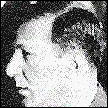
Rosen’s murder
“Lepke was yelling that he gave this Joe Rosen money to go away, and then he sneaks back into a candy store, after he tells him to stay away,” Allie testified. “Lepke was hollering: ‘There is one son of a bitch that will never go down to talk to Dewey about me.’ Max (Rubin) was trying to calm him down. He was saying, “take it easy; take it easy Louis. I’ll handle Joe Rosen; he’s all right.'”
“What did Lepke say to that?” Turkus asked.
“He says, ‘You told me that before.’ He says ‘This is the end of it. I’m fed up with that son of a bitch.’ He says, ‘and I’ll take care of him,” Allie recalled.
Two days later, Allie testified, he read in the morning papers that “Joe Rosen” had been killed in his candy store in Brooklyn. The papers said Dewey had been looking for Rosen. In Allie’s mind, that clinched it. Lepke had killed the shopkeeper.
The testimony of Allie Tannenbaum was good enough for the jury. Four hours after they were handed the case, at 2 a.m., the verdict came back against Lepke. The co-founder of the national Syndicate was guilty of first degree murder. The penalty for murder at the time in New York was death by electrocution.
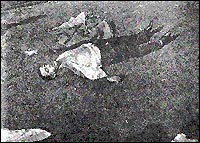
Kid Twist Reles probably would have gotten a kick out of testifying in Lepke Buchalter’s trial. After all, it was front page news and Reles would have been a star witness, if he had been around. It would have been the kind of coverage he would have loved. But before Lepke went to trial, Kid Twist was dead.
Conspiracy theorists had a field day with how Reles died. He was in a hotel in Coney Island, surrounded by five, maybe six cops who never left his side, but he still managed to take a dive out a sixth story window. Two bedsheets were found tied together and lashed to a heating register with a piece of wire. Even Assistant D.A. Burton Turkus believed that Reles had somehow been murdered while he was under police protection.
In his book, Murder, Inc., Turkus discounts several of the leading theories, including suicide, accidental death due to an escape attempt and accidental death in the course of a prank.
However, sometime after Kid Twist’s plummet from his sixth story hideout, the FBI analyzed the wire found on the radiator in his room and compared it to the wire next to his body. The break in the wire was due to stress, the FBI ruled. It was capable of holding 130 pounds and at the time of his death, Kid Twist weighed more than 160 pounds which was sufficient to cause the stress break.
It appears unlikely that anyone was able to penetrate the protective gauntlet that shielded Kid Twist and Reles probably died trying to climb down the makeshift rope to the room below. For what reason we will never know; divine retribution is as good a reason as any.
Justice
A big gangster doesn’t go down without a fight, and at the time there was no one bigger than Lepke Buchalter. Louis might have been safely behind bars, but if he had his way, he would never see the inside of Sing Sing’s death chamber. Lepke had connections, and more importantly, he had knowledge that could make a lot of people uncomfortable. And not just gangsters; Lepke was well-connected in political circles, too. Judges, prosecutors, even Senators were beholden to the Brooklyn crime lord. In the fight of his life, Lepke would pull out all of the stops to cheat justice one more time.
Lepke was convicted of murder in December 1941, but it would take another three years before justice would be meted out. New York’s judicial system requires that the NY State Court of Appeals hear and review any murder case involving the death penalty, and Lepke’s was no exception. The court upheld the conviction in October 1942. Lepke was in federal custody at the time, serving out his racketeering conviction and New York demanded that he be turned over to the state for execution. Not surprisingly, Lepke opposed the transfer and put up a valiant fight. He called in most of his markers with his federal friends in the Justice Department and the court system and managed to stay out of New York’s hands until January 1944.
The Sing Sing executioner was ordered to report for work at 11 p.m. on Thursday, March 2, 1944 to carry out the executions of Louis Capone, Mendy Weiss and Lepke Buchalter. That night, the men all ordered the same meals: steak, french fries, salad and pie for lunch, roast chicken, shoestring potatoes and salad for dinner. The trio were shaved, dressed in typical execution garb — slippers, black slacks with a slit on the left leg to make it easier to attach the electrodes and white socks. Then they were moved to “the Dance Hall,” the pre-execution cells just 25 feet away from the chair.
Mendy was tight-lipped and silent, Capone, who had a weak heart, appeared nervous, but Lepke was confident.
“Something is gonna happen,” he told his friends. “I can feel it.”
By 9:40 p.m., nothing had happened. Lepke’s wife came in and spent a tearful few moments with her husband, then left to go back to the city.
When she arrived back in New York, the bulldog editions of the newspapers were trumpeting the news that Governor Thomas E. Dewey — the man whose probe had helped put Lepke in the chair — had offered a 48-hour reprieve while the state’s highest court looked over the case one more time.
At least that was the reason the newspapers gave for the delay.
Eventually, word leaked out that Lepke had information that could rock the U.S. political system. What Lepke knew could help Dewey, who was running against Roosevelt for president, become an unbeatable candidate. Facts would be revealed that Lepke had enough information to make “a noted public official of New York City” face a conspiracy charge, could tie a “nationally prominent labor leader” in with a murder, and show that “a close relative of a very high public officeholder” was a front for two mobsters who ran national rackets. In return for what he knew, Lepke wanted to live.
“Whether Lepke’s revelations would have altered the course of history will, of course, never be known,” Turkus wrote. “However, to aspire to the presidency and be handed information of such national implication that it might swing the tide was as great a temptation as a man ever had. To the credit of Dewey, he did resist and he did reject. He would not do business with Lepke, even with the greatest prize on Earth at stake — the Presidency of the United States!”
On Saturday, as the final hours of the stay ticked away, the men were moved back to the Dance Hall. Once again they ordered their last meals and said their goodbyes. The open line to the governor’s mansion was checked once again, but this time there would be no stay. Lepke had run out of luck.
Louis Capone was the first to go. He said nothing as they strapped him into the chair. At 11:05 it was over. Mendy Weiss came next. He sat down in the chair and as the attendants made the preparations, Mendy once again protested his innocence. He asked the warden to pass along his love to his family and was silent. Three minutes later, Mendy was taken out on a gurney.
Lepke was last, as befits a gang leader. His eyes were hard as he surveyed the assembled witnesses and he acknowledged the ones he knew. The last thing he saw was the attendant lowering the hood over his eyes. The 2,200 volts of current pushed his body against the eight restraints on the chair. After the current ceased and the doctor declared him dead, the hood was lifted from his face. Perspiration covered his brow, drool appeared at the sides of his mouth and Lepke’s face was discolored. Louis “Lepke” Buchalter was dead.
Lepke’s execution signaled the end of the halcyon days of Murder, Inc. The murder troop had been decimated by prosecutions and Lepke’s war of extermination, and alternatives had to be found to enforce Syndicate policy. Albert Anastasia, who had miraculously escaped both the mob purge and the law, continued to act as Lord High Executioner for several years, but in the end, he too, would face mob justice.
In the late 1950s, the first generation Syndicate boys were in decline. Joe Adonis had been deported, as had Lucky Luciano. Frank Costello had been forced into retirement by Vito Genovese, leaving Anastasia in charge of the Vincent Mangano crime family. True to form, Vito Genovese wanted to be capo di tutti capo of the New York families and saw Anastasia as standing in his way. Don Vito worked a deal with Mangano underboss Carlo Gambino in which Gambino would take over the Mangano family when Anastasia was gone.
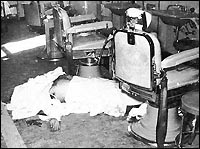
On October 25, 1957, Anastasia walked into the Park Sheraton Hotel in New York, sat down in a barber chair and closed his eyes. Two men, reportedly Carlo Gambino and Joe Biondi entered the barbershop, told the barber to get lost and proceeded to open fire on Albert A. Anastasia, a bull of a man, leapt from the chair, but the gunmen kept firing. He died on the floor of the barbershop in a classic mob rubout.
With Albert A.’s slaying, the face of mob activities changed forever. No longer would there be a national enforcement arm of the Syndicate. The mob had evolved into a more business-like enterprise, with less unification and more internal strife.
There are those who would argue that this was always the case with organized crime, and who doubt the romantic notion of a stable of killers sitting around waiting for orders from a national board of directors. They say mobsters only killed when necessary for the course of business. That may be the case. But for a ten-year period after the ascension of Lucky Luciano, there did exist a small band of killers who reveled in their work, who took pleasure in killing for business, who saw the gun as a means to further commerce. These were the killers of Murder, Inc.
Murder, Inc.
Bibliography
Balsamo, William and George Carpozi, Jr.Crime, INC.: The inside Story of the Mafia’s First 100 Years.
Capici, Jerry. 1999. Correspondence with the author.
Cohen, Rich,Tough Jews: Fathers, Sons & Gangster Dreams in Jewish America.
Feder, Sid and Joachim Joesten. 1952. The Luciano Story.
Morton, James, Gangland International: The Mafia and Other Mobs. Little Brown & Company, 1998.
Turkus, Burton and Sid Feder.Murder, INC.: The Story of the Syndicate.